
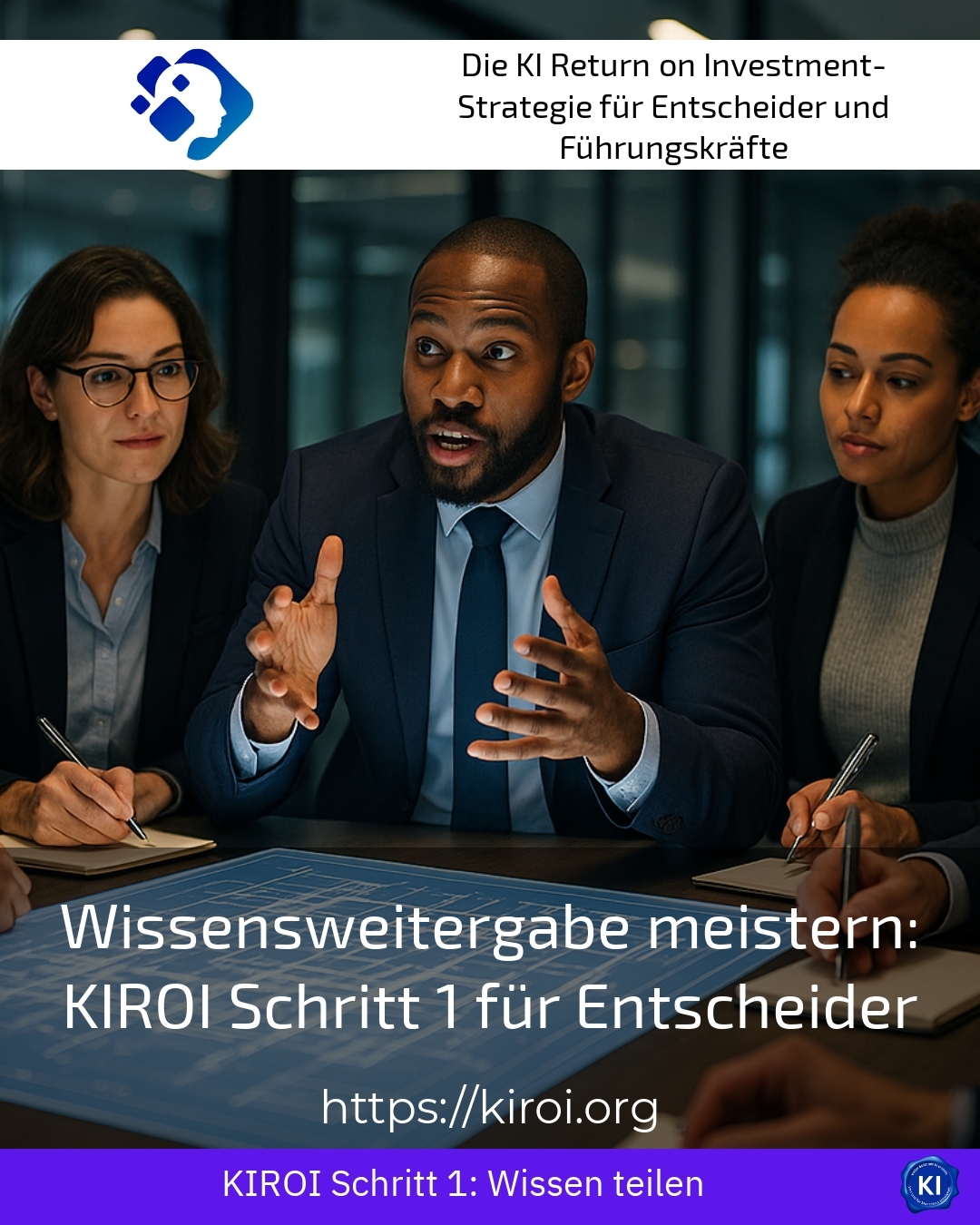
Efficient knowledge transfer represents a key challenge for leaders, who are concerned not only with preserving existing knowledge but also with fostering innovation and collaboration. The KIROI model, with its first step, offers a structured approach that directly addresses this: decision-makers are supported in consciously designing the complex process of knowledge transfer and purposefully implementing suitable methods within their organisation. This guidance ensures that knowledge is not merely viewed as a static asset, but as a dynamic factor for sustainable business success.
Understanding knowledge sharing as strategic responsibility
Knowledge transfer is more than just documenting information. Decision-makers are therefore faced with the task of actively shaping learning and communication processes and fostering a culture in which the exchange of knowledge is a matter of course. Especially in age-mixed teams, it becomes apparent how valuable experience and fresh know-how can work together to create sustainable learning experiences and solve complex problems more effectively.
An example from the industry shows how a manufacturing company brings experienced professionals and young employees together through targeted mentoring programmes. This allows knowledge to be passed on in a practical way, while simultaneously promoting junior staff. Similarly, a logistics company uses „Lunch & Learn“ sessions, where teams regularly exchange knowledge and project experiences in a relaxed atmosphere. This form of knowledge transfer fosters a sense of togetherness and creates space for new ideas.
In the IT sector too, companies are increasingly establishing hybrid learning formats. These combine digital learning platforms with in-person workshops. This mix enables learning independent of location and time, and promotes interactive exchange between employees at different sites. Personal contact and the opportunity for dialogue remain central elements.
KIROI Step 1: Providing impetus for sustainable knowledge transfer
The first step of the KIROI model focuses on identifying existing knowledge resources and selecting suitable dissemination formats. Decision-makers analyse which knowledge will be particularly relevant in the future and who are the key individuals holding this knowledge. This creates a knowledge map that serves as the basis for targeted measures.
A financial services provider used precisely this method by systematically identifying its experts in individual specialist areas. Subsequently, with the support of KIROI, the company developed tailor-made mentoring programmes that specifically supported the knowledge transfer between experienced and younger employees. Managers were integrated into the process as role models.
Another example is a medium-sized trading company that chose storytelling as its core format for knowledge transfer. Complex topics were presented in vivid stories and conveyed in training sessions. This not only promoted understanding but also an emotional connection to the content. Employees frequently report that this format supports their motivation to learn.
In the technical services sector, digital knowledge bases are increasingly becoming the core of knowledge transfer. An energy supplier implemented a platform where employees can upload self-created video tutorials and FAQs. The combination of codified and personalised knowledge creates a sustainable learning environment.
Best Practice in the use of KIROI Step 1
BEST PRACTICE with one customer (name hidden due to NDA contract) In an international mechanical engineering company, the systematic use of KIROI Step 1 significantly improved knowledge sharing. A digital knowledge map was created, transparently recording key individuals and their expertise. Simultaneously, hybrid learning formats were developed, combining in-person workshops with digital learning modules. The result was significantly improved team networking and faster onboarding times for new projects.
Practical tips for decision-makers on implementation
For successful knowledge transfer, it is recommended to consider the following points:
- Begin with a clear analysis of existing knowledge sources and the identification of key individuals.
- Consciously promoting personal exchange through mentoring or learning tandems.
- Using digital platforms to make knowledge accessible flexibly and independently of location.
- Integrating storytelling to make learning content engaging and memorable.
- Promoting an open learning culture where experiences from mistakes are also shared.
- Involving managers as active shapers of knowledge exchange.
This combination of different methods helps to ensure that knowledge sharing is not perceived as a chore, but rather as a valuable tool that supports daily work and fosters innovation.
My analysis
Knowledge transfer is a multifaceted process that requires careful planning and conscious design of the learning environment. KIROI Step 1 offers companies valuable support in strategically embedding this task. By combining different methods and utilising both personal communication and modern digital formats, decision-makers can create a sustainable knowledge culture. Such measures not only increase innovative capacity but also permanently strengthen collaboration and employee loyalty.
Further links from the text above:
Rethinking knowledge transfer: KIROI Step 1 for decision-makers[2]
Rethinking knowledge transfer: KIROI Step 1[4]
Knowledge Transfer Methods & Examples[1]
Mastering knowledge transfer: KIROI Step 1 for decision-makers[8]
For more information and if you have any questions, please contact Contact us or read more blog posts on the topic Artificial intelligence here.







 Deutsch
  English (UK)