
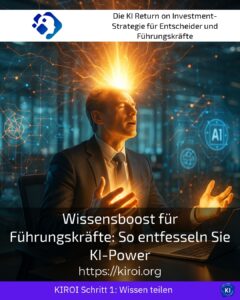
Rethinking knowledge transfer is more important than ever for decision-makers today. This is because the process of systematically transferring knowledge is not merely about information transmission, but a deliberate design of learning and communication processes. Companies face the challenge not only of preserving knowledge but also of delivering it to the right place situationally and according to need. The AIROI concept, as a first step, supports decision-makers in establishing sustainable and flexible solutions for knowledge transfer within the company.
Knowledge transfer: Importance and challenges for decision-makers
Many companies lack a structured way of sharing knowledge. Knowledge often remains hidden within individual minds or departments. Particularly in rapidly changing sectors such as technology, services, and manufacturing, managers frequently report that valuable experiential knowledge is lost when employees leave the company or retire. This leads to a loss of competitiveness and innovative capacity.
Typical challenges in knowledge sharing include:
- Finding suitable formats for different teams and topics.
- Employee motivation to actively share and impart knowledge.
- The establishment of sustainable structures that also take hold in the long term.
- To meaningfully integrate technological support and hybrid learning formats.
These challenges demonstrate that it goes beyond mere documentation. The methodological diversity of knowledge transfer must be used specifically to meet the individual needs of the organisation.
AIROI Step 1: Providing impetus for sustainable knowledge transfer
The AIROI concept addresses precisely this point. Decision-makers are guided in analysing the variety of methods for knowledge transfer and developing tailor-made approaches for their company. Hybrid learning formats play a special role in this, meaning the combination of online and in-person formats that reach people at different locations and with different working methods.
A key focus is on motivating employees not only to retain knowledge but also to impart it situationally and as needed. External support helps to question old patterns and jointly develop new structures that are sustainable in the long term.
BEST PRACTICE with one customer (name hidden due to NDA contract) In the service sector, a communication-based knowledge network was established through AIROI coaching. By analysing and adapting communication channels and utilising appropriate tools, expert knowledge became more transparent and quicker to access, which significantly strengthened cross-departmental collaboration.
Case studies of effective knowledge sharing in various sectors
In the technology sector, many companies rely on regular, practical workshops. There, employees share experiences and learn about new technologies. This creates a common understanding and promotes innovation as well as cross-departmental collaboration.
In production facilities, communication workshops are used to improve collaboration and create an atmosphere of trust. This not only increases transparency but also builds trust – both important factors for sustainable knowledge transfer.
Learning tandems and age-mixed teams also demonstrate their value in service companies. Older employees pass on their experience, and younger colleagues bring current specialist knowledge. This exchange increases employee satisfaction and opens up a wide range of new approaches to solutions.
Utilising a diversity of methods strategically: from mentoring to digital learning platforms
For successful knowledge transfer, it is important to use different methods to suit the situation. Here are some tried and tested examples:
- Mentoring and Coaching: Experienced employees support their colleagues through regular knowledge sharing, thereby promoting personal and professional development.
- Storytelling: Knowledge is conveyed more vividly and memorably through engaging stories. This promotes the learning process and the lasting retention of content.
- Digital learning platforms: E-learning supports learning independent of time and place, so that knowledge content can be imparted flexibly.
- Workshops and training courses You create space for dialogue, reduce inhibitions, and promote an open learning culture.
The combination of these methods in a hybrid learning format in particular makes it possible to reach people more effectively and motivate them to actively pass on knowledge.
Another important point is the conscious handling of implicit knowledge – that is, undocumented experiential knowledge. Formats such as learning tandems or coaching help here because they promote personal exchange.
Knowledge transfer as a strategic task for decision-makers
Decision-makers are needed to create the framework in which knowledge sharing becomes a matter of course. This includes, for example:
- The development of tailor-made knowledge management processes that fit the requirements of the respective industry and company size.
- Creating a culture where learning and sharing are valued and actively encouraged.
- The integration of technological tools to facilitate and make knowledge sharing transparent.
- The continuous reflection on existing processes to evaluate experiences and optimise structures.
This enables companies to react flexibly to changes and benefit from the collective intelligence of their employees in the long term.
My analysis
Knowledge transfer is more than a purely technical process. It demands a rethink towards the conscious design of learning and communication processes. AIROI offers valuable impulses for decision-makers here to develop tailor-made and sustainable solutions. The combination of diverse methods — from mentoring and storytelling to hybrid learning formats — allows for the effective sharing of knowledge, thereby strengthening innovation capability and collaboration within the company. Decision-makers should understand knowledge transfer as a strategic task in order to promote a future-proof learning culture.
Further links from the text above:
Mastering knowledge transfer: AIROI Step 1 for decision-makers
Knowledge Transfer | Definition, Methods & Examples – persomatch
Knowledge Transfer Methods: Success Strategies for Businesses
Knowledge Transfer Methods: Strategies for Knowledge Retention
Knowledge management: definition, methods and tools for effective corporate management
For more information and if you have any questions, please contact Contact us or read more blog posts on the topic Artificial intelligence here.








 Deutsch
  English (UK)