
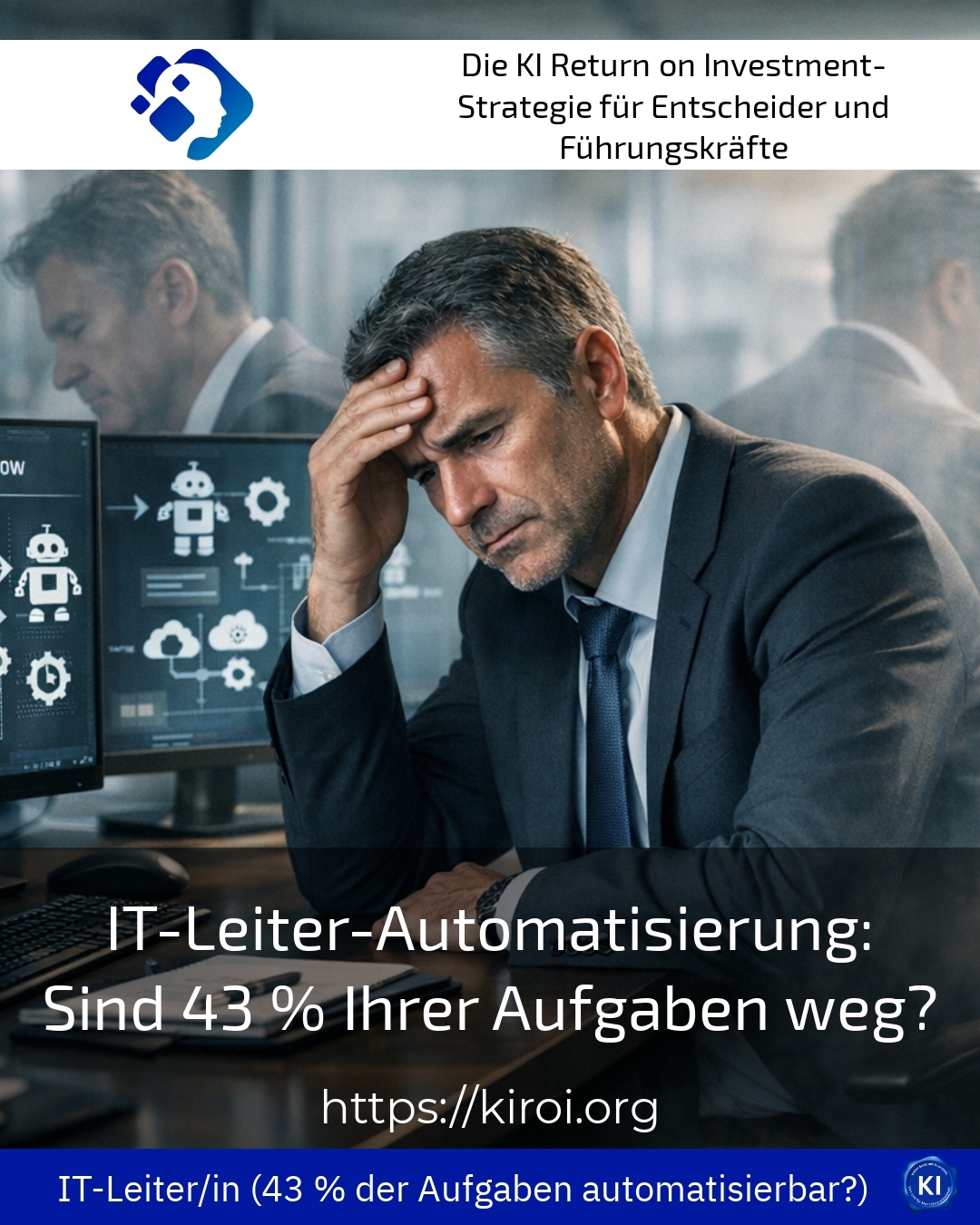
Have you ever wondered what your daily tasks could be taken over by intelligent systems in a few years, while at the same time facing the challenge of leading your company through digital transformation? The Job-Futuromat platform of the Institute for Employment Research provides insightful data that particularly excites executives in the technical sector [1]. The IT Manager Automation describes a fundamental change that not only affects operational activities but also changes the entire professional image in a lasting way. It is evident that approximately 43 percent of the classic core tasks could already be replaced today by technological solutions. This development does not pose a threat but rather opens up new perspectives for strategic development and creative leadership.
Digital transformation is fundamentally changing the professional landscape.
The technological revolution has long since taken hold in leadership positions. Intelligent systems are increasingly taking on routine tasks. They automatically analyze network workloads and generate capacity forecasts. At the same time, they coordinate software updates across entire infrastructures. This development specifically affects areas such as server monitoring, patch management, and resource allocation. Previously, executives spent hours manually reviewing system logs. Today, automated monitoring solutions perform this work in fractions of a second.
A particularly impressive example can be found in the area of help desk coordination. Chatbots and self-service portals are now handling a significant portion of standard requests independently. The automatic ticket assignment is based on intelligent algorithms that recognize priorities and forward requests to the appropriate departments. Documentation of system changes is also increasingly being automated. Change management tools meticulously log every action and create audit trails without manual intervention.
In the area of license management, the change is particularly evident. Software asset management systems automatically inventory installed applications. They match usage data with acquired licenses and promptly identify compliance risks. Budget planning also benefits from automated forecasting tools. These analyze historical spending patterns and derive recommendations for future investments.
Best practice with a AIROI customer
A medium-sized manufacturing company faced the challenge of modernizing its entire infrastructure monitoring. Initially, the responsible area manager expressed great concerns regarding his future role and wondered what tasks would remain to him after the automation. Within the framework of our transruptive coaching support, we jointly developed a strategy that shifted the focus from operational activities to strategic value creation, allowing the area manager to establish his position as an indispensable innovation driver. The implemented solution fully automated all routine monitoring of the data center and generated meaningful reports for the management without manual effort. The area manager thus gained about twelve hours per week for strategic projects such as the evaluation of new cloud services and the development of digitalization concepts for adjacent business areas. After six months, he reported that his work was once again fulfilling and forward-looking for the first time in years. The management honored his newly acquired strategic contribution with expanded competencies and a seat on the company’s digitalization committee.
IT management automation as an opportunity for strategic realignment
The apparent loss of areas of responsibility actually opens up enormous opportunities. Executives gain time for value-creating activities. Strategic planning takes center stage. Vendor management and contract negotiations require human judgment and negotiation skills. Developing innovation roadmaps remains a profoundly human skill. Here, technical understanding combines with entrepreneurial foresight and industry knowledge.
Employee development is gaining momentum through IT Manager Automation Even the meaning of it matters. Teams need to be prepared to handle automated systems. Training concepts require a deep understanding of both the technology and the human learning processes. Designing a future-proof corporate culture requires emotional intelligence and leadership skills. These qualities cannot be automated.
In the field of cybersecurity, the need for human expertise becomes particularly evident. Automated systems reliably recognize known threat patterns. However, evaluating novel attack vectors requires creative thinking and experience. The development of security policies must take into account individual company-specific factors. Risk assessments between security and user-friendliness require a fine touch. Crisis management in the event of security incidents requires quick decisions under uncertainty.
Practical examples from everyday work
The transformation is evident in the various everyday situations of technical management at the senior level. First, let’s look at the topic of capacity planning for data centers: Previously, management analysts manually analyzed workload trends over several weeks, creating elaborate forecast models in spreadsheets and presenting their findings in time-intensive meetings. Today, intelligent analysis tools take on these tasks in real time. They proactively identify bottlenecks and propose optimization measures.
A second example concerns software distribution within the corporate network. Automated application deployment now takes place without human intervention. Systems check for compatibility, plan installation windows, and automatically perform rollbacks in the event of problems. The management merely defines overarching rules and priorities. The systems themselves autonomously handle the operational execution.
The third example comes from the field of incident management. Intelligent correlation engines today automatically link incident reports from various sources. They recognize causal relationships between seemingly independent events. Escalation paths are controlled based on rules. Solution proposals are based on historical experience from comparable situations. The manager intervenes only when making complex decisions.
New competencies for the leadership role of tomorrow
The changing landscape of tasks requires an adaptation of the competence profile. Technical expertise remains important, but is no longer sufficient. Strategic thinking is gaining in importance. The ability to understand business processes holistically becomes the decisive differentiating feature. Leaders must be able to integrate technology and business strategy.
Communication with non-technical stakeholders is becoming increasingly important. Boardrooms expect clear explanations of complex technical issues. Translation between technical and business language becomes a core competency. This involves not only simplifying information but also creating relevant connections to business goals.
Innovation management is becoming a central area of responsibility. Identifying promising technology trends requires continuous training. Evaluating solution providers requires in-depth market knowledge. Pilot projects must be designed and managed. Transferring successful experiments to regular operations requires change management skills.
Best practice with a AIROI customer
A healthcare executive approached our transruptions coaching team with the specific concern that the increasing automation of their department could make their position redundant in the long term. They were particularly concerned because several of their core tasks had already been taken over by new systems. We jointly analyzed the remaining areas of activity and identified significant potential for strategic development, particularly in the areas of the digital patient record and interoperability between different medical systems. During our collaboration, the mentor developed a comprehensive concept for integrating telemedicine applications into the existing infrastructure, which he presented to the clinical management and immediately sparked great interest. Through the freed up capacity, she was able to intensively address the regulatory requirements of the Medical Devices Regulation and positioned herself as an internal expert for compliance issues regarding digital health applications. The transruptions coaching helped her transform her uncertainty into productive energy and further develop her role from an operational to a strategically shaping position. Today, she also leads an interdepartmental digitalization project with direct reporting lines to the clinical management team.
IT manager automation is changing team structures in a lasting way
The change affects not just individual positions, but entire organizational structures. Traditional hierarchies are increasingly giving way to agile team configurations. The coordination of automated systems requires new organizational forms. DevOps principles permeate traditional departmental boundaries. Site reliability engineering is establishing itself as a link between development and operations.
Human resources planning must anticipate these changes. Job profiles are shifting from technical depth to horizontal breadth. Generalists with broad knowledge become more valuable than isolated specialists. At the same time, new expert roles are emerging for specific automation technologies. The balance between breadth and depth becomes a leadership challenge.
In the area of network management, this development is exemplary. Software-Defined Networking automates the configuration of complex infrastructures. Intent-Based Networking automatically translates business requirements into technical parameters. The manager defines target conditions instead of individual configuration steps. The implementation is carried out autonomously by intelligent systems. The monitoring of target achievement remains the human responsibility.
Guidance through the transformation process
The change does not happen overnight and requires conscious planning. Many executives report uncertainty in the face of the changes. The question of one’s own relevance is a concern for many affected individuals. Transruptive coaching offers valuable support and guidance in this regard. The guidance provided by experienced consultants helps identify individual development paths.
Clients often report an initial sense of overwhelm. The speed of technological development seems overwhelming. The multitude of available automation solutions makes orientation difficult. Transruptive coaching provides the impetus for a structured approach. The support helps prioritize and focus on essential areas of action.
Another common topic is communicating the changes within the team. Employees also express concerns about their jobs. The manager must take these concerns seriously and address them constructively. Transruptions coaching helps develop appropriate communication strategies. The process of creating positive change is thus significantly easier.
My AIROI Analysis
The analysis of IT Manager Automation It reveals a nuanced picture that offers neither cause for panic nor carelessness, but rather a clear roadmap for action. While the data from the Job Future Index do show significant potential for automation in traditional activities, they do not include the numerous new fields of work that will emerge as a result of this automation. Executives who proactively address this change will not only secure their positions but can significantly enhance them.
The shift from operational to strategic tasks corresponds to a maturation process of the entire industry. What was once considered expert work is becoming a commodity and creates space for higher-value contributions. The leader of the future acts not as a technical troubleshooter but rather as a strategic designer of digital business models. This development requires the courage to change and the willingness to continuously develop.
Transruptions coaching proves to be a valuable tool for accompanying this change. The individual assessment of one’s strengths and development areas creates clarity. The formulation of concrete development goals provides guidance in a dynamic environment. Regular reflection on progress ensures sustainable change. Those who consciously embark on this path will experience automation not as a threat, but as liberation, which finally creates space for what truly makes human leadership possible.
Further links from the text above:
[1] Job-Futuromat of the Institute for Employment Research
For more information and if you have any questions, please contact Contact us or read more blog posts on the topic Artificial intelligence here.







 Deutsch
 English (UK)