
Do you know the feeling when your best employees, because of their fear of making mistakes, no longer dare to come up with a single new idea?
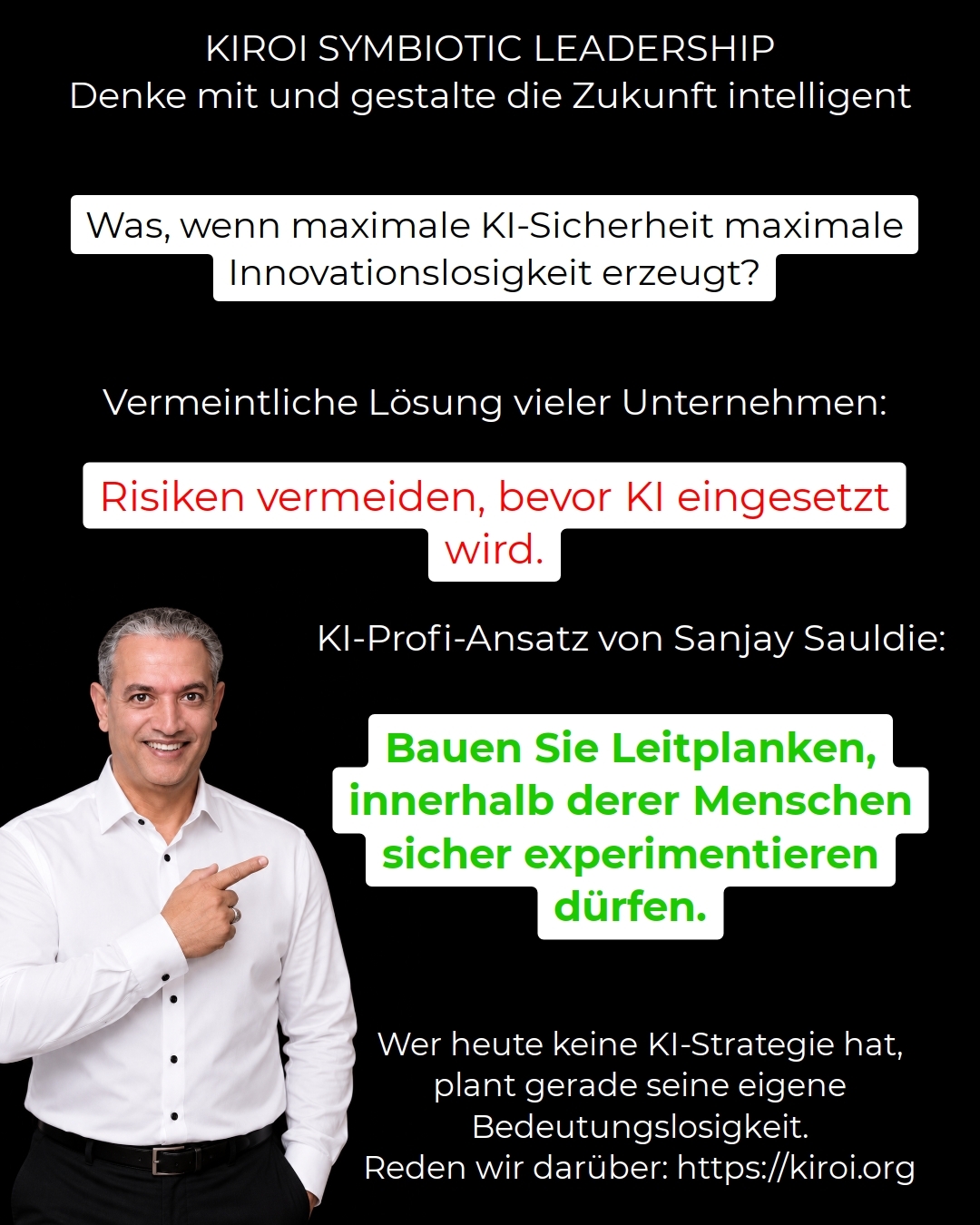
There is currently a situation in many companies that seems paradoxical at first glance: The more security measures are introduced, the less innovation actually takes place, and this very phenomenon is preoccupying executives across all industries because they recognize that their well-intentioned protective measures unintentionally lead to a kind of intellectual paralysis. The question of whether Maximum AI security produces maximum lack of innovation, This article is aimed at both thinkers and practitioners alike. Because anyone who wants to secure everything runs the risk of causing the greatest damage: stagnation. In this article, you will learn how to overcome this dilemma using AIROI the framework as a structured guide.
The dilemma between security and progress
Many organizations face a fundamental challenge that is not easily resolved. On the one hand, regulators, customers, and internal compliance departments demand comprehensive security protocols. On the other hand, competition is pushing for rapid adaptation of new technologies. For example, if a financial service provider wants to automate its credit decisions, it immediately faces strict regulatory requirements [1]. These requirements are justified and protect consumers from unfair practices. At the same time, they can lead to innovative approaches being stifled at their very inception.
An insurance company that wants to modernize its claims processing often faces similar tensions. The legal department warns of liability risks, while the IT department emphasizes the technical hurdles. In the meantime, employees observe how more agile competitors are gaining market share. This dynamic generates frustration and can lead to a sense of powerlessness. Therefore, it is crucial to find a middle ground that allows for both security and the freedom to experiment.
How average companies tackle the problem
Most organizations choose a path that seems reasonable at first. They try to, Avoiding risks before AI is deployed, By establishing extensive testing processes. These testing processes typically include risk analyses, privacy impact assessments, and ethical evaluations. A telecommunications provider often reports that just approving a pilot project can take several months. During this time, competitors have already gathered initial experience and improved their systems.
An energy provider that wants to implement intelligent grid control is all too familiar with these delays. The technical departments create extensive documentation, while the actual innovation remains on the sidelines. This creates a culture of protectionism in which no one wants to take responsibility for bold decisions. The result is a gradual loss of competitiveness. It becomes particularly problematic when companies believe that absolute security is even achievable.
In healthcare, this pattern is particularly evident. Clinics want to use diagnostic systems to help doctors make a diagnosis. But the fear of misdiagnoses and legal consequences is already hampering many projects at the planning stage. Practitioners repeatedly report that early engagement with real data provides crucial insights [2]. Without this insight, theoretical risk analyses often remain abstract and of little help.
AIROI The solution: guidelines for safe experimentation
The AIROI-framework offers a way out of the described dilemma. The central idea is: Build support beams within which people can safely experiment. These guidelines define clear boundaries without completely restricting the scope of action. Imagine a highway on which the guidelines do not prevent vehicles from driving quickly, but only from leaving the roadway. This very principle applies AIROI to the introduction of intelligent systems in organizations.
One logistics company has successfully implemented this approach by creating so-called experimental spaces. In these confined areas, teams are allowed to try out new approaches without endangering the entire company. The rules are clearly defined: maximum budget, limited amount of data, defined time frame. Within these parameters, however, there is complete freedom. This leads to innovations that can later be scaled up.
Best practice with a AIROI customer
A medium-sized machine manufacturer faced the challenge of optimizing its maintenance processes. The management initially feared that any automation could lead to erroneous decisions that would cause costly production outages. As part of AIROI the mentoring process, the company developed a three-stage experimental model. In the first stage, selected technicians were allowed to test new algorithms exclusively on historical data. This testing phase did not pose any risk to the ongoing operation, but provided valuable learning opportunities. The second stage allowed for parallel recommendations, in which the system made suggestions but people made the final decisions. Only in the third stage did the system independently take on certain routine decisions. Through this structured approach, the company was able to reduce its maintenance costs by almost twenty percent within eighteen months. At the same time, employees felt secure and included because they were able to actively participate in the process. The management reported that the initial skepticism had transformed into genuine enthusiasm.
Concrete elements of effective guidelines
Effective guidelines are characterized by several features that companies should consider. First, they must be formulated in a clear way so that every employee can understand them. For example, a pharmaceutical company has introduced a simple system of traffic lights that immediately indicates which experiments are allowed. Green means unrestricted movement, yellow requires coordination with the department responsible, and red is forbidden without the approval of the management. This simplicity promotes quick decisions and prevents lengthy discussions.
Secondly, guidelines should be adaptable because both technologies and regulatory frameworks are constantly evolving. A retail company reviews its experimentation guidelines quarterly and adapts them as needed. This way, the company remains agile without abandoning the fundamental security principles. This regular review also signals to employees that innovation is desired.
Thirdly, guiding principles need a clear escalation logic for unforeseen situations. A media company has established a standby service that is available around the clock. If an experiment yields unexpected results, teams can respond immediately and request support when needed [3]. This security gives the experimenters the necessary confidence to take more daring approaches.
Why maximum AI security leads to maximum lack of innovation
The pursuit of absolute safety leads to a dead end because it overlooks a fundamental aspect. Innovation always arises through trial and error, through the accumulation of experience under real conditions. A automotive supplier that wanted to improve its quality control made exactly this experience. The initial models worked excellently in the laboratory, but failed under production conditions. Only through controlled experiments in the real manufacturing environment did the breakthrough occur.
In addition, there is a psychological effect that management should not underestimate. When employees constantly feel that every mistake could have serious consequences, they stop thinking creatively. A consulting company regularly observes this phenomenon among its clients. The best ideas often arise where people feel confident enough to make unconventional suggestions. This psychological safety cannot be enforced through rules, but only through appropriate conditions.
Transruptive coaching helps companies find just this balance. It accompanies teams on their journey from a culture of fear to an experimental culture. It is not about ignoring safety concerns, but about integrating them constructively. A construction company recently reported that this support has been crucial in advancing the digitalization of project planning. Previously, no one had dared to question the established processes for years.
Practical steps for implementation
The introduction of guidelines requires a structured approach that involves various stakeholders. First, companies should conduct a survey to identify which implicit and explicit rules already exist. A chemical company discovered during this analysis that many supposed prohibitions were based on custom. No one had ever officially stipulated that certain experiments were not allowed.
In the next step, it is advisable to select pilot projects in which the guiding principle concept can be tested. A tourism company began with the personalization of travel recommendations because this project presented manageable risks. The positive experiences also convinced skeptical executives and paved the way for more ambitious projects.
After all, continuous communication is crucial for long-term success. A textile company publishes an internal newsletter monthly that reports on experiments and their results. This transparency fosters knowledge sharing and motivates other teams to develop their own ideas. This creates a positive dynamic that extends far beyond individual projects.
My AIROI Analysis
The analysis shows that the perceived contradiction between security and innovation is resolvable when companies are willing to question their mindsets. The AIROI framework provides a proven framework that takes into account both legitimate security concerns and the necessary space for experimentation. The key insight is that absolute security is an illusion that ultimately causes more harm than it prevents, because it traps organizations in a state of stasis.
Successful companies are characterized by defining guiding principles within which creative experimentation is not only allowed but explicitly encouraged. These guiding principles provide direction without completely restricting freedom of movement. They allow employees to take risks that are calculable and reversible. This creates a culture of learning in which mistakes are not viewed as catastrophes but as valuable sources of knowledge.
The practical examples from various industries illustrate that this approach is not a theoretical exercise but delivers measurable results. Companies that dare to allow controlled experiments regularly report breakthroughs that would never have been possible under restrictive conditions. At the same time, they show that responsible experimentation by no means means disregarding fundamental ethical or legal principles. On the contrary: Through the deliberate exploration of boundaries, teams often develop a deeper understanding of the actual risks and can assess them better than any theoretical analysis could.
Further links from the text above:
[1] BaFin – Artificial Intelligence in the Financial Sector
[2] BMWK – Artificial Intelligence Strategy
[3] EU Commission – Regulatory framework for artificial intelligence
Are you a leader and would you like to learn how you can genuinely introduce AI into your company in a valuable and sustainable way, away from the hype? Take part Contact us or read more blog posts on the topic Artificial intelligence here.








 Deutsch
 English (UK)