
Have you ever wondered why your best employees spend up to two hours every day searching for information that actually already exists within the company?
This question concerns decision-makers in almost every industry, and the answer to it reveals a fundamental misunderstanding of how to handle organizational knowledge. The concept Knowing must find people It is currently revolutionizing the way progressive organizations structure their information flows, radically challenging previous approaches. While conventional strategies aim to improve search functions and optimize databases, forward-thinking leaders recognize that the real problem lies not in finding information but in the fundamental architecture of knowledge transfer itself.
The paradox of the modern information society
We live in a time when information is abundant and at the same time relevant knowledge seems more accessible than ever before. In production environments, for example, experienced machine operators know exactly which settings work best for specific batches of material, but this knowledge often remains in the minds of individual individuals and is irretrievably lost with their departure. Field service technicians face complex repair cases and must contact colleagues by phone because although relevant solutions have been documented, they have disappeared in the depths of disorganized folder structures. Quality managers spend hours locating previous inspection reports, even though these documents were systematically stored and should theoretically be available.
The real problem isn’t that employees can’t or don’t want to search; it’s that searching itself represents an outdated paradigm. In a world where intelligent systems can recognize patterns and anticipate needs, manual search for information feels like searching through a phone book in the age of voice assistants. Yet companies continue to invest heavily in improving search capabilities, rather than questioning the underlying concept and radically rethinking it.
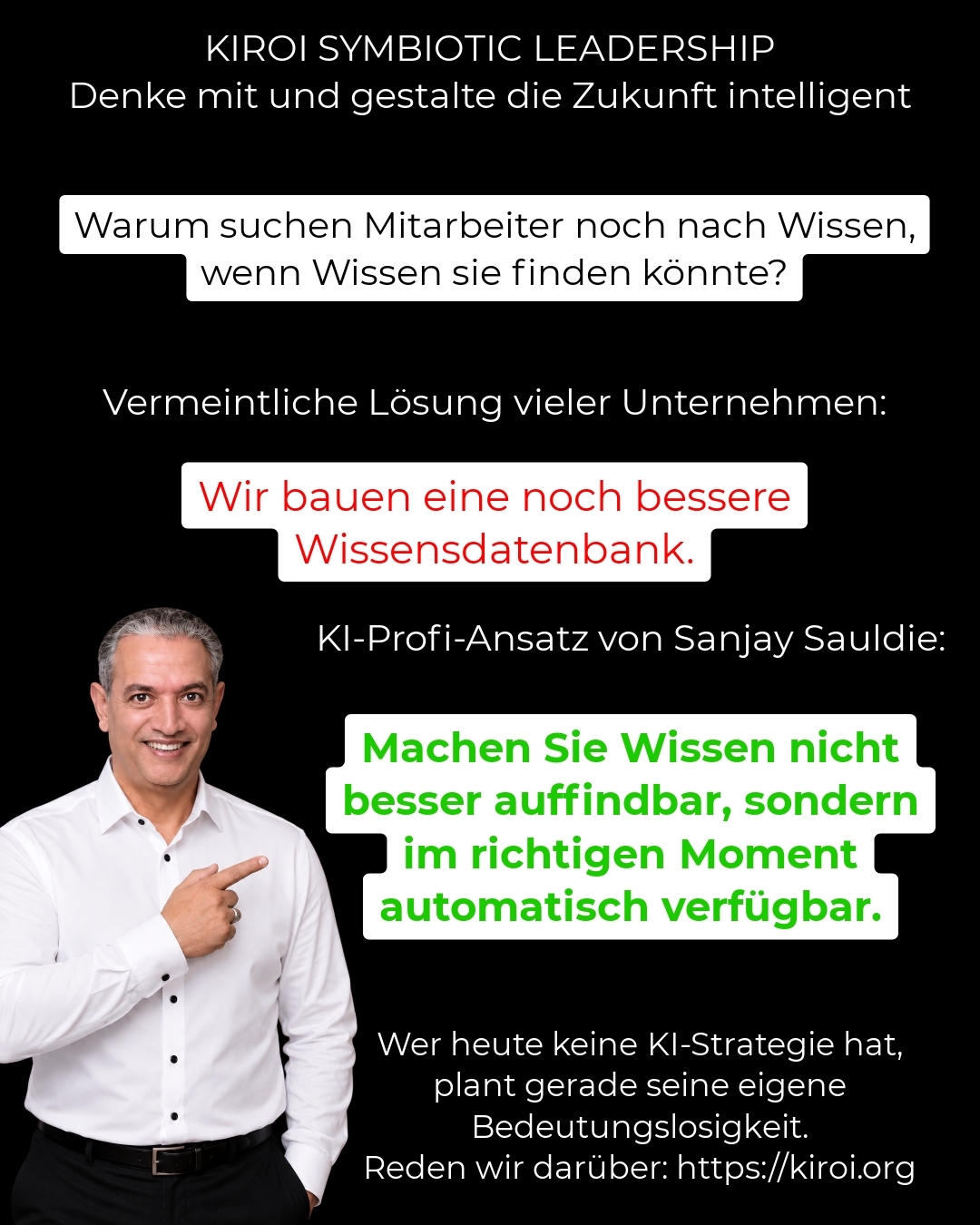
The conventional approach: We build an even better knowledge database
Average companies respond to knowledge problems with a predictable strategy that can be summarized in a simple sentence: We are building an even better knowledge database. This response seems logical and reasonable at first glance, as it follows familiar patterns and does not fundamentally alter existing structures. Project teams are formed, budgets are released, and external consultants are hired to implement wiki systems, optimize search engines, and develop taxonomies that are intended to better categorize the collected knowledge.
In manufacturing companies, this approach leads to the implementation of sophisticated document management systems in which work instructions, maintenance histories, and quality protocols are stored according to elaborate schematics. Logistics companies invest in centralized platforms where transport guidelines, customs regulations, and customer specifications are to be bundled. Maintenance departments receive new databases for spare parts information, maintenance intervals, and manufacturer documentation, which are intended to bring all relevant information together in one place.
The fundamental problem with this approach, however, lies not in the quality of the systems or the carefulness of the implementation, but in the underlying assumption that people should actively seek knowledge. This assumption ignores the cognitive burden associated with every search query, the context changes that disrupt the workflow, and the simple fact that people often do not know what they are looking for. An employee in final assembly may not know that a similar problem had already occurred months ago in another shift and was elegantly solved. The best knowledge database in the world cannot solve this problem if no one asks the right question.
Why better search doesn't solve the problem
Improving search functions merely addresses symptoms and does not address the root cause of the knowledge problem. Even the most advanced search engine requires that the searcher already has an idea of what they need and can translate that idea into appropriate search terms. In practice, however, this process often fails at several points because specialized knowledge is named differently, because relationships are not obvious, or because the most relevant information is in formats that are difficult for search engines to capture.
An maintenance technician facing an unusual error message may be searching for the error code and finding the corresponding chapter in the manual. What he misses is the informal notes of a colleague who experienced exactly this problem two years ago and found an unconventional solution that is not documented in the manual. A production planner analyzing capacity constraints searches through reports and metrics, but he does not automatically learn that a process optimization in a sister plant has achieved remarkable improvements that could be transferred to his situation.
AIROI The solution: Finding people who know
The AIROI-approach radically breaks with the traditional paradigm and formulates a new guiding principle: Make knowledge not more discoverable, but automatically available at the right moment. This seemingly simple formulation implies a fundamental change in the way organizations think about knowledge management and technically implement it. Instead of empowering employees to seek more efficiently, the AIROI goal is to Knowing must find people – proactively, contextually and exactly when it is needed.
In practical implementation, this means that intelligent systems continuously analyze the work context and automatically display relevant information without requiring an explicit search query. A machine operator who makes a certain parameter setting automatically receives a notification that in similar situations in the past, certain adjustments led to better results. A quality inspector who documents a deviation immediately sees comparable cases from the company’s history with the respective root cause analyses and initiated measures.
Best practice with a AIROI customer
A medium-sized company with multiple production sites faced the challenge that valuable knowledge was not being systematically shared and problem solutions were developed independently at different locations, which caused significant duplication of effort and inefficiencies. As part of the AIROI coaching process, a comprehensive analysis of the existing knowledge flows was first conducted, which revealed that employees spent an average of 47 minutes per day searching for existing knowledge. The implemented solution uses intelligent algorithms that recognize the current work context and automatically display relevant information from the entire company history, allowing, for example, a technician to immediately see which settings were successful on similar orders at other sites. What was particularly remarkable was the integration of shift logs, maintenance reports, and quality data into a connected knowledge graph that makes connections visible that had previously remained hidden. The transmittal of interruptions AIROI involved not only technical design but also intensive workshops with management and key employees to establish a culture of knowledge sharing and to reduce fear of touch with the new systems. After the introduction phase, team leaders reported a noticeably improved quality of decision-making because relevant information no longer had to be painstakingly gathered but was available at the right moment.
Contextual intelligence as the key to proactive knowledge transfer
The technical basis for the principle Knowing must find people It forms the so-called context intelligence, which brings together and interprets various data sources. These systems not only capture what task an employee is currently working on, but also understand the context in which that task is taking place. An example from the field of technical maintenance illustrates the principle: When a technician opens a service order for a specific asset, the system automatically analyzes the history of that asset, comparable assets within the corporate network, and similar service orders from the past to proactively provide the most likely relevant information.
In warehouse environments, context intelligence can recognize that a picker is handling an unusual item and automatically display prompts for proper handling, hazardous materials, or specific packaging requirements. In quality assurance, systems can detect that certain inspection parameters should be handled with increased attention because in the past, similar product batches have shown anomalies. This proactive provision of knowledge not only reduces the search effort but also prevents errors that arise from ignorance or lack of experience.
The human dimension of the knowledge flow
Technology alone cannot solve the knowledge problem, which is why the AIROI-approach always takes into account the human dimension and fully accompanies transformation processes [1]. The introduction of proactive knowledge systems requires a cultural change in which the sharing of knowledge is not perceived as an additional burden, but as a natural part of daily work. Employees in production environments often have decades of experience that is not documented anywhere and that would be lost if these individuals left the company.
The AIROI-approach makes capturing and sharing knowledge as easy as possible by allowing findings to be documented directly in the work context and automatically linked to relevant situations. A machine operator who has found a creative solution to a setup problem can capture this knowledge with just a few clicks, and the system ensures that this information appears automatically in the future when similar situations arise. This low-threshold form of knowledge documentation overcomes many of the hurdles that have led classic knowledge management systems to fail.
Integration into existing workflows
A critical success factor for proactive knowledge systems is their seamless integration into existing workflows, so that they are not perceived as an additional tool but function as a natural extension of the familiar means of work. In manufacturing environments, this means, for example, that knowledge insights are integrated directly into the machine control or into mobile devices that are already in use. In administrative areas, relevant information appears contextually in the applications used by employees daily, without requiring the opening of separate programs.
Technical implementation requires careful planning and iterative adjustments, which is why AIROI onboarding typically begins with pilot projects that deliver quick, visible results and can serve as a reference for rollouts across the enterprise. For example, an maintenance team could act as a pilot group and gather the experience that then feeds into the broader rollout. This step-by-step approach reduces risks and enables continuous learning and adaptation [2].
Knowing must find its way into everyday practice
The practical implementation of the principle Knowing must find people This is evident in numerous concrete use cases that illustrate the difference from traditional knowledge management. For example, when onboarding new employees, the proactive system replaces long manuals and training materials with context-specific help that appears exactly when it is needed. A new warehouse employee no longer receives a stack of documentation to go through; instead, intelligent prompts guide them through their first tasks and help them learn the relevant knowledge in its practical application.
In complex problem-solving situations, the value of proactive knowledge systems becomes particularly evident, because they can establish connections that people alone would often fail to recognize. When a production line exhibits inexplicable quality fluctuations, an intelligent system can uncover correlations with factors that at first glance do not seem to be related—for example, with supplier batches, environmental conditions, or machine maintenance. This type of pattern recognition exceeds the human capacity for information processing and opens up new possibilities for problem solving and continuous improvement [3].
My AIROI Analysis
The fundamental shift from active knowledge seeking to proactive knowledge delivery marks a paradigm shift that goes far beyond technological innovation and will have profound implications for organizational structures, leadership concepts, and work culture. The traditional assumption that employees should and can seek knowledge is increasingly proving insufficient in a work environment characterized by an abundance of information, time pressure, and increasing complexity. The AIROI-approach offers a thoughtful alternative that is not only more efficient but also more human-centric, as it reduces cognitive burdens and frees employees from frustrating search activities.
The guidance provided by experienced AIROI partners enables companies to structure and manage this transformation process in a structured and risk-conscious manner, without falling into the typical pitfalls of large IT projects. Particularly valuable in this context is the combination of technological expertise and organizational psychology, which ensures that new systems not only function technically but are also accepted and used productively by employees. The experiences from numerous projects show that the success of proactive knowledge systems depends significantly on how well they are integrated into the existing working reality and how convincingly the added value is communicated to all involved parties. Organizations that consistently take this path report noticeable improvements in quality, efficiency, and employee satisfaction – results that could not be achieved with traditional knowledge databases and that justify the effort of the transformation.
Further links from the text above:
[1] AIROI-Master plan for sustainable AI implementation
[2] Disruptions Coaching for Digital Transformation
[3] AIROI-Blog with current insights on AI integration
Are you a leader and would you like to learn how you can genuinely introduce AI into your company in a valuable and sustainable way, away from the hype? Take part Contact us or read more blog posts on the topic Artificial intelligence here.









 Deutsch
 English (UK)