
Will your workplace soon be taken over by a machine, or does digital transformation offer completely new career opportunities for you?
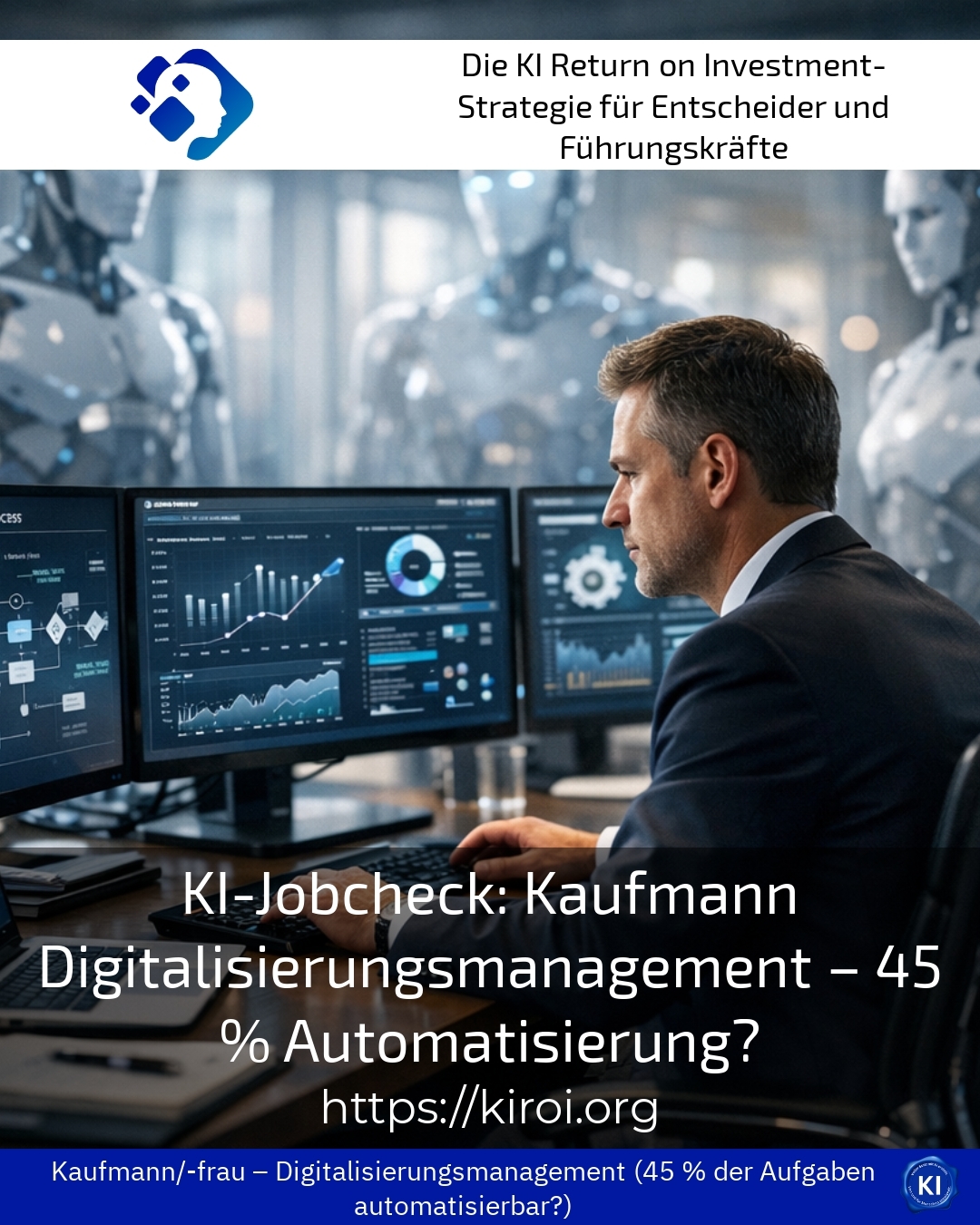
This question currently concerns countless professionals in the field of digital business processes. The KI Jobcheck: Digitalization Management Specialist – 45 % Automation? This shows a remarkable number. Almost half of all activities could theoretically be handled by intelligent systems. But what does this mean in practice for people who work with IT systems, databases, and digital workflows on a daily basis? The Job-Futuromat platform of the Institute for Labor Market and Occupational Research [1] provides insightful data in this regard. These findings deserve a nuanced consideration.
What the 45 percent really mean
At first glance, the figure of 45 percent seems quite alarming. Many employees are wondering if their professional future is at risk. However, behind this statistic lies a more complex reality. The automation potential merely describes which activities could be technically replaced. It does not, however, say anything about whether this replacement actually takes place. Economic, legal, and social factors play a crucial role. For example, advising specialist departments on the selection of new software solutions is hardly automated. The same applies to the creative design of digitization strategies. Moderation between IT experts and the management also requires human intuition.
The KI Jobcheck: Digitalization Management Specialist – 45 % Automation? Upon closer analysis, it reveals interesting distinctions. Routine tasks such as database maintenance are more affected. The analysis of system logs can be partially automated. Standardized documentation processes are also suitable for machine-assisted processing. On the other hand, strategic planning remains largely in human hands. The development of individual IT concepts requires creativity and contextual knowledge. Project management with its social dynamics also resists automation.
Examples from the digital business world
Let us take a closer look at specific situations from everyday work life. A professional analyses the existing IT infrastructure of a medium-sized company. She identifies optimization potential and develops improvement proposals. At the same time, she takes into account the budget requirements of the management. She communicates with various departments about their specific requirements. This multifaceted task requires empathy, strategic thinking, and technical understanding. Another example concerns the introduction of new ERP modules. Here, the professional coordinates training sessions for employees from various departments. She adapts training materials to different levels of knowledge. Furthermore, she documents feedback and implements improvements. The integration of cloud solutions into existing systems also demonstrates the complexity. The professional examines security aspects and data protection requirements. It coordinates with external service providers and internal stakeholders.
Best practice with a AIROI customer
A medium-sized business faced the challenge of fundamentally modernizing its digital processes while at the same time optimally integrating its existing employees. Therefore, the management added transruptive coaching to support this change in a structured way. The team responsible for digital process management initially reported a great deal of uncertainty regarding new AI-based analysis tools, because many employees feared that their expertise would soon become obsolete. Through our AIROI methodology, we developed a competency model together with the professionals, which clearly showed which of their skills would remain indispensable in the future. The employees recognized that their strengths lay in interpreting complex data analysis and communicating with internal departments, which no software could replace. Within six months, the initial skepticism turned into genuine enthusiasm for the new possibilities, as the professionals were now able to delegate repetitive tasks to intelligent systems and gained more time for strategic projects. The company experienced a significant increase in employee satisfaction, and at the same time, the process quality and the speed of response to customer inquiries improved significantly.
As the KI Jobcheck: Digitalization Management Expert – 45 % Automation? It affects your career
The findings from the Job Future Report [1] should be understood as a guide. They allow for a realistic assessment of one’s own professional position. At the same time, they reveal potential for development. Those who familiarize themselves with the basics of AI today strengthen their market position. Understanding machine learning becomes a key skill. Equally important remains the ability to critically evaluate automation proposals. Not every technically feasible solution makes economic or social sense.
Significant changes are already evident in the area of system administration. Automated monitoring tools take on monitoring tasks around the clock. Intelligent ticket systems automatically categorize and prioritize support requests. Predictive maintenance algorithms detect impending hardware failures early on. These developments relieve professionals of monotonous tasks. At the same time, new tasks arise in the configuration of these systems. Interpreting AI-generated recommendations requires in-depth expertise. Training users in the use of new tools is also gaining importance.
Practical scenarios of transformation
The daily work with database management systems is changing noticeably. In the past, optimizing database queries required hours of manual analysis. Today, intelligent tools help identify inefficient queries. The professional focuses increasingly on interpreting the results. They decide which optimization suggestions should be implemented. Another example concerns network planning for new corporate locations. Simulation tools automatically calculate various configuration options. Human expertise remains indispensable when evaluating security risks. Coordination with data protection officers also requires communicative skills. Changes are also evident in the area of software license management. Automated compliance checks independently identify license overruns. However, strategic planning of license portfolios remains a human domain.
Transruptive coaching accompanies professionals during these very same transition processes. Clients often report feeling overwhelmed by the rapid technological development. They wonder what further training is appropriate. Many are seeking guidance in a changing work environment. Others want to reposition their existing strengths. Coaching provides impulses for personal development strategy. It supports the identification of more future-proof areas of competence.
Recognizing opportunities and developing skills
The KI Jobcheck: Digitalization Management Specialist – 45 % Automation? This highlights an important aspect. The remaining 55 percent of non-automated activities are particularly valuable. They include complex decision-making processes and interpersonal interactions. This presents enormous potential for professional development. Analyzing business processes requires systemic thinking. Translating technical requirements into understandable language remains a human strength. The ethical evaluation of automation decisions is also gaining importance.
In project management for IT deployments, this dynamic is particularly evident. Coordinating various stakeholders requires emotional intelligence. Conflicts between functional departments and IT must be sensitively managed. Change management processes require human guidance and empathy. An example from practice: The migration of a warehouse management system affects all business areas. Resistance to change must be recognized and addressed. Training concepts need individual adaptation to different user groups. The documentation of lessons learned requires reflection. The follow-up after project completion remains an important human task as well.
Best practice with a AIROI customer
A specialist from the IT coordination department came to us with specific questions because she was uncertain about her future role after the introduction of an AI-based helpdesk system and feared that her years of experience in technical support might soon become redundant. During the transruptive coaching, we analyzed together the actual changes in the work routine and identified completely new potential that had opened up through the automation, because suddenly the specialist had time for more strategic tasks that had never been possible before. We developed an individual competence roadmap that included both technical training in AI administration and soft skill training for advising specialist departments, because this combination is particularly in demand on the labor market. Within a few months, the client assumed the role of an internal consultant for digital transformation and now supports other departments in the implementation of intelligent systems, while utilizing her practical experience from support in a profitable way. Her employer recognized the added value of this new position and created a corresponding position that did not previously exist, which is why the professional is now significantly happier and better paid than before.
The role of further education and adaptability
Continuous learning becomes the central prerequisite for success. The half-life of professional knowledge is constantly decreasing. At the same time, new fields of expertise are emerging at an increasingly rapid pace. Fundamental data analysis techniques are gaining importance across industries. Understanding algorithms and their limitations is becoming more important. Ethical issues related to digitalization are also coming to the fore. The ability to critically evaluate AI outputs will distinguish good professionals from excellent ones in the future.
In the field of cybersecurity, these developments are particularly striking. Automated systems reliably detect anomalies in network traffic. However, evaluating genuine threats requires human judgment. False-positive reports must be distinguished from real attacks. Developing security strategies remains a complex human task. Sensitizing employees to phishing risks also requires pedagogical skill. Collaborating with external security services requires negotiation skills. Documenting security incidents for regulatory authorities requires precision and legal knowledge.
My AIROI Analysis
After in-depth examination of the data from the Job Future Observatory [1] and numerous consultations, a differentiated picture emerges. The 45 percent automation potential is neither a reason for panic nor for carelessness. Rather, it marks a turning point that requires active action. Professionals in the field of digital business processes face a historic opportunity. They can actively contribute to the transformation or passively wait. The AIROI methodology clearly recommends the first path.
Three development directions appear particularly valuable to me. First, the deepening of technical competencies in the field of AI. Those who understand how intelligent systems work can use them better. Second, the strengthening of communicative and advisory skills. The translation between technology and business remains a core human competency. Third, the development of strategic perspectives on digitalization processes. Here lies the greatest potential for professional advancement.
Transruptions coaching accompanies professionals in navigating this complex landscape. It supports honest self-assessment of one’s strengths and areas for development. It provides insights for identifying more future-proof specializations. It accompanies the implementation of concrete further training initiatives. Automation is advancing relentlessly. The question is not whether, but how we deal with it. Those who get the right priorities right today will be among the winners of the digital transformation tomorrow.
Further links from the text above:
[1] Job-Futuromat of the Institute for Employment Research
For more information and if you have any questions, please contact Contact us or read more blog posts on the topic Artificial intelligence here.









 Deutsch
 English (UK)