
Do you really know who in your company is currently using which intelligent systems – and what they are doing with sensitive data?
This question may sound uncomfortable, but it touches on the core of a challenge that many organizations are currently facing. AI governance It is rapidly becoming a crucial success factor for forward-thinking companies. Yet surprisingly many executives rely on the principle of hope instead of establishing clear structures. In a time when intelligent algorithms increasingly influence decisions, a well-thought-out control strategy is indispensable. This article shows you why proactive action is now necessary.
The underestimated dimension of AI governance in practice
The reality in German companies presents a nuanced picture that prompts reflection. Many organizations have indeed implemented technologically advanced systems, but the accompanying structures lag far behind. For example, a medium-sized machine manufacturer uses automated quality control without documented processes for error decisions. An insurance company employs algorithms for claims processing, but no one systematically examines the decision logic. A trading company uses forecasting systems for inventory management, but responsibilities remain unclear.
These examples illustrate a widespread problem that extends across all industries. Technological enthusiasm often overshadows the necessary organizational diligence. This creates risks that become apparent only when problems arise, and can then have significant consequences. Therefore, the implementation of intelligent systems requires a holistic approach from the outset that takes into account both technical and organizational aspects.
Best practice with a AIROI customer
A leading logistics company faced the challenge that various departments had independently implemented intelligent route planning systems. The lack of coordination led to conflicting optimization goals and inefficient resource allocation. As part of the AIROI coaching process, the company initially developed a central overview of all the systems in use and their decision-making areas. Subsequently, the team established clear responsibilities for each application area. The executives defined escalation paths and control mechanisms that enable regular reviews. Particularly valuable was the introduction of a governance board that evaluated system performance and ethical aspects on a monthly basis. Within six months, the error rate for automated decisions decreased by forty percent. At the same time, employee confidence in the technological solutions increased significantly. This transformation was only achieved through the consistent support and structured approach of the coaching process.
Why AI governance means more than compliance
Many decision-makers mistakenly reduce governance to fulfilling regulatory requirements. However, this view is too narrow and misses valuable potential. Well-thought-out control of intelligent systems encompasses strategic, ethical, and operational dimensions alike. A financial services provider can sustainably strengthen customer trust through clear rules. A healthcare company protects both patients and its own reputation through transparent processes. An energy provider minimizes the risk of critical infrastructure outages through defined responsibilities.
The proactive design of governance structures gives companies a real competitive advantage in competitive markets. Customers and partners trust organizations that can demonstrate responsible handling of technology. Investors increasingly evaluate the governance maturity when assessing corporate risks as well. Employers are increasingly favoring talent that takes ethical standards seriously and communicates transparently. The strategic importance thus goes far beyond mere risk management.
Create structures instead of hoping for luck
The difference between successful and struggling organizations often lies in the quality of their governance architecture. For example, an automotive supplier early on established a three-tiered control system for automated production decisions. A retail chain implemented transparent criteria for personalized customer interaction through intelligent systems. A pharmaceutical company developed detailed protocols for validating algorithmic research findings.
These examples show that structured approaches can work successfully in a wide variety of contexts. Investing in governance structures pays off in the long term through stability and trust. It is crucial to adapt the structures to the specific needs and risk profiles. One-size-fits-all solutions rarely work, but proven frameworks can serve as a starting point.
The seven pillars of effective AI governance in business everyday life
A robust governance strategy is based on several fundamental elements that interact and reinforce each other. First, organizations need a clear allocation of responsibilities at all levels of the hierarchy. Second, transparent processes for the approval and monitoring of intelligent systems must exist. Third, employees need appropriate training to understand their role within the governance framework.
Fourthly, effective governance requires regular audits and independent reviews of the algorithms used. Fifthly, escalation paths for problematic decisions should be clearly defined and communicated. Sixthly, companies need mechanisms for continuous improvement of their governance practices. Seventhly, external stakeholders need to be appropriately included in the dialogue.
A telecommunications provider implemented all seven pillars systematically over a period of eighteen months. A chemical company group initially focused on the most critical elements and expanded gradually. A media conglomerate adopted an agile approach to build governance in parallel with technological developments.
Best practice with a AIROI customer
An internationally operating consulting firm came to the coaching with a specific problem: various project teams used different intelligent tools without overarching standards or quality controls. Sensitive customer data was sometimes processed in unverified applications, posing significant risks to the reputation and contractual relationships. The AIROI coaching accompanied the development of a corporate-wide governance framework over several months. Together, the team initially identified all critical use cases and systematically assessed their risk potential. Based on this, differentiated guidelines were developed that aligned the innovation needs with security requirements. The employees received training that not only conveyed rules but also fostered an understanding of their necessity. Particularly important was the establishment of a feedback mechanism that enabled continuous adjustments. The consultants report today of increased customer confidence and smoother project schedules as a direct result of the governance initiative.
The role of leadership in governance implementation
Executives bear a special responsibility for the success of governance initiatives in their organizations. Without visible commitment from the top level, even the best concepts remain ineffective. A CEO of an industrial corporation makes governance a fixed agenda item at every strategy meeting. The CEO of a medium-sized technology company regularly communicates about governance progress to all employees. A department manager at a large bank integrated governance goals into the performance evaluation of his leadership team.
These examples show how leadership through concrete actions sets priorities and shapes culture. Employees are strongly influenced by the behavior of their superiors and act accordingly. When governance is perceived as a burdensome obligation, evasion strategies and shadow processes emerge. However, when it is communicated as a strategic opportunity, the willingness to actively participate in shaping it grows.
From theory to implementation
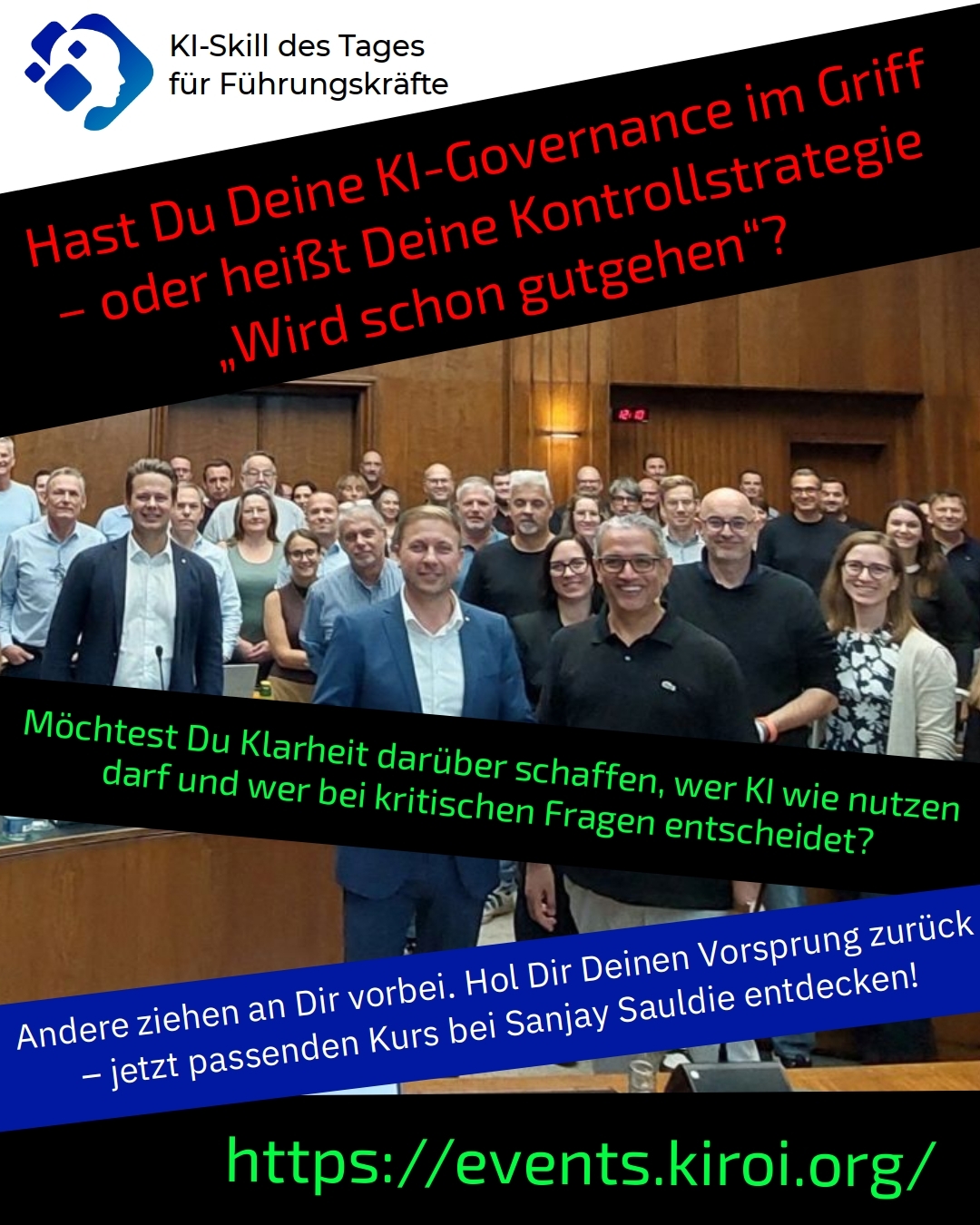
Transforming theoretical governance concepts into lived practice requires a structured approach. Take your existing skills to the professional level – as already done by over 8,000 people from over 500 companies with Sanjay Sauldie [1]! The first step typically involves an honest assessment of the current situation. Which systems are in use? Who is responsible? What risks exist?
A food manufacturer began with a comprehensive inventory of all automated decision-making processes. A hotel chain conducted workshops to identify hidden applications in various locations. A construction company used external experts for an objective risk assessment of its technological landscape.
After the analysis phase, the prioritization of action areas is based on risk and benefit. Not all areas require immediate intensive governance, but critical applications cannot be delayed. The gradual implementation enables learning effects and reduces resistance to change within the organization.
My AIROI Analysis
The guidance provided to numerous companies in the development of their governance structures reveals recurring patterns and success factors. Organizations that invest early in well-thought-out control mechanisms manage technological transformations significantly more confidently than their hesitant competitors. AI governance does not prove to be a brake on innovation but rather an enabler for responsible growth. Companies often report increased employee acceptance after clear rules of engagement have been established. Customers and partners appreciate the transparency and the associated trust in the technological solutions.
At the same time, experience shows that each organization must find its own path to the appropriate governance. Standard solutions rarely work without adapting to corporate culture, industry, and risk appetite. Transruptions coaching accompanies this process through structured impulses and proven frameworks. The combination of external perspective and internal knowledge generates sustainable results. Particularly valuable is the continuous reflection and adaptation of governance structures to changing circumstances. Organizations that understand governance as a living process rather than a one-time project are more successful in the long term. The investment in professional guidance pays off many times over through avoided risks and utilized opportunities.
Further links from the text above:
[1] AIROI Events – Professional development for executives
For more information and if you have any questions, please contact Contact us or read more blog posts on the topic Artificial intelligence here.











 Deutsch
 English (UK)