
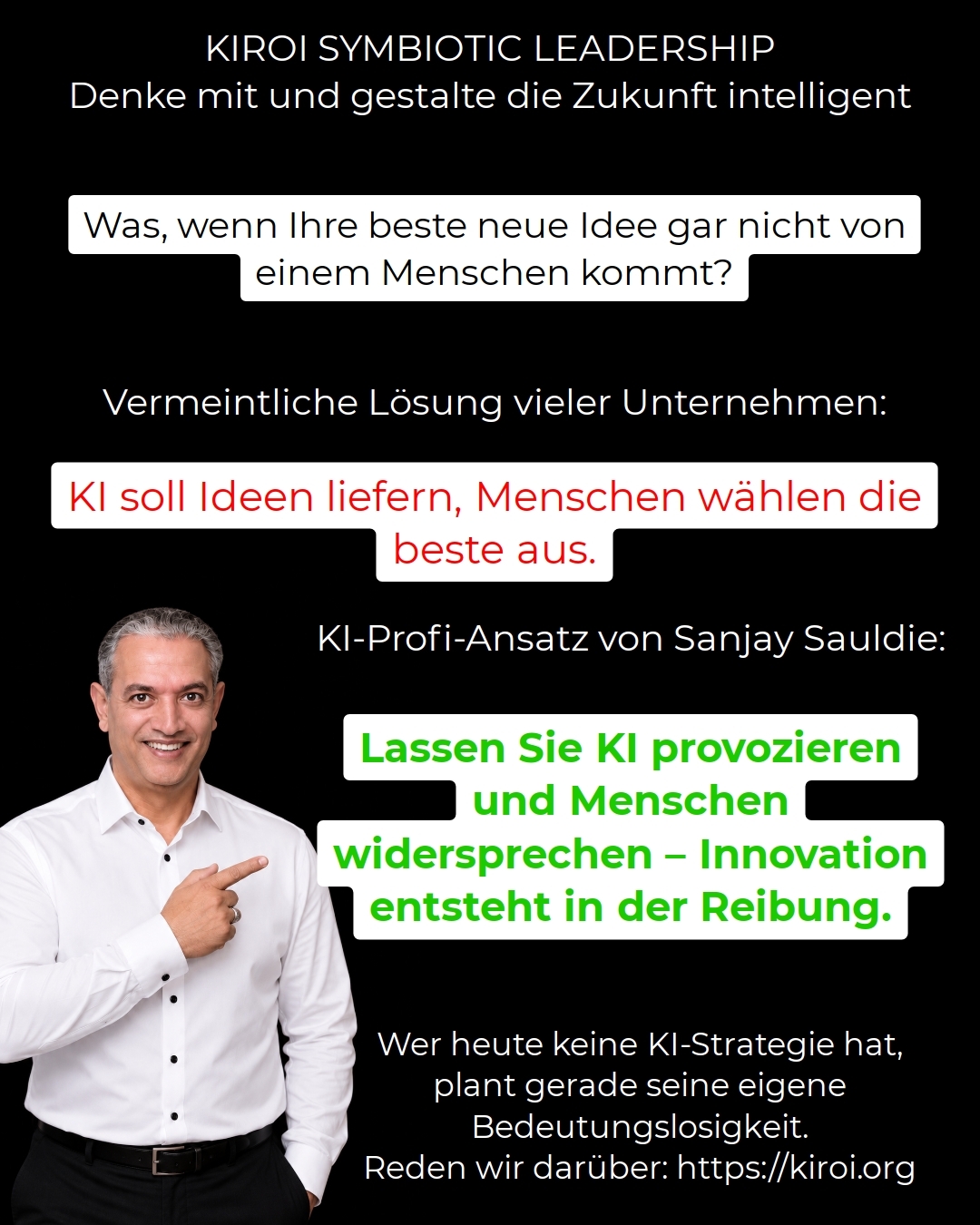
Have you ever wondered why your most brilliant ideas sometimes come from completely unexpected directions – and what happens when that direction is no longer a human brain in the future? The question may sound provocative, but it hits at the heart of what is currently happening in numerous organizations. AI is supposed to provide ideas, That is the new motto, and people choose the best one. But this seemingly simple division of labor hides a fundamental change in the way we understand creativity, innovation, and entrepreneurial thinking. In this article, you will learn why the traditional approach is too short-sighted. You will also learn how the AIROI concept suggests a radically different path. Moreover, you will discover why real innovation only arises in the friction between human and machine.
The traditional way: If AI is to provide ideas and only select from people
Most average companies take a seemingly logical approach when they want to integrate algorithmic systems into their innovation processes. They view the technology as a kind of superior brainstorming partner that tirelessly generates suggestions while people can sit back and choose the best from a rich offering. This view is alluring in its simplicity. It suggests that creativity will be delegable in the future. It promises efficiency gains without fundamental changes in corporate culture. But that is exactly where the problem lies, which many organizations only realize when the hoped-for breakthroughs fail to materialize.
Take an example from the manufacturing industry. A medium-sized machine engineering company implemented a generative system for product development. The system delivered hundreds of design suggestions for a new component within a few hours. The engineers selected the most promising design. But the result was disappointing—average at best. There was something missing that distinguished true innovation. A logistics company experienced a similar situation with route optimization. The algorithmically generated suggestions were mathematically correct, but they ignored implicit driver knowledge about local conditions. A financial services provider also reported disappointment. The automatically generated asset strategies were solid, but not better than what experienced analysts already knew.
The pattern is clear. When companies use technological systems purely as ideation generators and reduce people to the role of passive selectors, real innovation rarely results. Instead, they produce optimized mediocrity—results that work, but don’t inspire anyone. The reason lies deep in the nature of what innovation actually means. Real breakthroughs do not arise from the selection from predefined options. They arise through the creative tension between different perspectives, through contradiction, through constructive conflicts between what is and what could be.
AIROI The philosophy: provocation as a catalyst for real breakthroughs
The AIROI-Konzept follows a fundamentally different approach that completely redefines the dynamics between human and machine. Instead of considering algorithmic systems as ready-made sources of ideas, AIROI it uses them as conscious provocateurs. The technology is not intended to please. It is intended to challenge, irritate, and provoke conflict. Because only in the friction between machine provocation and human resistance does that creative energy arise that drives real innovation. This approach may seem counterintuitive at first. Why would one employ a system that deliberately makes uncomfortable suggestions? The answer lies in the psychology of creative processes.
Humans are creatures of habit. We tend to stick to established patterns of thought. Even when we want to be creative, we often follow familiar paths. A chemical company used this insight in the development of new materials. The system deliberately proposed connections that experienced chemists would have dismissed as impractical. This very contradiction led to intense discussions that ultimately resulted in an unexpected compromise. An energy provider experienced a similar phenomenon in network planning. The system’s provocative proposals forced engineers to question their underlying assumptions. A pharmaceutical company reported similar experiences in drug research.
Best practice with a AIROI customer
A long-established company in the precision engineering sector faced the challenge of fundamentally renewing its product range without jeopardizing the expertise built up over decades. The management team had already implemented several innovation projects that had all resulted in conventional results because the teams were unconsciously falling back on familiar patterns of thought and were afraid to take risks. As part of a transruptive support process, we implemented a AIROI process-based approach in which the algorithmic system systematically generated product concepts that challenged established industry conventions. For example, the system suggested completely eliminating certain components considered essential or radically simplifying them. The experienced engineers initially reacted with fierce opposition, which was exactly the desired effect. In moderated friction sessions, they had to formulate and justify their objections precisely. This process forced the team to explicitly make implicit knowledge explicit while simultaneously openly examining which assumptions were actually grounded in fact and which were merely based on tradition. The result was a product concept that no one initially proposed, but which combined both technical excellence and bold innovation. The market launch exceeded all expectations because the product addressed customer needs that had not previously been articulated.
Why friction is more productive than harmony
The AIROI-approach is based on an important insight. Creative breakthroughs rarely occur in environments where everyone agrees on everything. They arise where different perspectives collide and challenge each other. This friction is uncomfortable. It requires courage and the willingness to question one's own beliefs. But it is precisely this discomfort that is the price of real innovation. If AI is supposed to provide ideas, Then these ideas should not just please people; they should disturb, irritate, and compel people to think.
An automotive supplier experienced this when developing new powertrain components. Instead of harmonious collaboration, the AIROI concept fostered intentional conflict between algorithmic suggestions and human expertise. The team argued intensively about every design proposal, defending positions and revising them again. In the end, a product was created that no one could have developed alone. A toolmaker reported similar dynamics. The provocative system proposals initially sparked frustration but led to profound discussions about fundamental issues. An equipment manufacturer successfully used the method in optimizing complex production processes.
Practical implementation: This is how the paradigm shift is achieved
Implementing the AIROI-approach requires more than just technological adjustments. It requires a cultural shift that goes deep into the way teams work. Many organizations have learned to avoid conflicts and promote harmony. AIROI Drechsel reverses this logic. It calls on companies to not only tolerate productive friction but actively encourage it. This starts with the way algorithmic systems are configured. Instead of being optimized for consensus, they should be oriented toward provocation. Their task is not to please people, but to challenge them.
A manufacturer of industrial electronics implemented this approach in its development team. The system was instructed to generate proposals that violated established design principles. The engineers had to seriously consider each proposal and provide a detailed justification for their objection. A supplier of medical technology went even further. He organized regular friction sessions in which teams discussed algorithmic provocations. A manufacturer of packaging solutions used the method for sustainability innovations [1].
Best practice with a AIROI customer
An established company in the field of special machinery manufacturing approached us because internal innovation projects regularly failed or remained at the concept phase. The highly skilled employees possessed enormous expertise, but this knowledge paradoxically acted as an innovation brake. Every new proposal was immediately met with concerns stemming from years of experience. In transruptive coaching, we introduced a structured AIROI protocol that reversed the dynamics. The algorithmic system took on the role of the naive but persistent questioner. It generated concepts that experienced designers labeled as infeasible and then asked penetratingly why. These why-chains forced the team to reveal their assumptions layer by layer. It became clear that many objections were based on outdated assumptions that no longer applied under current technological conditions. The team learned to distinguish between well-founded expertise and mere habit. The friction between machine persistence and human experience created a new space for thinking in which innovation became possible. Within half a year, the company developed three patentable concepts after previously having produced no significant innovations for years. The executives often reported that it was not the technology itself, but the changed discussion culture, that made the difference.
AI is supposed to provide ideas – but what kind of ideas?
The crucial question is not whether algorithmic systems can generate ideas. They undoubtedly can. The real question is what kind of ideas they should deliver. The average approach demands pleasant, actionable, low-risk suggestions. The AIROI-approach demands the opposite. It seeks ideas that provoke irritation, provoke resistance, and compel thought. This different orientation has fundamental consequences for the results that companies can achieve.
One manufacturer of printing presses experienced this difference first hand. The original system provided optimized variants of existing concepts. The AIROI-configured system proposed radical new designs. Most of these proposals were impractical. But they opened up areas of thought that would otherwise have remained closed. A manufacturer of construction machinery made similar experiences in the development of autonomous functions. A manufacturer of laboratory technology used provocative system proposals to fundamentally rethink established measurement methods [2].
The role of the human being: From the selection panel to the active participant
In the AIROI-model, the role of the human being changes fundamentally. He is no longer a passive recipient of algorithmically generated suggestions. He becomes an active participant who takes on provocations, questions them, and contributes to the further development through his opposition to them. This change in roles is demanding. It requires the willingness to engage in uncomfortable discussions. It requires the ability to articulate one’s own beliefs while remaining open to revision. And it requires a corporate culture that does not view productive conflicts as a disruption but as a source of innovation.
A sensor technology manufacturer specifically trained its teams on constructive conflict management. The employees learned how to proactively address algorithmic provocations. A plastic parts manufacturer established formalized friction protocols. Every disagreement had to be documented and justified. A specialist in surface coatings reported that the new dynamic initially caused discomfort. However, after a period of acclimatization, teams found the provocative meetings enriching and stimulating.
My AIROI Analysis
The question of whether the best new idea might not come from a human is ultimately misplaced. It suggests a competition between human and machine, with a winner and a loser. Reality is more complex and interesting. The best ideas do not emerge purely humanly or algorithmically. They arise in the friction between the two, in that productive tension that is AIROI systematically cultivated. This insight has far-reaching implications for the way companies should employ algorithmic systems.
The average approach – the technology generates, the human chooses – squanders enormous potential. It reduces both sides to functions that do not match their respective strengths. Algorithmic systems can produce more than just options. They can provoke, irritate, and break down patterns of thought. People can do more than just choose. They can dissent, argue, and bring their expertise to constructive conflict with machine suggestions. Only when both sides fully realize their potential do those breakthroughs emerge that truly advance companies.
The AIROI-method offers a structured framework for orchestrating this friction. It is not a panacea. It does not guarantee results. But it opens up a space for thinking where innovation becomes more likely because it unleashes the creative energies hidden in the tension between human and machine. Organizations that take this path often report surprising breakthroughs. They discover possibilities that no one – neither humans nor machines alone – would have foreseen. And that is the core of true innovation [3].
Further links from the text above:
[1] Fraunhofer Society: Artificial Intelligence in Industry
[2] Platform Industry 4.0: Innovation through digitalization
[3] AIROI-Blog: Current articles on intelligent automation
Are you a leader and would you like to learn how you can genuinely introduce AI into your company in a valuable and sustainable way, away from the hype? Take part Contact us or read more blog posts on the topic Artificial intelligence here.










 Deutsch
 English (UK)