
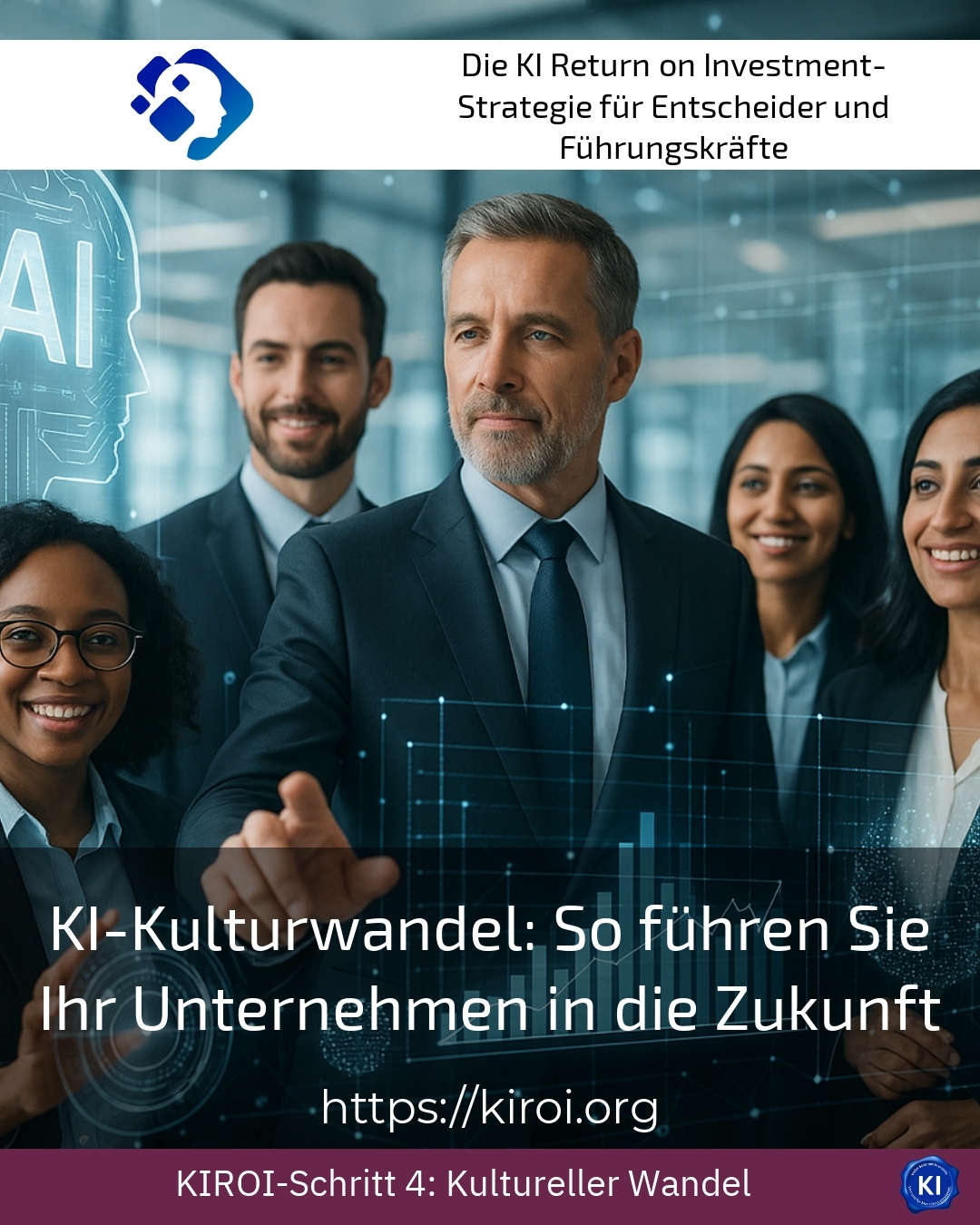
Imagine your company is at a crossroads, and the decisions you make today will determine whether you're still relevant in ten years. The AI Culture Change: How to Lead Your Business into the Future is no longer just a theoretical consideration, but an urgent necessity for any organisation wishing to survive in the digital age. While some leaders are still hesitant, others have already recognised that technological transformation is doomed to failure without a profound change in corporate culture. The exciting question therefore is no longer whether you should undergo this transformation, but how you can design it successfully.
Understanding the fundamentals of AI-driven cultural change
Before companies introduce new technologies, they must understand that people are at the core. Technology alone does not create sustainable success. Rather, it arises from the connection between humans and machines. Many organisations invest substantial sums in software and hardware. Nevertheless, they fail at the human component. Employees often feel overwhelmed or uninvolved [1]. Therefore, a holistic approach is needed. This considers both technical and cultural aspects equally.
A key aspect of this change is that leaders must redefine their own roles. They become enablers and facilitators. They provide impetus and create spaces for experimentation. At the same time, they must convey security and take fears seriously. Clients often report that this balance, in particular, presents the greatest challenge. The transformation is successful when all involved understand why change is necessary. Transparent communication plays a crucial role in this.
This dynamic is particularly evident in the manufacturing industry. Production managers must convince their teams of automated processes. At the same time, the fear of job losses is growing. In retail, customer behaviour is changing rapidly. Sales staff need to acquire new skills. In the healthcare sector, nursing staff are also experiencing profound changes. Documentation systems are becoming more intelligent, requiring adaptation.
Best practice with a AIROI customer A medium-sized company in the logistics sector faced the challenge of modernising its entire warehouse management system while bringing its long-serving employees along. The management deliberately opted for a participatory approach and established a cross-functional team from various departments. Initially, all employees were informed about the planned changes in workshops and were able to express their concerns. Transruption coaching guided this process over several months and helped to constructively address resistance. The involvement of experienced warehouse workers as so-called Change Ambassadors proved particularly valuable. These ambassadors of change were able to reach their colleagues on an equal footing and alleviate fears. After six months, there was a significantly increased acceptance of the new systems. The error rate decreased by thirty percent, while employee satisfaction demonstrably rose. This example illustrates how important it is to combine technological progress with genuine cultural change.
Strategies for Successful AI Culture Change in Practice
Implementing profound change requires a well-thought-out strategy. This should consider various dimensions. Firstly, it is important to analyse the current state. Where does the organisation stand today? What strengths and weaknesses exist? Subsequently, leadership teams define a clear vision. This vision must inspire and provide direction [2]. However, it must also not be unrealistic. Clients often report that exaggerated expectations lead to frustration.
In the banking sector, for example, we are seeing branch employees become digital advisors. They are learning new systems and expanding their skill profiles. In the insurance industry, companies are automating claims processes. At the same time, new roles are emerging for complex cases. The tourism industry is experiencing a similar transformation. Travel agencies are evolving into experience designers. These examples demonstrate the diversity of possibilities.
The role of leaders in the AI culture change
Leaders bear a particular responsibility in transformation processes. They must act as role models and actively live the change. This means they use new technologies themselves. They show openness to change and admit when they don't know something. This authenticity builds trust with employees. At the same time, leaders must formulate clear expectations. What exactly is supposed to change? What behaviours are desired? Answering these questions requires intensive reflection and dialogue.
In the automotive industry, plant managers face precisely this challenge daily. They must combine tradition and innovation. In the energy sector, executives are faced with similar tasks. The energy transition requires new ways of thinking and business models. This dynamic is also evident in the pharmaceutical industry. Research leaders must manage interdisciplinary teams and break down silos.
Transruption coaching supports leaders in this demanding task. It offers a safe space for reflection and development. Leaders can discuss their uncertainties without showing weakness. They receive inspiration for new approaches and perspectives. This creates the necessary inner clarity for external change.
Best practice with a AIROI customer An internationally operating trading company wanted to fundamentally revise its customer experience strategy, using intelligent systems in the process. However, the biggest hurdle was not the technology, but the established company culture with strong departmental boundaries. Management realised that a purely technical approach would be doomed to failure and sought professional support. As part of the transruptions coaching, the different perspectives of the stakeholders were first captured and analysed. This revealed that Marketing, Sales, and IT had completely different ideas about the future. Moderated dialogue formats succeeded in developing a common understanding and building bridges between the departments. Employees were brought together in so-called Innovation Circles and independently developed solution ideas. This bottom-up dynamic generated energy and motivation that management could never have created on their own. After eight months of intensive work, not only the technical infrastructure had changed, but also the way of collaboration throughout the entire company.
Overcoming resistance and creating acceptance
Every change creates resistance, and that is completely normal. People react to uncertainty with scepticism or rejection. These reactions are human and understandable. What is crucial is how organisations deal with this resistance [3]. An authoritarian approach usually exacerbates the problems. Instead, patience and genuine interest in the concerns of those affected are needed. Listening is often more important than explaining.
This is very evident in the education sector. Teachers are often sceptical of new learning platforms. They fear for their pedagogical autonomy and expertise. In the public sector, administrators approach digital administrative processes with caution. They are afraid of errors and their consequences. Similar concerns also exist in the trades. Master craft businesses question whether traditional knowledge still has value.
Overcoming these resistances is achieved through various measures. Firstly, transparent communication is essential. Employees must understand why change is necessary. Secondly, low-threshold learning opportunities are needed. Training should be designed to be practical and needs-based. Thirdly, involving multipliers from the workforce helps. These colleagues are trusted and can build bridges.
Sustainable Anchoring of AI Culture Change
A one-off project is not enough to bring about real change. Change must be embedded in structures and routines. This means that processes need to be adapted and incentive systems revised. Leaders should regularly acknowledge and reinforce new behaviours. Successes must be celebrated and communicated. At the same time, there needs to be room for mistakes and learning experiences.
In the media industry, we're observing this dynamic particularly intensely. Editorial teams are constantly having to reinvent and adapt. The telecommunications sector is experiencing similar challenges. Customer service is increasingly being automated and personalised. The construction industry, in turn, is digitalising planning processes and construction sites. Building Information Modelling is fundamentally changing the entire value chain.
Transruption coaching supports companies on this long-term journey. It's not about quick fixes, but about sustainable development. Regular reflection loops help to stay on course and adapt. This creates a learning organisation that sees change as an opportunity.
Best practice with a AIROI customer A family-run business in the food industry with over a century of history faced the challenge of how to combine tradition and modernity. The third generation of the entrepreneurial family wanted to introduce intelligent production systems, while long-serving employees remained sceptical. Transruptions coaching initially helped to acknowledge the emotional significance of the company's history and integrate it into the vision for the future. In storytelling workshops, older employees shared accounts of past changes and how the company had overcome them. These stories fostered a sense of continuity and confidence for the future. At the same time, younger employees were employed as tech scouts, allowing them to contribute their digital expertise. This intergenerational collaboration created a unique corporate culture that united the best of both worlds. The introduction of new systems proceeded significantly more smoothly than in comparable companies within the industry. Today, the company is considered a pioneer of people-centred digitalisation in the entire region and attracts young talent.
Developing skills for the future
The world of work is changing rapidly, and with it the skills required. Technical knowledge alone is no longer enough. So-called future skills are becoming increasingly important. These include critical thinking and problem-solving ability. Creativity and emotional intelligence are also becoming more important. Employees need to learn to deal with uncertainty and to develop continuously.
This trend is particularly evident in the financial sector. Analysts must interpret and communicate complex data. In the legal profession, research tasks are fundamentally changing. Lawyers are focusing more on advice and negotiation. In engineering too, job profiles are changing considerably. Design engineers are increasingly working with simulations and virtual prototypes.
Companies must therefore invest in further training and foster a learning culture. This is not just about formal training. Informal learning in the workplace is just as important. Mentoring programmes and peer-learning formats support this process. This creates learning teams that inspire and drive each other forward.
My AIROI Analysis
Following my comprehensive analysis of current developments, it is clear that cultural change represents the central challenge for companies. Technology is available and increasingly accessible. The difference between successful and failing transformations almost always lies in the human factor. Organisations that take their employees seriously and involve them demonstrably achieve better results. They achieve higher acceptance and can implement changes more quickly.
I find the importance of leadership in this context particularly noteworthy. Leaders significantly shape the culture through their behaviour. If they exemplify openness and a willingness to learn, the teams will follow. Conversely, if they exude uncertainty or show resistance, they block the entire process. This insight underlines the necessity of targeted leadership development as part of any transformation strategy.
Transruption coaching has proven to be a valuable tool for supporting companies through these complex change processes. It provides the necessary space for reflection and development at both an individual and organisational level. The best practices described show that sustainable transformation is possible when people are placed at the centre. I am convinced that companies that consistently follow this path will be more successful in the long term than those that rely solely on technology.
Further links from the text above:
[1] McKinsey: Culture – The Overlooked Ingredient for Business Transformation
[2] Harvard Business Review: Change Management
[3] World Economic Forum: Future of Work
For more information and if you have any questions, please contact Contact us or read more blog posts on the topic Artificial intelligence here.








 Deutsch
  English (UK)