
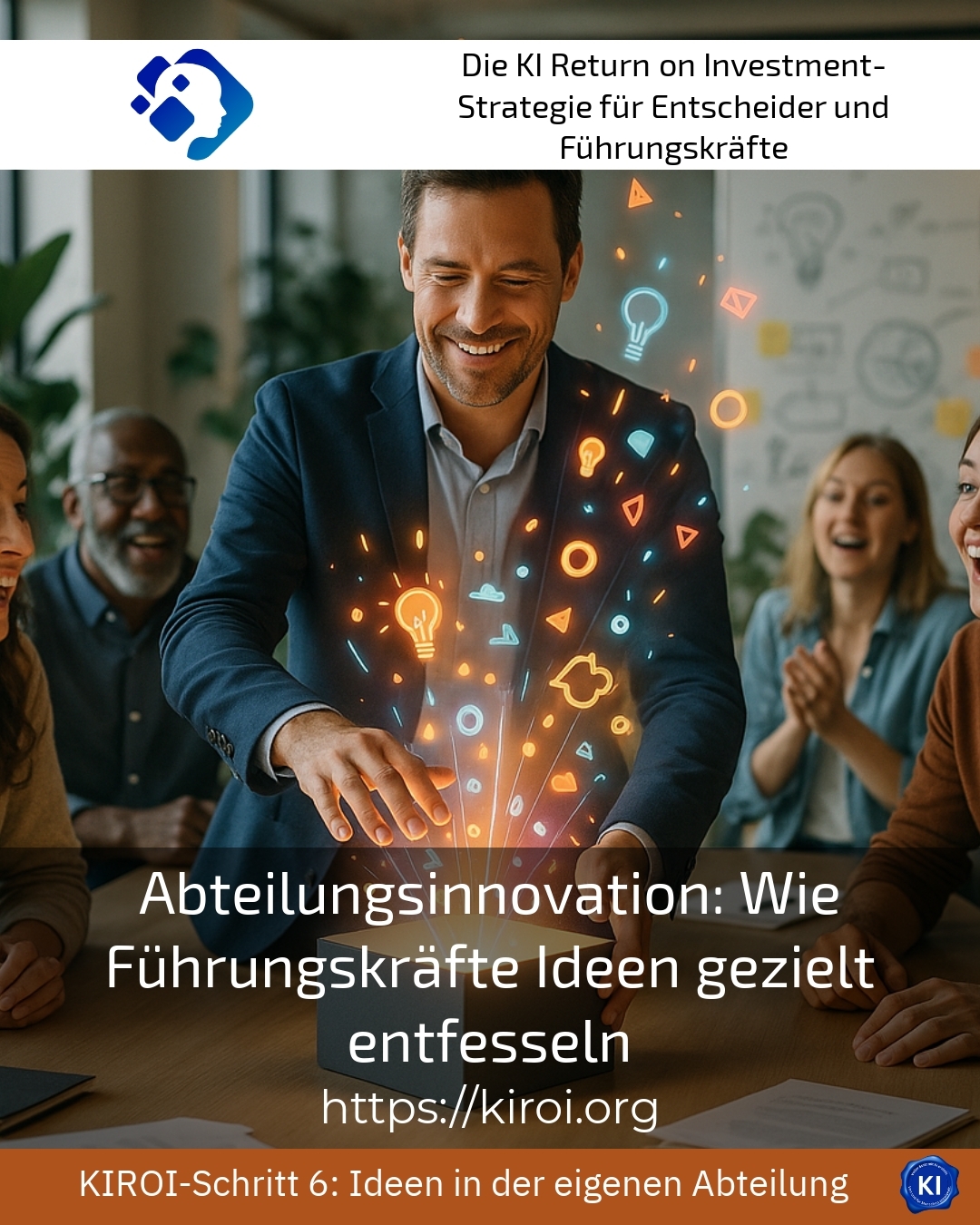
Imagine there is a massive reservoir of unused ideas slumbering in your department, just waiting to be finally released. This is precisely where the concept of Departmental innovation: How leaders systematically unleash ideas , because in a world of permanent change, the ability to achieve creative renewal decides the success and failure of entire organisational units. Many decision-makers report that their teams possess unexpected potential. However, this potential often remains hidden. Structural barriers and ingrained thought patterns block the flow of innovation. This article shows you tried-and-tested ways. You will learn how you, as a leader, can become a catalyst for breakthrough ideas.
The Hidden Power of Departmental Innovation: How Leaders Can Unleash Ideas Targetedly
In almost every organisation, unwritten rules exist. These rules determine which proposals are heard and which are not. Leaders face the challenge of breaking down these invisible barriers. They must create an atmosphere in which employees can express their thoughts freely. A head of department in product development recently reported an interesting phenomenon. His most experienced specialists were holding back their best ideas. They were afraid of being perceived as troublemakers. Only through targeted one-to-one discussions was he able to bring these valuable insights to light.
Similar observations were made by a team leader in quality assurance. Her employees had long recognised where processes could be optimised. However, they lacked a suitable channel for this feedback. She subsequently introduced weekly innovation rounds. Suggestions for improvement were explicitly gathered in these rounds. The result far exceeded all expectations. Within a few months, several actionable concepts for increasing efficiency emerged.
A third example comes from the field of internal communication. There, a department head recognised the importance of informal formats for exchange. He initiated regular creative breakfasts with no rigid agenda. These gatherings produced a surprisingly large number of innovative approaches. The relaxed atmosphere significantly lowered the barrier to unconventional thinking.
Psychological safety as the foundation for the development of ideas
Research clearly shows that psychological safety is the decisive factor for innovation [1]. Employees must feel that it is acceptable to make mistakes. Only then will they dare to share even unpolished ideas. Leaders play a central role as role models in this regard. They should talk about their own mistakes and learning processes themselves. This openness is contagious and encourages others to follow suit.
In a logistics department, a manager experimented with the so-called error log. Every week, she shared one of her own mistakes with the team. This created a culture of openness and mutual learning. The employees also began to share their experiences. This mutual transparency led to unexpected synergy effects in problem-solving.
A sales team used a different approach to promote psychological safety. There, they introduced retrospectives modelled on agile methods. In these structured reflection sessions, potential for improvement was discussed openly. The clear structure helped to address even sensitive topics. At the same time, destructive finger-pointing was avoided through clear communication rules.
Best practice with a AIROI customer
A medium-sized enterprise in the technical services sector approached transruptions Coaching with a specific challenge. Management had noticed that innovative ideas from operational departments were hardly reaching the decision-making level. Employees on the ground possessed valuable practical knowledge that remained unused. As part of the support provided by the AIROI Masterclass concept, an initial comprehensive analysis of existing communication channels was carried out. This revealed that several hierarchical levels acted as filters and ideas were diluted on their way up. Together, a new system for direct idea forwarding was developed. Employees could now submit their suggestions in a secure digital space. Managers committed to providing prompt feedback on every single contribution. Within six months, the number of submitted suggestions for improvement increased more than threefold. Particularly remarkable was the quality of the submitted ideas, which increased significantly. Several of these proposals were actually implemented and led to measurable efficiency gains. Employees reported an increased identification with their work area and an improved working atmosphere.
Structured methods for generating ideas in teams
Paradoxically, creativity often needs a structured framework to be able to unfold fully. Leaders should know various methods of idea generation and use them appropriately for the situation. The classic brainstorming method definitely has its merits. However, it must be properly facilitated to achieve its full effect. Too often, extroverted personalities dominate proceedings in such sessions.
A department in the field of project planning relied on the method of brainwriting. In this process, all participants first write down their ideas silently on cards. Only after that are the thoughts gathered and discussed together. This procedure also gives introverted team members an equal voice. The results surprised everyone involved through their diversity and depth.
In the field of customer service, experiments were conducted using Edward de Bono's Six Thinking Hats method [2]. Team members consciously adopted different perspectives. One would argue optimistically, whilst another emphasised risks and concerns. This shift in perspective led to more balanced and well-thought-out concepts. The method also helped to de-escalate personal conflicts by keeping discussions objective.
Another successful example comes from staff development. There, design-thinking workshops were used to solve complex challenges. The focus was always on the perspective of the internal customers. Through iterative prototyping and rapid feedback, solutions were continuously improved. This user-centric approach led to high acceptance of the developed measures.
The role of the leader as an enabler of creative processes
Modern leadership means less control and more empowerment of employees. Leaders should see themselves as gardeners who create favourable conditions for growth. They do not dictate which plant grows where. Instead, they prepare the soil and ensure there is sufficient light and water. This servant mindset requires a change in thinking for many decision-makers.
A purchasing divisional manager reported on his personal transformation. Previously, he had contributed most of the ideas himself. He had to learn to hold back and give others space. Initially, this restraint was difficult for him. Over time, however, he recognised the value of this behavioural change. His team developed solutions that he would never have come up with himself.
A team leader in the accounting department had similar experiences. Initially, she had reservations about delegating decision-making powers. Gradually, however, she transferred more responsibility to her team members. The result was significantly greater initiative throughout the entire team. The quality of the work output also improved measurably.
Departmental innovation: How leaders purposefully unleash ideas through systematic experimentation
Innovation rarely arises from a single brilliant idea. Rather, it is the result of systematic experimentation and continuous learning [3]. Leaders should foster a culture of controlled trial and error. Small-scale experiments with limited risk enable valuable insights. As much can be learned from failures as from successes.
An IT department introduced so-called innovation sprints. Once a quarter, the team dedicated a week exclusively to experimental projects. Employees could freely choose what they wanted to work on. At the end of the week, everyone presented their results to the entire team. Several of these experiments later resulted in successful projects.
In the field of process optimisation, the concept of pilot projects was relied upon. New ideas were initially tested on a small scale. Only upon a positive outcome was there a gradual expansion. This approach significantly reduced the risk. At the same time, it enabled rapid adjustments based on the experience gained.
A corporate communications leader established regular after-action reviews. After every major project, a systematic analysis was conducted to see what had worked well. They spoke just as openly about areas for improvement for future ventures. These learning loops led to the continuous development of their working methods.
Best practice with a AIROI customer
An internationally active trading company sought support in establishing a leadership culture that fosters innovation. Previous attempts to introduce idea management systems had failed due to a lack of acceptance. As part of the support provided by transruptions-Coaching, a comprehensive initial assessment was first carried out. In the process, several obstacles that were blocking the free flow of ideas were identified. Middle management proved to be a decisive bottleneck in the innovation process. Many team leaders viewed new proposals as criticism of their previous work and reacted defensively accordingly. The coaching programme therefore specifically targeted this group. In several workshops, the managers worked on their self-image and their role in the innovation process. They learned to view employees' suggestions as a valuable resource rather than a threat. At the same time, clear processes for handling ideas were established. Every proposal received qualified feedback within defined timeframes. This combination of cultural work and process optimisation had a lasting impact. The number of submitted suggestions for improvement rose significantly, and the implementation rate also improved considerably. The company was able to realise several process innovations that had been initiated directly by employees.
Recognising and constructively dealing with resistance
Change naturally meets with resistance. Managers should not ignore or suppress this. Instead, it is worthwhile to understand the causes of resistance. Often, legitimate worries and concerns are hidden behind them. An open dialogue can help to dispel these concerns.
In the manufacturing sector, a new ideas management system was initially met with scepticism. Long-standing employees feared that their experience might be devalued. The manager took time for personal discussions. In doing so, she learned about past negative experiences with similar initiatives. These insights helped in adapting the new system to the needs of the workforce.
A controlling team initially reacted with hesitation to the introduction of creative methods. The analytically minded employees perceived brainstorming sessions as chaotic and not very goal-oriented. The team leader then developed a hybrid format. Creative phases alternated with structured analysis steps. This adapted approach gained significantly more acceptance among those involved.
Even within the legal department, the introduction of innovative ways of working did not succeed without resistance. The lawyers were accustomed to minimising risks and paying attention to precedents. Open experimentation ran counter to their professional conditioning. One manager found an elegant way to resolve this tension. She framed innovation as the systematic further development of existing practices rather than a radical upheaval.
Sustainable embedding of an innovation culture
One-off initiatives often fizzle out without a lasting impact. Leaders must therefore think and act long-term. Innovation promotion should be firmly integrated into everyday work. Regular rituals and recurring formats help with this. This is how creative thinking becomes second nature rather than the exception.
An area of strategy development established monthly innovation evenings. These took place deliberately outside of regular working hours. Participation was voluntary, and the atmosphere was relaxed. Over time, a vibrant community of innovation enthusiasts developed. Many of the ideas developed there later found their way into official projects.
In the field of customer service, innovation became an integral part of performance agreements. Every employee was expected to submit at least two suggestions for improvement per year. This clear expectation signalled the importance of innovation to the organisation. At the same time, the best ideas were publicly recognised and rewarded.
An organisational development leader relied on mentoring tandems. Experienced innovators guided colleagues in developing their own ideas. This person-to-person knowledge transfer proved to be particularly effective. After a while, the protégés took on mentoring tasks for others themselves.
My AIROI Analysis
The systematic promotion of the capacity for innovation in departments requires a well-thought-out interplay of various factors. My experience from numerous support projects shows that technical solutions alone are not enough. The key lies in changing attitudes and behaviours at all levels. Managers must lead by example and actively live a culture of openness. I find the creation of psychological safety particularly important as a basic prerequisite for creative development. Employees must have the trust to be able to express unconventional thoughts too. At the same time, innovation needs structured framework conditions and clear processes. This apparent tension can be resolved through well-considered designs. The AIROI approach offers valuable guidance for managers and organisations here. It combines human-centred perspectives with systematic methods for promoting innovation. The examples presented show that sustainable change is possible. However, it requires patience, endurance and the willingness for continuous reflection. Managers who take this path can unlock unforeseen potential in their teams. Investing in a culture of innovation pays off in the long term through higher motivation and better results. Transruption coaching can effectively accompany and support this development process.
Further links from the text above:
[1] Harvard Business Review: Psychological Safety
[2] Six Thinking Hats – De Bono Group
[3] McKinsey: The Eight Essentials of Innovation
For more information and if you have any questions, please contact Contact us or read more blog posts on the topic Artificial intelligence here.









 Deutsch
 English (UK)