
Why do so many companies fail to gather creative ideas from all departments and turn them into profitable solutions?
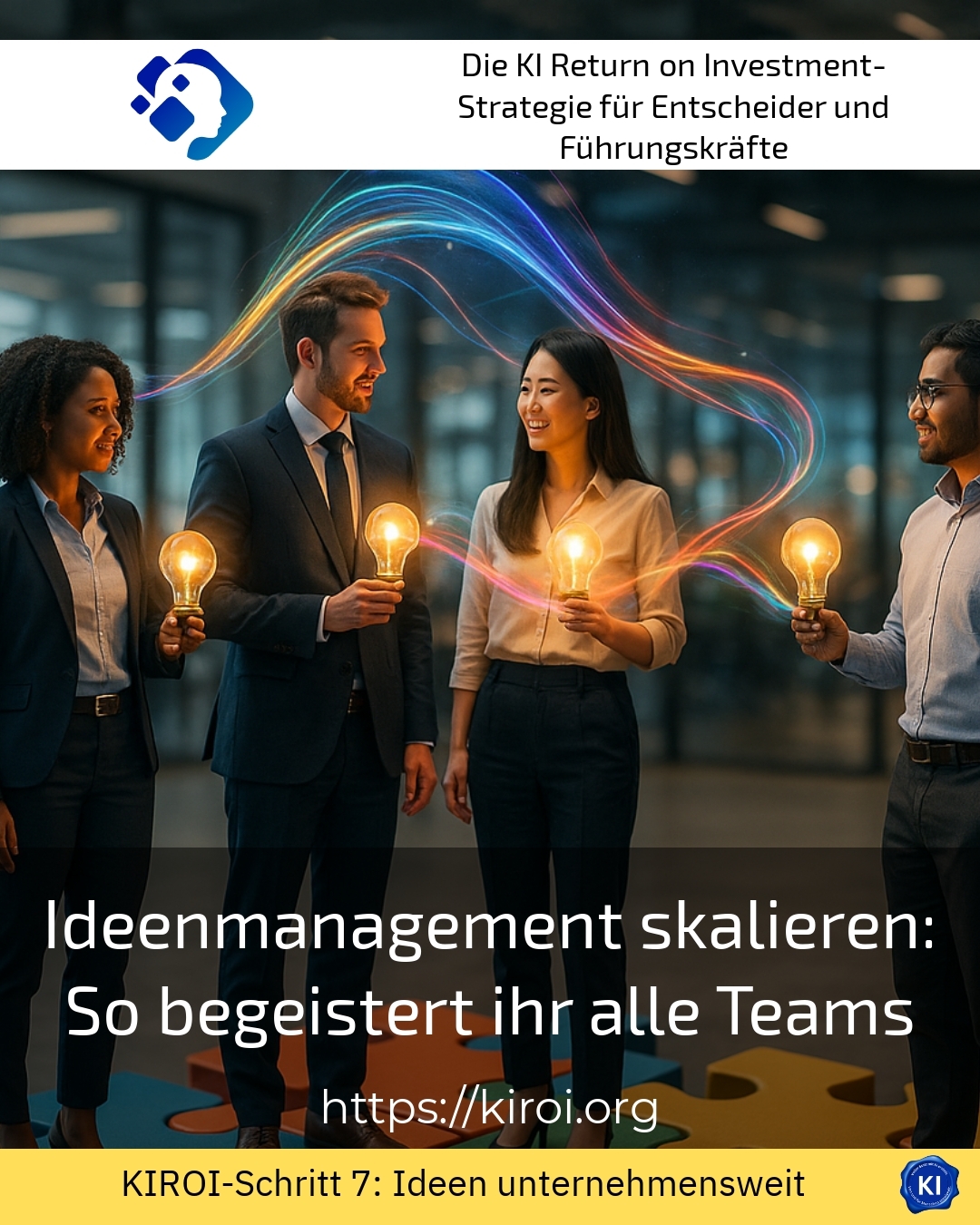
This question concerns executives in all sectors of the economy because they recognize that innovation cannot come solely from the top. Scaling ideas management This poses one of the greatest challenges, because it is not just about technical solutions. Rather, companies need to create a culture in which every employee feels encouraged to make improvements and actively participate in the change. Clients often report that initial pilot projects have been successful, but the wider-scale implementation then stalls. This is where transruptive coaching comes in to help organizations navigate this challenging transformation and build sustainable structures.
The fundamentals for successful idea management are scalable
Before companies can extend their innovation culture to all teams, they need to understand the prerequisites for it. A clear vision forms the foundation on which everything else can be built and thrive. Leaders should first define the strategic goals they want to achieve through the collection of employee ideas. At the same time, they need transparent processes that explain to everyone in the company how proposals are submitted and evaluated.
For example, a medium-sized machine manufacturer from southern Germany faced the challenge that while production workers had valuable optimization ideas, they rarely made it to the top management. The introduction of a digital portal alone did not solve the problem, because many employees were unsure whether their suggestions were even wanted. It was only when management personally went into the production halls and actively asked about improvement potential that the dynamics changed fundamentally. A logistics company from the Rhineland had experienced similar experiences when it tried to involve drivers and warehouse workers more. The solution was to introduce regular feedback rounds and publicly reward every implemented suggestion. A third example comes from the food industry, where a manufacturer of frozen products equipped its shift workers with simple forms and awarded weekly prizes for the best ideas.
Best practice with a AIROI customer
An international company in the renewable energy sector approached us because despite an established proposal system, it was no longer generating significant innovations. The employees perceived the existing system as bureaucratic and unappreciative, resulting in a decline in participation to a minimum. As part of our transruptive coaching, we first analyzed the existing structures and conducted interviews with employees from various levels of the hierarchy. It turned out that the evaluation criteria for submitted ideas were completely opaque and many proposals remained unacknowledged for months. Together with the leadership team, we developed a new concept that provided clear timeframes for feedback and included regular innovation workshops. Within six months, the number of submitted improvement proposals increased by more than three times. Particularly noteworthy was that many ideas were now developed across departments, because we had established formats for interdisciplinary exchange. Today, the company reports that employee satisfaction has increased and several process optimizations have enabled significant cost savings.
Overcoming cultural barriers and sparking enthusiasm
The biggest obstacles to Scaling ideas management These issues are rarely addressed in the technical realm, but almost always lie hidden in the corporate culture. Many employees have accumulated negative experiences in the past, such as when their suggestions were ignored or criticized. These experiences permanently shape behavior and lead employees to prefer to keep their creative impulses to themselves. Leadership must therefore actively work to create a climate of psychological safety in which mistakes are viewed as learning opportunities.
A pharmaceutical company from Hesse recognized this problem after an employee survey revealed shockingly low levels of innovation readiness. The management decided to hold a so-called “error festival,” in which executives spoke publicly about failed projects. This openness had a liberating effect on the entire workforce and signaled that experimentation was explicitly encouraged. A automotive supplier from Baden-Württemberg took a different approach and established anonymous idea channels through which critical improvement suggestions could also be submitted. This gave management insights into areas of concern that no one had previously dared to address. A telecommunications provider from North Rhine-Westphalia experimented with gamification elements and awarded points for each submitted idea, which could then be exchanged for small rewards.
The role of leaders in scaling
Without the active support of management, any initiative to promote employee ideas will sooner or later fail. Leaders must act as role models and regularly contribute their own improvement suggestions or publicly acknowledge them. Their role also includes providing resources so that promising ideas can actually be implemented. Clients often report that this very implementation phase is the most critical moment, because many good ideas disappear into the drawer.
A retail conglomerate with several hundred stores faced the challenge that ideas from the retail outlets rarely reached the headquarters. The solution was to appoint regional innovation ambassadors who acted as a bridge between the locations and the head office. These individuals gathered suggestions, consolidated similar concepts, and presented the most promising approaches to the board. An insurance company from Bavaria established quarterly innovation days where teams could present their ideas to a jury of executives and external experts. The winners not only received recognition but also the budget and time to further develop their concepts. An energy provider from the north of Germany specifically trained its team leaders in creativity techniques so that they could in turn encourage their employees to think innovatively.
Use technical infrastructure and digital tools purposefully
Modern software solutions can significantly support the process of idea collection and evaluation, provided they are properly implemented. It is important to choose tools that fit the existing IT landscape and can be intuitively operated by all employees. Complex systems often lead to lower participation because the effort involved in submitting a proposal is perceived as too high. At the same time, digital platforms should create transparency by providing a clear overview of the status of each submitted idea [1].
A chemical company from Rhineland-Palatinate chose a cloud-based solution that was accessible from both the desktop and smartphone. This flexibility was crucial because many production workers did not have a fixed computer workstation. A media company from Hamburg integrated its ideas management platform directly into the existing intranet, so employees did not need to register again. This low barrier to entry contributed significantly to the high level of engagement the company experienced. A financial services provider from Frankfurt experimented with artificial intelligence to automatically categorize submitted suggestions and group similar ideas [2].
Best practice with a AIROI customer
A medium-sized company in the construction industry sought our guidance because, despite good initiatives in individual branches, it was unable to establish a corporate-wide innovation culture. The various locations operated with different systems, which significantly hampered the exchange of ideas and led to duplication of work. As part of the transruptions coaching, we first developed a shared understanding of what requirements a central platform should fulfill. To ensure that future users could bring their own needs into the equation, we recruited employees from all the branches. After a careful evaluation of various providers, the company chose a solution that particularly suited the workflows on construction sites. The implementation was carried out gradually, starting with a pilot phase at two locations, whose experiences fed into the further rollout. Today, all branches use the same platform, and regularly, cross-location projects are created from the submitted improvement suggestions. Management reports that employees are proud of their contributions to the company’s development and are more identified with their employer.
Scaling idea management through cross-departmental collaboration
The best innovations often arise at the intersections between different departments, where different perspectives meet. Companies should therefore specifically establish formats that promote and enable exchange across departmental boundaries. Both physical spaces and digital meeting places can play an important role in this process and contribute to networking. Clients often report that informal conversations at the fringes of official events are particularly valuable sources of inspiration.
A consumer goods manufacturer from Saxony established a so-called innovation lab where employees from production, marketing, and sales worked together on projects. This space was deliberately designed differently from the other offices and was intended to stimulate and encourage creative thinking. A technology company from Munich introduced monthly lunch roulette sessions in which employees from different teams were randomly paired for lunch together. These casual encounters led to numerous new contacts and later collaborations between the departments. A health care provider from Berlin organized regular hackathons in which mixed teams developed prototypes for new service offerings within two days.
Establishing sustainable structures for long-term success
One of the biggest challenges in Scaling ideas management It consists of maintaining the initial enthusiasm over an extended period of time. Many companies experience a significant decline in engagement after a successful initial phase because the novelty wears off. To counteract this effect, organizations must continuously develop and adapt their innovation programs. Regular success stories that are communicated internally can help maintain interest and spark new impulses.
A business from Lower Saxony implemented a mentoring program in which experienced ideators supported and guided new colleagues. This personal support helped many employees overcome their initial inhibitions and submit their first proposals. An industrial company from the Ruhr region established an annual innovation conference where the best projects of the past year were presented and awarded. This event became a highlight in the company calendar and motivated many teams to make special efforts. A service company from Stuttgart linked participation in idea management with personal development discussions and career opportunities for employees [3].
My AIROI Analysis
The experiences from numerous consulting projects clearly show that scaling innovation processes requires much more than technical solutions or new software tools. The decisive success factor lies in the corporate culture and the willingness of management to embrace and support real change. Companies that view and treat their employees as valuable sources of improvement ideas not only benefit from concrete innovations, but also from increased motivation and commitment. Transruptive coaching has proven particularly effective in this context, as it addresses and accompanies both the strategic level and the practical implementation.
What seems particularly important to me is the realization that scaling is not a one-time project but a continuous development process that is never truly complete. Companies must be willing to regularly review and adapt their approaches as conditions or requirements change. The examples from various industries impressively demonstrate that there is no one-size-fits-all solution that works equally well for all organizations. Instead, concepts must be tailored individually to the specific circumstances and cultural characteristics of a company. Those who adhere to these principles and patiently work on developing their innovation culture will be able to benefit in the long term from more engaged teams and better results.
Further links from the text above:
[1] Haufe: Successfully managing ideas in companies
[2] Bitkom: Artificial Intelligence in Business Use
[3] DGFP: Strategic idea management and employee participation
For more information and if you have any questions, please contact Contact us or read more blog posts on the topic Artificial intelligence here.







 Deutsch
 English (UK)