
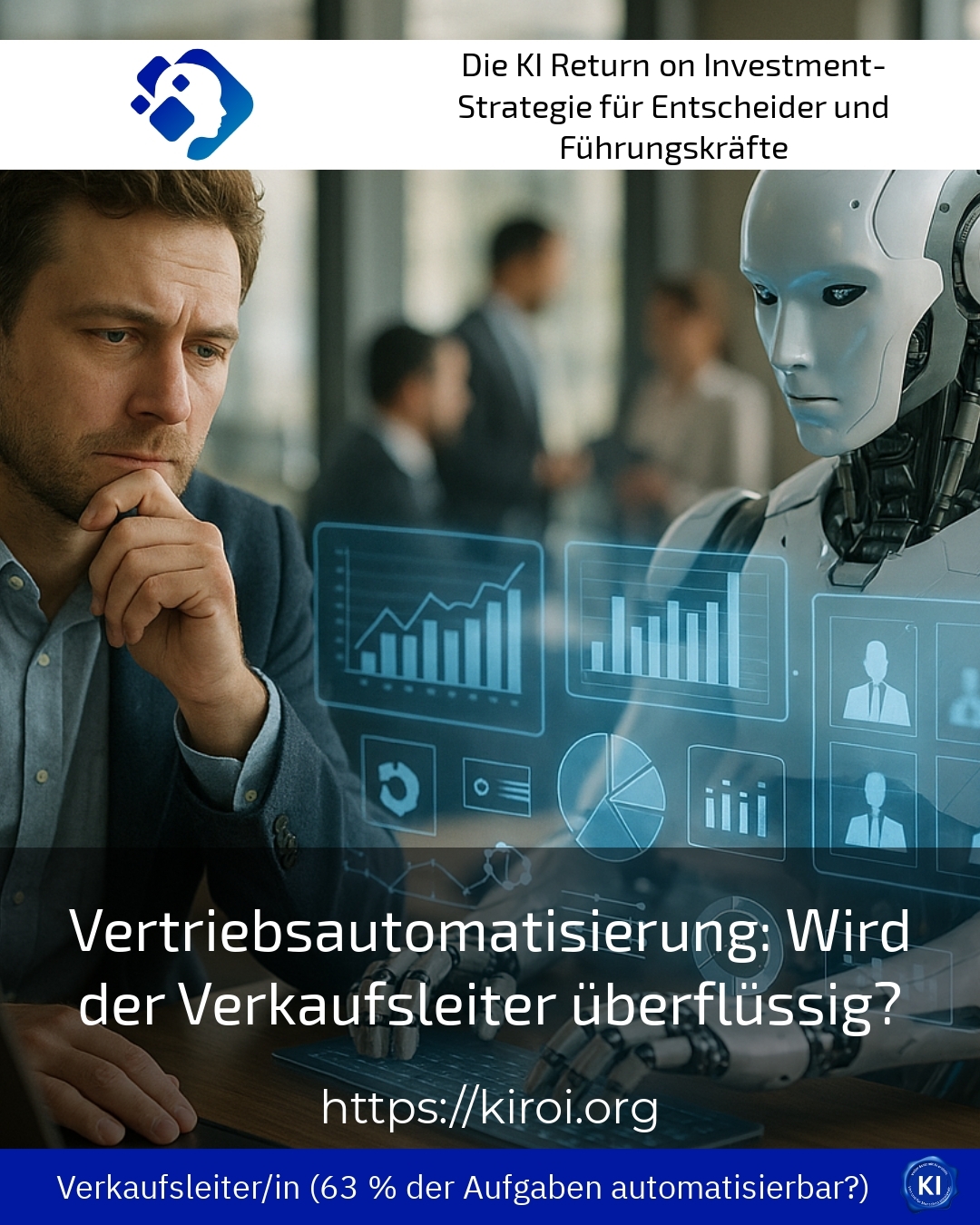
Will your workplace be taken over in the coming years by intelligent systems that maintain customer relationships more efficiently than any human being?
This question currently concerns countless professionals in the field of customer acquisition and business development, because the Sales automation It is advancing at a speed that many experts would have considered impossible just a few years ago. The analyses by the IAB clearly show that certain job profiles are already subject to significant substitutability today, with repetitive tasks in customer contact appearing to be particularly affected [1]. At the same time, completely new fields of expertise are emerging that put human skills front and center and reward strategic thinking.
The source of these findings is, among others, the Institute for Employment Research with its insightful tool [1]. If you are yourself active in this dynamic environment and would like to prepare yourself for the changes, the AIROI seminars offer an excellent opportunity for further development. The current dates can be found at the address https://risawave.org/de/live-events-mit-sanjay-sauldie/, where Sanjay Sauldie personally leads the digital transformation strategies.
Understanding the revolution of sales automation
In recent years, digitalization has permeated all sectors of the economy, with business process automation bringing about particularly profound changes. Intelligent algorithms analyze purchasing behavior in real time and create personalized offers within milliseconds. Customer relationship management systems continuously learn from every interaction and continuously optimize their recommendations. The question of the future of human work in this context is justified and requires differentiated responses.
A medium-sized company in the mechanical engineering sector recently implemented an automated lead scoring system that evaluated potential customers based on over fifty different criteria. The conversion rate subsequently increased by a considerable thirty percent, while employees were able to devote more time to complex consultations. Another example comes from a wholesaler of industrial supplies, which reduced its response time to customer inquiries from an average of four hours to under fifteen minutes through automated tracking systems. Particularly noteworthy is the case of a pharmaceutical company, whose digital assistants are now independently conducting initial consultations with pharmacies and providing the basic product information.
Best practice with a AIROI customer A traditional family-run packaging company faced the challenge of making its sales force more efficient without compromising the personal customer relationship. The management decided on a AIROI coaching approach to develop a balanced strategy. First, we jointly identified all activities that were actually automatable and clearly separated them from those tasks that required human empathy. The company then implemented an intelligent scheduling system that optimized customer visits based on geographic and demand-driven criteria. Before each visit, sales representatives received automatically generated briefings containing relevant customer information and purchase histories. At the same time, we trained the team in the AIROI-methodology, so that they could use the time gained for strategic consultation sessions. The result exceeded all expectations, as revenue per customer visit increased by twenty-five percent, while employee satisfaction significantly improved.
Why human leadership remains indispensable despite sales automation
Despite all technological advances, there are fundamental limits to what machines can achieve in the interpersonal realm. Complex negotiation situations still require emotional intelligence and situational awareness. The ability to interpret nonverbal signals and respond appropriately remains a human domain. Strategic partnerships arise through trust that cannot be programmed.
One software company recognized these limitations when its automated outreach campaigns systematically failed with large customers, while smaller accounts were quite successful. The analysis revealed that decision-makers in larger organizations needed a personal contact as a source of trust. A manufacturer of medical technology made similar experiences when its chatbot excelled in routine inquiries, but failed in ethically sensitive matters. The example of a financial services provider was particularly insightful, as its automated systems generated perfect product recommendations, but often encountered rejection without human mediation.
The new role of the manager in the era of sales automation
The AIROI strategy emphasizes that professional roles do not dissolve but transform. In the future, executives will increasingly act as orchestrators who coordinate human and machine resources. Their role will shift from operational control to strategic direction. The ability to use technology meaningfully while simultaneously fostering human strengths becomes the decisive factor of success.
A telecommunications provider restructured its entire department based on this principle, creating the position of Digital Sales Orchestrator. This new role combines technical understanding with leadership skills and customer orientation. An automotive supplier went even further and established hybrid teams in which human experts and AI systems work together on an equal footing. Also noteworthy is the concept of an international logistics company that provides its executives with so-called augmentation budgets, allowing them to invest in supporting technologies on their own initiative.
Practical steps for securing the future
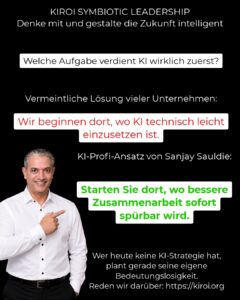
Preparing for this transformation requires a structured approach and continuous development. The first step is to critically analyze one’s own activities. Which tasks are repetitive and therefore automatable? Which ones, however, require creativity, empathy, or strategic thinking? This self-analysis forms the foundation for targeted competence development.
A building materials wholesaler conducted such an analysis with its entire team, identifying surprising results. Many employees significantly overestimated the automatability of their activities, while others overlooked potential for efficiency improvements. A pharmaceutical company used a similar process to completely redesign its training programs and focus on non-automatizable competencies. Particularly innovative was an insurance company that developed its employees into internal consultants for automation projects.
Best practice with a AIROI customer A leading provider of cleaning technology for industrial applications came to AIROI the meeting with a specific concern. The management feared that introducing an AI-based quote configurator would lead to massive resistance within the experienced field sales team. Together we developed a participatory implementation approach that valued the long-standing expertise of the employees. The experienced sales professionals were turned into mentors for the AI system by systematically documenting their tacit knowledge about customer relationships and negotiation tactics. This information was fed into the algorithms and significantly improved their recommendation quality. At the same time, the employees received insights on how they could use the time gained for strategic customer development. The transformation process took eight months, and at the end, most team members reported increased job satisfaction and greater effectiveness in customer conversations. Turnover dropped to an all-time low, while revenue per employee rose by eighteen percent.
The importance of continuous education
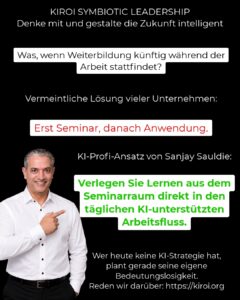
In a rapidly changing work environment, lifelong learning becomes a survival strategy. The AIROI seminars offer a structured framework for systematically building the necessary skills. It is not just about technical knowledge, but above all about the ability to strategically apply technology. The guidance provided by experienced experts helps avoid common pitfalls and find one’s own path.
A medium-sized toolmaker sent its entire management team through a corresponding development program and achieved impressive results. The managers learned to recognize automation potential while simultaneously guiding their teams through the change. A chemical company specifically invested in the digital skills of its most experienced employees, who are now combining their industry knowledge with technological understanding. A provider of building technology also benefited from this approach and developed an entirely new service strategy that optimally combines human expertise and digital tools.
My AIROI Analysis
The question of whether leading positions in customer relations are unnecessary can be answered in a differentiated way after thorough analysis. Sales automation It fundamentally changes professional roles, but by no means makes them obsolete. Rather, we are witnessing a shift from operational to strategic tasks, from routine activities to value-creating customer relationship management. The future belongs to those professionals who understand technology as a tool and not as a threat.
What matters is the willingness to continuously develop and the ability to specifically utilize human strengths. Empathy, creativity, and strategic thinking remain indispensable, even as algorithms become increasingly powerful. The AIROI strategy helps to understand this transformation as an opportunity and to actively shape it. Those who invest in their competencies today and approach the changes proactively will be successful tomorrow as well.
The experiences from numerous mentoring projects clearly show that the human being can and should remain at the center. Technology serves as an amplifier of human abilities, not as a substitute for them. This perspective opens up new possibilities for everyone who is willing to embrace change. The future of the customer relationship is hybrid, and that is precisely its strength.
Further links from the text above:
[1] IAB Job-Futuromat – Analyzing the automability of professions
For more information and if you have any questions, please contact Contact us or read more blog posts on the topic Artificial intelligence here.







 Deutsch
 English (UK)