
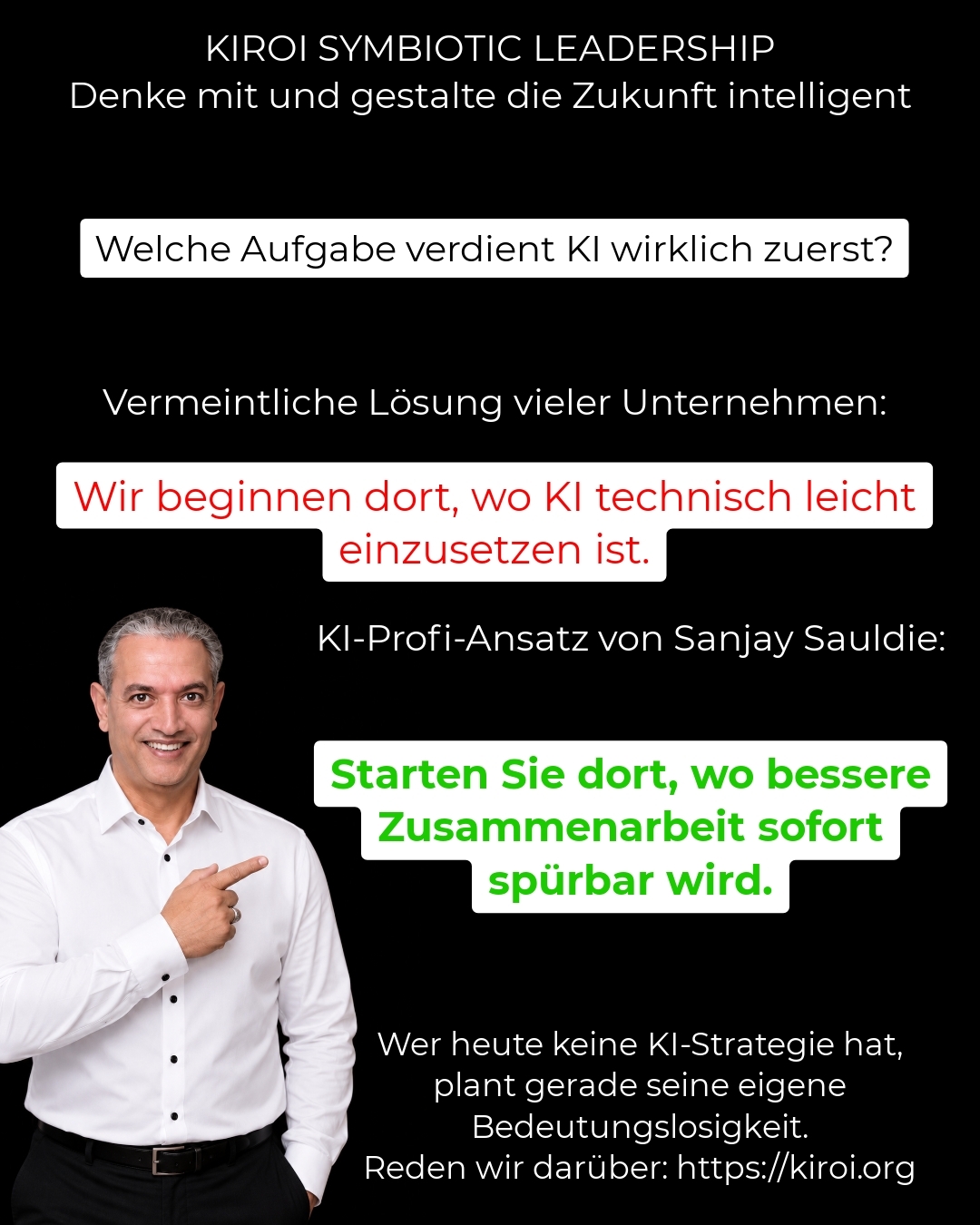
What happens when companies start with intelligent systems in the wrong place and completely overlook the real levers for growth?
This question concerns executives in almost all industries. They invest substantial sums in new technologies. Yet the hoped-for breakthroughs remain elusive. The reason often lies not in the technology itself. It lies in the order of implementation. The question Which task is really worth AI first? It determines the success or failure of entire transformation projects. Many organizations start where it seems technically easy. However, this approach rarely leads to noticeable improvements in the workday. Instead, isolated, isolated solutions are created without real added value for the workforce [1].
The classic approach of average companies
In many organizations, a common pattern prevails. Decision-makers start where the technical hurdle appears to be the lowest. They initially automate repetitive processes such as data entry or billing processing. This approach seems logical and low-risk at first glance. After all, such tasks can be well defined and measured. But this is precisely where the fundamental problem of this approach lies hidden.
For example, a medium-sized manufacturing company initially implemented a system for automatically capturing delivery receipts. The technical implementation was accomplished without any problems within a few weeks. The employees in the logistics department actually saved time on manual input. However, collaboration between purchasing, production, and sales did not improve at all. The actual communication problems remained completely untouched by this measure.
A business decided to use intelligent chatbots in customer service. The technology worked reliably for standard inquiries about opening hours and delivery status. However, customer satisfaction significantly decreased in complex consultation situations. The sales teams did not feel integrated into the new solution; they viewed the system as an outsider in their daily work.
A service company in the field of personnel recruitment also chose the seemingly simple route. It automated the pre-screening of application documents according to formal criteria. The recruiters thus gained time for other tasks in their daily work. At the same time, the exchange with the specialist departments deteriorated significantly. The requirements profiles were still communicated by email and were often misunderstood.
Why technical simplicity should not be the deciding factor
The approach We start where AI is technically easy to use ignores a key insight. Technological projects rarely fail due to the technology itself [2]. They fail due to a lack of acceptance and a lack of involvement of the people. The question Which task is really worth AI first? Therefore, it must be answered differently. It is not about technical feasibility. It is about the biggest lever for better cooperation.
A mechanical engineering company invested considerable sums in optimizing its production planning. The algorithms worked precisely and reduced downtime measurably. Nevertheless, the mood in the production remained tense. The workers felt ignored and not taken seriously. They sabotaged the system by deliberately providing false information in incident reports.
A company in the food industry relied on intelligent forecasts for purchasing goods. The predictions were surprisingly accurate and significantly reduced overstocking. Nevertheless, there continued to be shortages of seasonal products. The reason was the lack of coordination between marketing and purchasing. Promotions were not communicated in a timely manner, and the system was unable to react.
An insurance company successfully automated claims processing in standard cases. Processing times decreased significantly and customers received faster responses. However, the number of complaints for complex claims increased dramatically. The claims officers had lost their ability to make independent decisions. They relied blindly on the system recommendations.
AIROI The solution: A fundamentally different starting point
The AIROI-approach sets the priorities differently. It recommends: Start where better collaboration becomes immediately noticeable. This principle fundamentally changes the entire approach to transformation projects. Instead of technical feasibility, human benefit is at the center of all considerations [3]. The workforce experiences positive changes in their work routine from the very beginning.
After AIROI the method, a automotive supplier began improving the interface between development and production. Both departments had been struggling with communication problems for years. Change requests were lost and misunderstandings led to expensive rework. The new system made the exchange transparent and understandable. The employees in both departments immediately experienced relief.
One pharmaceutical company deliberately chose collaboration between research and approval as the starting point. The documentation requirements were complex and prone to errors. The intelligent system supported consistent recording and significantly reduced the need for follow-up questions. Both teams were able to focus on their core tasks from the very beginning. Acceptance was high from the outset.
A construction company focused on communication between the construction management and subcontractors. Schedule delays and material changes regularly led to chaos. The new system enabled real-time communication and automatic notifications. The construction managers saved several hours of phone calls and emails every day. Project timelines were measurably shortened.
Best practice with a AIROI customer
This medium-sized company in the plant construction sector faced a typical challenge when introducing intelligent systems. The management initially planned the automation of quote creation and calculation and had already allocated budgets for this purpose. However, during the transruptions coaching, it became clear that the real problems lay in a completely different area and that the planned investment would hardly have had any effect. The project managers on site communicated inadequately with the internal department, so important information about customer requirements was regularly lost and subsequent calculations showed significant deviations. The AIROI team assisted the company in reorienting its priorities and helped them focus on collaboration between the field sales team and project execution. The implemented system enabled the first time ever of complete documentation of all customer conversations and automatic task distribution to the relevant departments. After just a few weeks, employees reported a noticeable relief and a significantly improved information flow during critical project phases. Customer satisfaction increased measurably as commitments were kept and inquiries were answered more quickly. The originally planned calculation project was postponed to a later date because the organization initially wanted to establish the foundations for better collaboration.
How to identify the right starting point for your business
Identifying the optimal entry point requires a systematic analysis of existing collaboration patterns. Clients often report recurring conflicts between specific departments. These friction points provide ideal starting points for initial improvement measures. Transruptive coaching helps leaders recognize and prioritize these patterns.
Through this analysis, a logistics company discovered a surprising weakness. The dispatch and drivers communicated with each other using outdated systems. Changes in the route planning often reached the drivers too late. This led to empty runs and missed time slots for customers. Improving this interface had immediate positive effects.
A media company identified the collaboration between editorial and marketing as a bottleneck. Both areas worked largely in isolation from each other and pursued different goals. The new system enabled early coordination of topics and marketing potential. Revenue from special advertising formats increased significantly.
An energy provider focused on the communication between grid planning and customer service. Requests for home connections went through complicated approval processes. Customers often waited for months for binding commitments. The improved system significantly reduced these waiting times.
Which task is truly worthy of AI first in different company sizes
The answer to this question varies significantly depending on the size of the company and the industry. Smaller companies often benefit from improvements in customer communication. Larger organizations should prioritize internal interfaces between departments. In both cases, the AIROI basic principle applies: the human being is at the center of all considerations [4].
A craft business with twenty employees initially improved the scheduling of appointments with customers. The technicians received all relevant information directly on their mobile devices. Queries from the internal department decreased by more than half. At the same time, customer satisfaction significantly increased.
A medium-sized tool manufacturer with three hundred employees chose the interface between sales and production. Customer requirements were more precisely captured and transmitted directly to production. The number of complaints due to misunderstandings decreased significantly. At the same time, delivery times were shortened.
An international chemical company began improving collaboration between research sites. Insights were shared more quickly and duplication of work was avoided. The rate of innovation increased measurably.
Long-term benefits of the AIROI-approach
Companies that follow the AIROI-method report sustainable positive effects. The acceptance of further transformation projects is increasing significantly. Employees see technology as support rather than a threat. This positive attitude facilitates all subsequent change initiatives [5].
After the successful initial project, a textile company implemented further improvements. The workforce brought forward its own suggestions for optimization. A culture of continuous improvement emerged throughout the company. At the same time, turnover dropped to historic lows.
A software company experienced similar effects after improving collaboration between development and support. Customer issues were resolved faster and systematically fed into product development. Customer retention increased measurably over several quarters.
A healthcare provider improved communication between doctors and nursing staff. The quality of patient care was demonstrably improved. Both professional groups reported higher job satisfaction.
My AIROI Analysis
The central insight from numerous transformation projects can be clearly summarized: The starting point decisively determines the overall success of technological change initiatives in organizations of all sizes. Average companies choose the path of least technical resistance and initially automate simple, repetitive tasks without real added value for the daily collaboration of the workforce. This approach regularly leads to isolated solutions that are perceived by employees as an additional burden rather than as a relief and undermine the willingness for further change in the long term. The AIROI-method offers a fundamentally different approach by placing people and their collaboration with colleagues at the center of all considerations. Executives who adopt this approach often report a significantly higher level of acceptance and faster success in their projects. Transruptive coaching helps companies identify and implement the optimal starting point for their specific situation. The investment in better collaboration is proven to pay off multiple times through reduced friction losses, higher employee satisfaction, and improved customer relationships. The key lies not in the technology itself, but in its thoughtful application in the right places within the organization.
Further links from the text above:
[1] McKinsey – The State of AI
[2] Harvard Business Review – Digital Transformation
[3] AIROI-Method – Basics and Application
[4] Gartner – Artificial Intelligence Insights
[5] Forbes – AI and Business Transformation
Are you a leader and would you like to learn how you can genuinely introduce AI into your company in a valuable and sustainable way, away from the hype? Take part Contact us or read more blog posts on the topic Artificial intelligence here.









 Deutsch
 English (UK)