
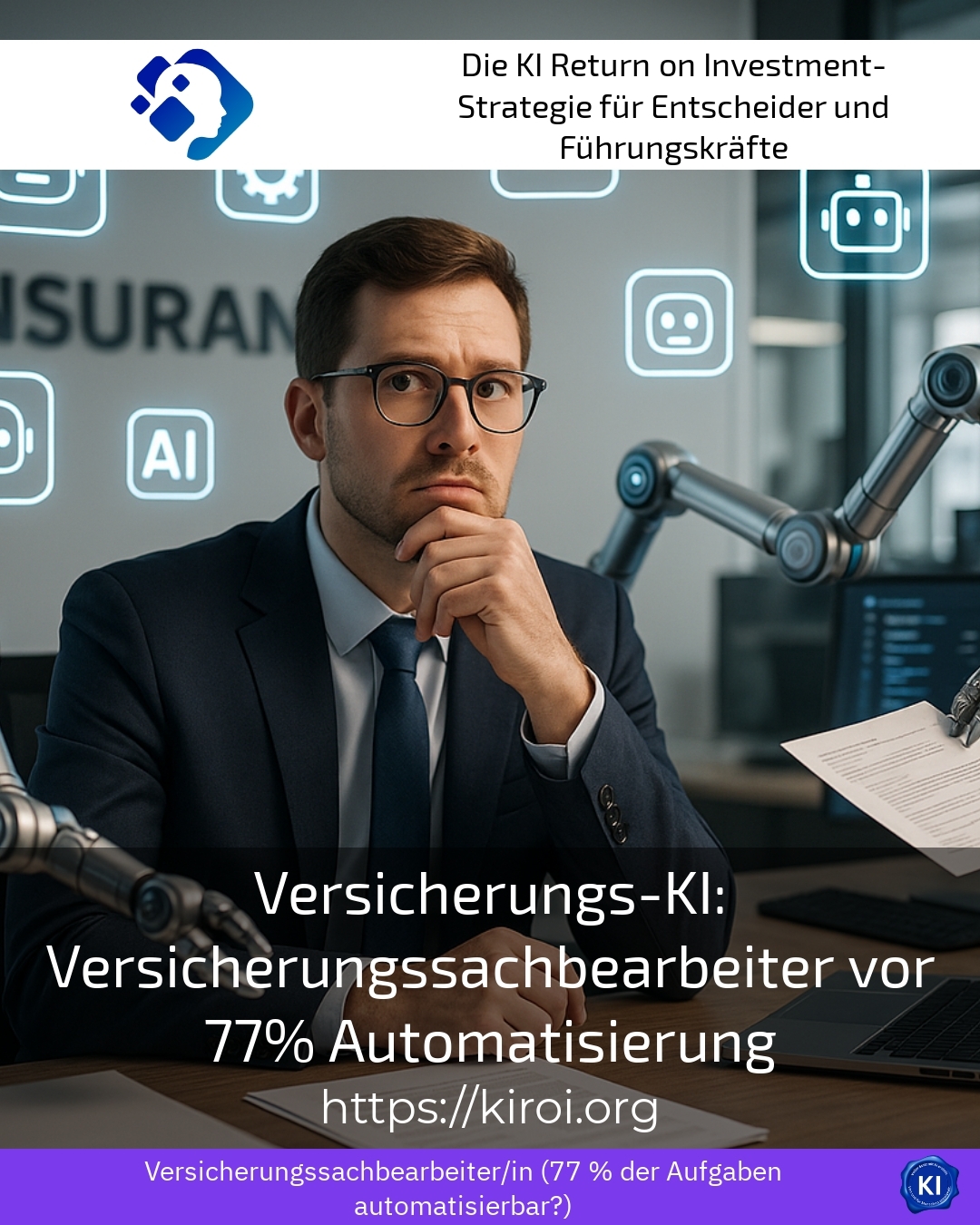
Will you still have a job in a few years if intelligent systems can already handle more than three-quarters of your daily tasks today? This question currently concerns countless professionals in the insurance industry, who are faced with the rapid development of automated processes and have to realize that Insurance AI It is no longer just a futuristic concept; it is already deeply embedded in everyday work life. The numbers speak for themselves and paint a picture that seems both alarming and fascinating, because the technological revolution is advancing relentlessly and fundamentally changing the way policies are handled, damages are regulated, and customer inquiries are answered.
The information about this profound change comes, among other things, from the Job Futureometer of the Institute for Employment Research [1], which provides scientifically based data on the automatizability of various occupational profiles. For all working people who are active in this exciting field and who want to actively shape their future, the AIROI seminars offer an excellent opportunity for further education and strategic realignment. The current dates can be found at https://risawave.org/de/live-events-mit-sanjay-sauldie/ [2], where you can register for lectures, workshops, and intensive seminars that provide you with concrete strategies for dealing with Insurance AI Give it to the hand.
The silent revolution in the office towers of the insurance industry
While many employees still assume that their expertise is irreplaceable, highly advanced algorithms are already working in the data centers of large insurance companies on tasks that were previously performed exclusively by humans. A customer’s claim for damage, such as a water leak in their apartment, often now undergoes fully automated review processes in which image-recognition systems analyze the submitted photos and within seconds make an initial damage assessment. The processing of car damage claims, where experienced claims handlers used to spend hours studying expert reports and checking repair cost estimates, is now carried out in many homes by intelligent systems that can draw on millions of comparison cases and recognize patterns that remain hidden to the human eye.
A particularly impressive example comes from the life insurance sector, where applications for risk life insurance are now pre-screened by algorithmic systems that compare health data with statistical models and automatically perform risk classifications. Travel reimbursement, which used to involve significant administrative overhead, is now fully handled by automated workflows in progressive companies, where submitted documents are captured using optical character recognition and reviewed against guidelines. Even the complex world of commercial liability insurance, where tailored solutions must be developed for a wide range of corporate risks, is undergoing a fundamental transformation through intelligent systems, whereby standardized risk analyses can be generated in fractions of the time required previously.
Best practice with a AIROI customer
A medium-sized insurance broker with twenty employees faced the challenge that the processing time for customer inquiries was continuously increasing and customer satisfaction was measurably declining. As part of AIROI the strategy, a comprehensive analysis of the existing processes was first carried out, which revealed that more than sixty percent of the incoming inquiries concerned standard recurring questions. Together with the AIROI-team, the company developed a structured approach that did not replace the employees but gave them intelligent tools. The employees were intensively trained and learned how to optimally use the new systems. Today, the employees answer complex customer inquiries faster and more thoroughly, while routine inquiries are prequalified. Employees often report a significantly increased level of job satisfaction, as they are now able to focus on more demanding tasks. The company was able to strengthen its market position while retaining all its jobs.
Insurance AI and the re-ordering of traditional professional roles
The traditional idea of the clerk who rolls through files and performs complex calculations in his office is increasingly a thing of the past, as modern systems take on these repetitive tasks with a precision and speed that no human could ever achieve. In healthcare insurance, for example, algorithmic systems examine submitted invoices for plausibility, compare diagnoses with treatments, and detect billing fraud that human reviewers might have missed. Tariff calculation, which was once the exclusive domain of highly specialized actuaries, is now largely supported by systems that compute complex statistical models in real time and can take into account far more variables than a human team ever could.
The property insurance division is experiencing Insurance AI A fundamental change. Today, building insurance risk assessment involves the integration of satellite imagery, weather data, and historical damage information, which is automatically analyzed. Fraud detection in auto insurance uses pattern recognition algorithms to identify suspicious claims and escalate them to manual review. Customer correspondence, which used to consume a significant portion of working time, is increasingly being pre-formatted by systems that understand the context of the request and can generate appropriate response suggestions.
At the same time, however, new requirements and fields of activity are emerging that require human qualities that cannot be replicated by algorithms. The empathetic accompaniment of a client who has suffered a serious blow to their life, the creative development of novel insurance products for previously unknown risks, and the ethical evaluation of algorithmic decisions remain domains of the human being.
The transformation of customer communication through intelligent systems
The way insurance companies interact with their customers has fundamentally changed, as modern communication channels are increasingly being occupied by intelligent systems that are available around the clock and can provide immediate responses. Chatbots answer questions about the coverage amount of a home insurance policy, automatically generate certificates for the vehicle registration office, and receive claims without the need for a human agent to intervene. Telephone availability, which was previously required significant human resources, is being complemented by speech recognition systems that independently process simple requests and forward more complex cases to qualified advisors.
Document processing represents another area where automated systems have achieved impressive progress. Incoming letters are scanned, classified, and assigned to the appropriate processes without requiring a human to perform the sorting process. Contract changes that previously required several days of processing time can be completed within hours through automated workflows. The creation of insurance policies, the calculation of premium adjustments, and the generation of termination notices are all carried out fully automatically.
Best practice with a AIROI customer
A regional insurer focused on agricultural risks faced the challenge that younger farmers increasingly preferred digital communication channels, while the older clientele continued to value personal advice. Through the support provided as part of AIROI the strategy, the company developed a hybrid concept that serves both customer groups. The employees received intensive training in the use of digital tools and learned how to combine their personal expertise with technological support. Field staff now use mobile applications that provide relevant information during customer interactions and calculate offers in real time. At the same time, the quality of personal advice was improved as routine tasks were automated. Customers often report an improved level of service. The company was able to increase its completion rate and improve employee satisfaction.
Strategies for the professional handling of technological change
In the face of these profound changes, the urgent question for every professional in the insurance industry is how to prepare for the new working world and secure their professional future. The AIROI Strategy offers a structured approach that does not rely on suppression or fear, but on active design and continuous development of one’s own competencies. It is not about resisting technological development, but about redefining one’s role in the interaction between humans and machines, placing those skills at the forefront that automated systems cannot handle.
The ability to solve complex problems in unforeseen situations remains a human domain. Negotiating procedures in disputes involving damages require a fine touch and social intelligence. Developing tailored insurance solutions for specialized industries requires creative thinking. Strengthening these core competencies while developing a deep understanding of the capabilities and limitations of automated systems forms the core of successful professional development.
The continuing education offerings within the AIROI-Seminare [2] address precisely these challenges and provide practical knowledge that can be applied directly in professional life. Participants learn how to use intelligent systems as tools that enrich their work instead of replacing it. They develop an understanding of which tasks can be meaningfully automated and where human expertise remains indispensable.
Insurance AI as an opportunity for professional re-positioning
Viewing technological development solely as a threat is too reductive, because at the same time completely new professional roles and career opportunities are emerging that were unthinkable just a few years ago. The position of the algorithmic auditor, who verifies the decisions of automated systems for fairness and legality, did not exist a decade ago. The role of the human-machine interface expert, who optimizes the collaboration between clerks and intelligent systems, represents an entirely new field of activity. The demand for professionals who can explain complex technical systems in a comprehensible way and support customers in using digital services is continuously growing.
In claims settlement, for example, specialized roles are created for cases that cannot be clearly determined by automated systems and require human judgment. Managing commercial clients with complex risk structures remains a field where personal advice and individual expertise are indispensable. Developing innovative insurance products for new risks such as cyberattacks or climate-related damage requires creative thinking and industry-specific knowledge.
Best practice with a AIROI customer
An experienced claims officer with more than twenty-five years of professional experience in the claims department of a composite insurer faced the question of how she could further develop her career in the face of increasing automation. In a AIROI workshop, she analyzed her strengths together with other participants and identified areas where her expertise remains indispensable. She realized that her comprehensive experience in assessing complex claims cases and her ability to lead difficult customer conversations represented valuable assets. After the seminar, the employee assumed a new role as a specialist for escalated cases and mentor for younger colleagues. Today, she applies her expertise to automated systems by validating training data and reviewing decision rules. Their job satisfaction has increased significantly, and they often report that their work is more meaningful today than ever before.
My AIROI Analysis
The insurance industry is in a phase of fundamental transformation driven by the use of intelligent systems and fundamentally changing traditional professional roles. The automation rate of 77 percent for certain processing tasks is not a dystopian forecast but already a reality in many companies. However, a nuanced analysis shows that this development does not necessarily mean the end of skilled employment, but rather a shift towards more demanding tasks. The AIROI strategy offers a structured framework for actively shaping this transformation rather than passively submitting to it.
What is crucial is the willingness to continuously develop and the openness to new working methods. Employees who engage early with the possibilities and limitations of automated systems will be the winners of this transformation. The combination of human expertise and technological support creates added value that neither humans nor machines can achieve alone. The seminars and workshops of AIROI-Strategie [2] provide exactly those competencies that are necessary for this hybrid working world. They provide impulses for repositioning and accompany employees on their journey into a future in which human qualities become more important than ever. The question is not whether the change is coming, but how we shape it.
Further links from the text above:
[1] Job-Futuromat of the Institute for Employment Research
[2] AIROI seminars and live events with Sanjay Sauldie
For more information and if you have any questions, please contact Contact us or read more blog posts on the topic Artificial intelligence here.







 Deutsch
 English (UK)