
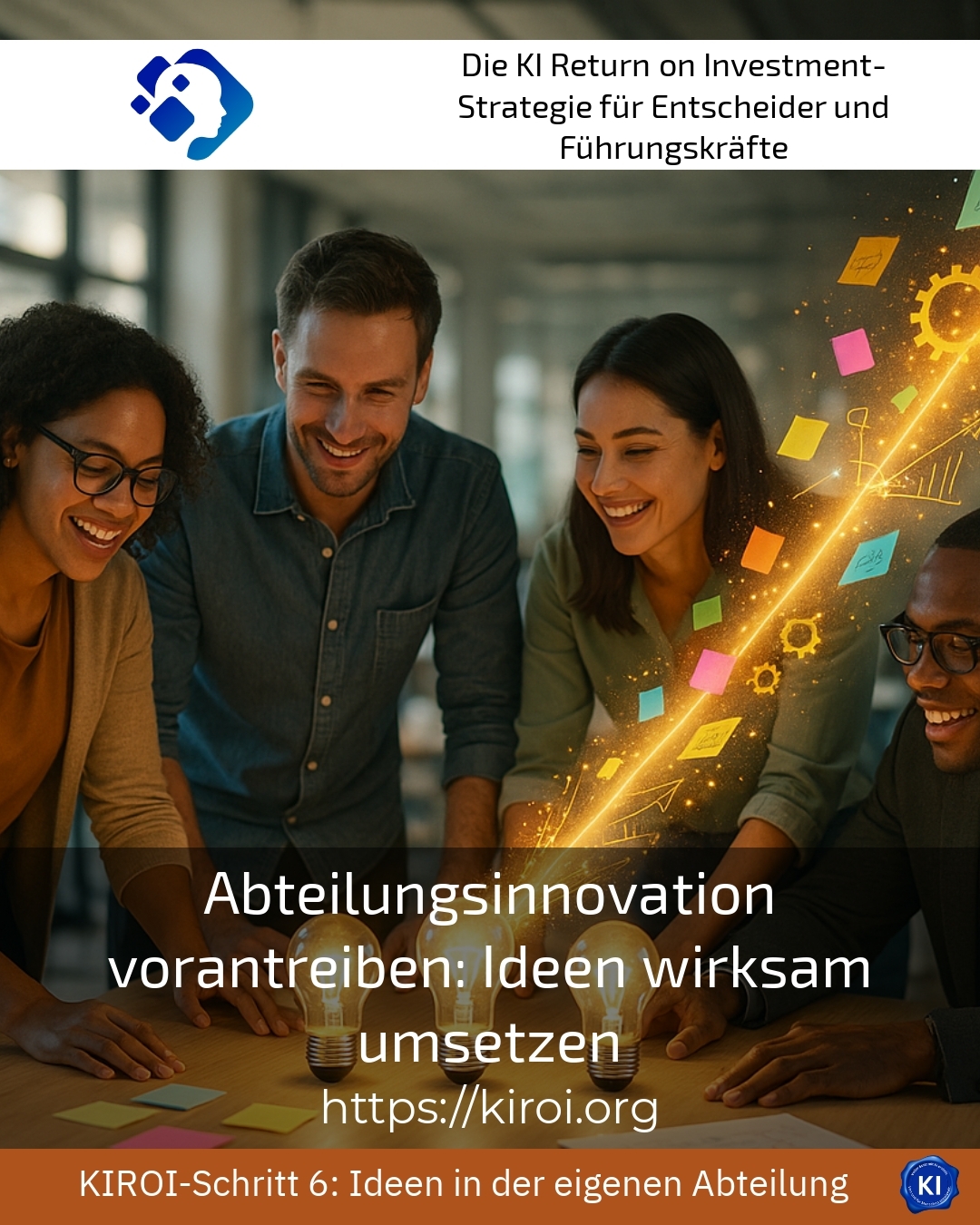
Why do so many promising ideas fail in companies, even though all parties are convinced of their potential? This question concerns managers and teams alike, because the ability to Drive departmental innovation: effectively implement ideas Today more than ever, decision-making determines the long-term success of an organization. In a time when markets are rapidly changing and technological developments are transforming entire industries, it is no longer enough to develop good concepts. Instead, it is crucial to systematically translate these impulses into reality and involve all parties in the process. Transruptive coaching accompanies these transformation processes and supports teams in sustainably anchoring their creative approaches.
The hidden obstacles on the path to successful implementation
Many organizations underestimate the complex dynamics between idea generation and its implementation. Clients often report similar challenges in their professional lives. There’s the brilliant marketing campaign that was developed in the workshop but never sees the light of day. Or the innovative product concept that disappears into the drawer because no one takes responsibility. These patterns are common across industries and lead to frustration among all involved.
For example, a medium-sized company in the mechanical engineering sector realized that its development department, while regularly designing innovative solutions, rarely saw them implemented in production. The reason was not a lack of quality in the ideas; rather, there was a lack of a structured bridge between the creative phase and the operational implementation. A financial services provider, meanwhile, found that its digital transformation ideas failed due to a siloed mindset. The IT department developed solutions that were not accepted by the sales department. A retail company observed that while its branch managers collected improvement suggestions daily, they were never systematically evaluated.
Best practice with a AIROI customer
An internationally operating logistics company struggled for years with the problem that innovative ideas from the individual branches did not lead to implementation. The local employees possessed valuable practical knowledge regarding process improvements and customer needs. However, there was no functioning channel to channel and evaluate this knowledge. As part of the transruptions coaching, we jointly developed a multi-stage system for ideation and prioritization. First, the company implemented digital platforms where employees could submit their proposals in a structured manner. Subsequently, interdisciplinary teams evaluated the submitted ideas according to established criteria such as feasibility, cost-benefit ratio, and strategic relevance. The most promising concepts received dedicated resources and a clear timeline for the pilot phase. Within eighteen months, the company was able to implement twelve significant process improvements that led to an efficiency increase of approximately fifteen percent. Particularly noteworthy was the increased employee motivation, as people now felt that their contributions were truly heard and implemented.
Drive departmental innovation: effectively implement ideas through systematic processes
Successful transformation of concepts into concrete results requires more than good intentions. It requires well-thought-out structures and clear responsibilities. It is repeatedly shown that companies in different industries identify similar success factors. For example, a pharmaceutical company established so-called innovation champions in each department. These specially trained employees act as the interface between creative impulses and their practical implementation. A power utility, on the other hand, relied on regular innovation sprints in which cross-functional teams developed prototypes within short periods of time. A telecommunications provider, in turn, introduced a digital dashboard that made the progress of all ongoing innovation projects transparent.
However, these different approaches share common principles that have proven particularly effective. First, each idea requires a clearly defined responsible party to drive its implementation forward. Furthermore, realistic resources must be provided, both in terms of time and finances. Finally, there needs to be regular points of review at which progress can be evaluated and, if necessary, adjustments made.
The role of the manager in driving departmental innovation
Leaders play a crucial role in implementing innovative ideas into action. Their task is not primarily to have the best ideas themselves. Rather, they must create an environment where creativity can flourish and mistakes are viewed as learning opportunities. One automotive supplier reported that its innovation climate improved dramatically after the management began publicly acknowledging failed projects. A media company established weekly open-door hours where employees could present their ideas directly to the board. An insurance company introduced a mentoring program in which experienced managers mentored young innovators in implementing their concepts.
Transruptive coaching helps leaders redefine their role in this process [1]. It is about becoming the facilitator rather than the decision-maker. This transformation often requires a change of mindset that does not happen overnight. Clients often report that they initially feel uncertainty when they are asked to relinquish control. However, over time they realize that this perceived relinquishment of control leads to better results.
Best practice with a AIROI customer
A medium-sized family business in the consumer goods industry faced the challenge of aligning its traditional corporate culture with the need for innovation. The management team recognized that the company needed to take new paths to survive in the increasingly digital market environment. At the same time, the established practices should not be abandoned prematurely. In the coaching process, we first developed a shared understanding of what values the company should continue to embody in the future. On this basis, management and employees jointly identified areas where innovation was particularly urgent. So-called innovation islands were created, that is, areas where new working methods and products could be tested without jeopardizing the core business. These islands served as experimental spaces from which successful concepts were gradually transferred to the overall organization. After two years, the company had successfully established a new product line while simultaneously stabilizing its traditional business. The employees particularly appreciated that the change was carried out in a gentle and respectful manner towards what was already in place.
Effectively implementing ideas: concrete tools and methods
The practical implementation of innovations requires concrete tools that teams can use in their daily work. It has been shown that different industries prefer different methods. For example, a software company successfully uses Design Thinking workshops, which involve users early in the development process. A manufacturing company, on the other hand, relies on Lean Innovation principles that emphasize rapid iterations and continuous improvement. A service company, in turn, uses Service Blueprinting to visualize complex customer journeys and identify improvement potential [2].
Regardless of the chosen method, certain success factors can be identified. The clear definition of goals and success criteria takes center stage. Without measurable metrics, it is impossible to assess whether an innovation actually delivers the desired added value. Equally important is the involvement of all relevant stakeholders from the very beginning. Ideas that are developed in secret often encounter resistance later on. Finally, patience and perseverance are required, because true innovation rarely happens overnight.
Driving forward the digital dimension in department innovation: effectively implementing ideas
Digital technologies can significantly accelerate and facilitate the innovation process. Collaboration platforms enable teams to work together on ideas regardless of location. Artificial intelligence can help analyze large amounts of data and detect patterns that remain hidden from the human eye. Project management tools create transparency about the progress of ongoing initiatives [3].
For example, a retail company uses machine learning algorithms to automatically categorize customer feedback and identify innovation potential. A construction company uses virtual reality to virtually experience new concepts before actual implementation. A healthcare provider uses process automation to reduce administrative tasks and create more room for creative work. These digital tools do not replace human creativity, but they can effectively complement it.
My AIROI Analysis
After intensive guidance of numerous organizations in their innovation projects, certain patterns emerge. The decisive success factor lies not in the brilliance of individual ideas, but in the ability to systematically implement them. Companies that establish a culture of continuous improvement are more successful in the long term than those that rely on sporadic bursts of innovation. The role of the leader thus fundamentally transforms from being a decision-maker to being an enabler.
What is particularly noteworthy is the importance of psychological safety for innovation success. Teams in which mistakes are viewed as learning opportunities develop more and better ideas. This finding has far-reaching implications for the design of work environments and leadership behavior. Transruptive coaching specifically addresses this and accompanies organizations in bringing about the necessary cultural changes.
The digital transformation offers enormous opportunities, but it also carries risks. Companies that use technology for its own sake often fail to achieve their goals. Those that use digital tools specifically to support human creativity are more successful. The balance between technological innovation and human expertise will become even more important in the future. Organizations that master this balance will be able to compete.
Further links from the text above:
[1] Harvard Business Review – Innovation Management
[2] McKinsey – The Eight Essentials of Innovation
[3] MIT Sloan Management Review – Innovation Insights
For more information and if you have any questions, please contact Contact us or read more blog posts on the topic Artificial intelligence here.










 Deutsch
 English (UK)