
Have you ever found yourself trying to pass on a task to someone else, but not really knowing what you were actually expecting?
Many executives are all too familiar with this situation, and it reveals a fundamental problem that goes far beyond mere communication. At a time when Delegate AI tasks The everyday business of managing one’s own expectations reveals an uncomfortable truth: The quality of the results depends directly on how precisely we can understand and articulate our own requirements. What at first glance appears to be a technical challenge turns out to be a reflection of our own mental clarity upon closer inspection, and this mirror can sometimes be a merciless judge.
The misunderstanding of the supposedly intuitive machine
In countless organizations, a widespread misconception persists that has stubbornly taken hold in the minds of many people. Many people firmly believe that modern algorithms and learning systems are already so sophisticated that they can predict unspoken wishes. This assumption leads to orders being given with vague formulations because it is assumed that the technology already understands what is meant. However, reality looks completely different and fundamentally contradicts this romantic idea.
Imagine a project manager asking for an analysis of customer satisfaction without specifying which timeframes are relevant, which customer segments to consider, or which metrics should serve as the basis. The result will inevitably be unsatisfactory, not because the technology used failed, but because the task statement was flawed from the outset. Another example can be found in product development, where teams ask for creative suggestions without defining the strategic framework, target audience, or technical constraints, leading to a flood of irrelevant ideas.
This phenomenon is particularly common in personnel management when performance evaluations or team analyses are requested without clear criteria for success or failure being established. The consequence is a cycle of dissatisfaction in which both parties remain frustrated and blame each other, even though the real source of the problem lies in the lack of clarity of the requirements.
Why average organizations fail to delegate tasks in AI
The majority of companies approach the integration of new technologies with a dangerous lack of caution that could prove to be a costly mistake in the long run. The prevailing approach is roughly as follows: We provide a rough description and hope that the system recognizes our true intentions and acts accordingly. This strategy is based on the myth that modern systems have already developed a kind of intuition that matches human empathy.
In practice, this attitude manifests itself in many ways and permeates all levels of hierarchy. For example, executives expect reports to be created automatically in the desired format and tone of voice, without ever explicitly communicating these preferences. Teams in research and development hope that their vague visions will be translated into concrete concepts, even though they themselves still have no clear idea of what the final outcome should look like. Sales representatives demand personalized customer interactions without providing the necessary information about customer profiles, purchase history, or individual preferences.
The consequences of this negligent approach are far-reaching and manifest themselves in wasted resources, frustrated employees, and an increasing skepticism towards technological solutions overall. What was introduced as a promising tool for increasing efficiency quickly becomes the scapegoat for all sorts of problems, even though the real cause lies in the lack of preparation and thought processes of the human actors.
The hidden costs of unclear delegations
What many decision-makers underestimate are the cumulative costs that arise from repeated iterations and refinements when tasks are not formulated precisely from the outset. A single poorly defined order can trigger a domino effect that extends through the entire value-added chain and consumes additional resources at every stage. The time spent on corrections, follow-up questions, and re-work often far exceeds the effort that would have been required for careful initial formulation.
In quality assurance, for example, unclear testing criteria lead to inconsistent evaluations and a loss of confidence in the results. In procurement, vague specifications result in incorrect orders or inappropriate selection of suppliers. In internal communication, misunderstandings arise when circulars or communications are intended to be written without a clear target group and core message.
AIROI The methodology: Delegating AI tasks as a learning process
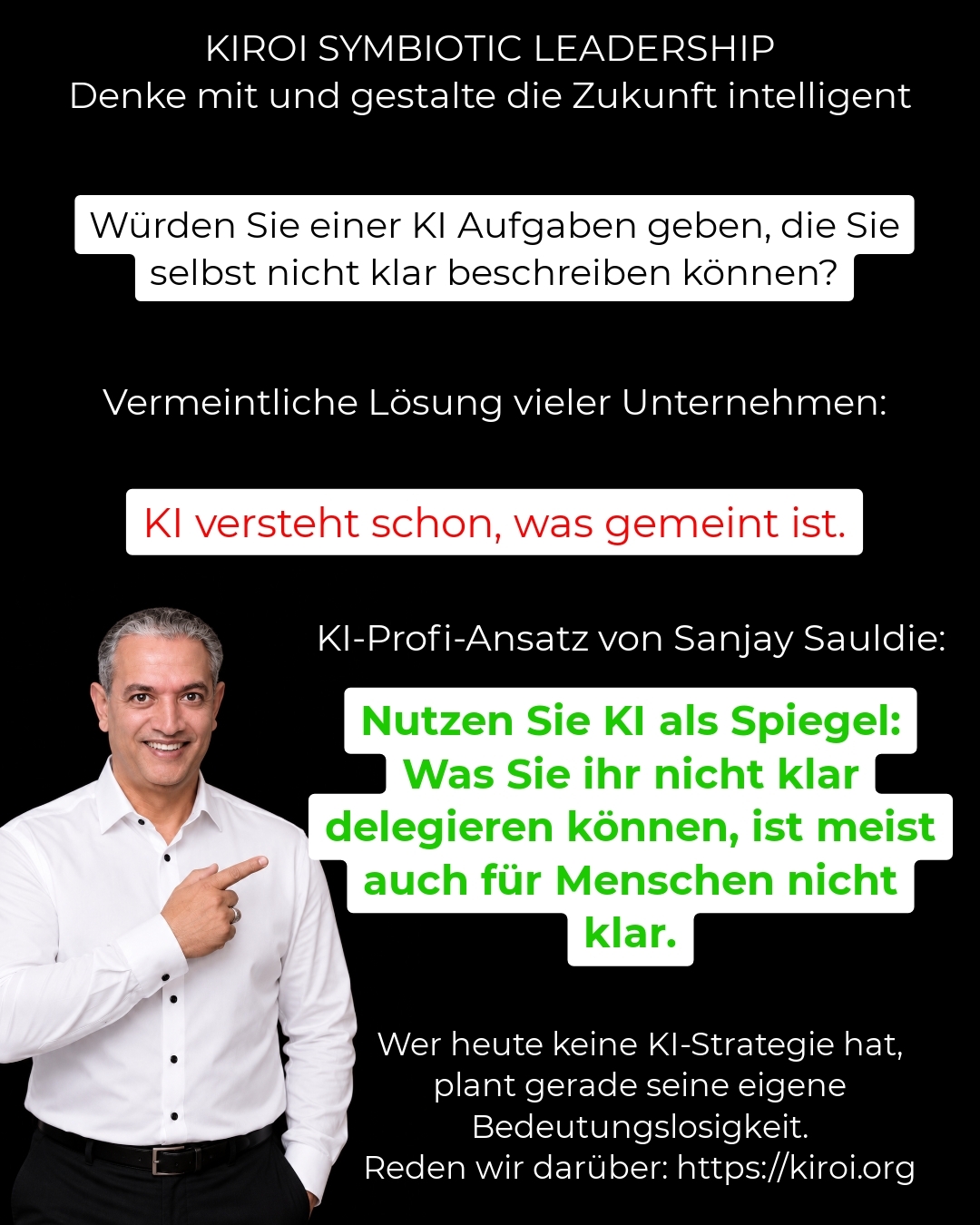
The AIROI-approach offers a fundamentally different perspective on the collaboration between humans and machines, which goes far beyond mere optimization and initiates a profound change in thinking. The central insight is this: Use technological systems as a mirror of your own mental clarity; because what you cannot precisely delegate to these tools is, in most cases, not sufficiently clearly defined for your human employees and colleagues as well.
This philosophy transforms the way we approach delegation fundamentally, turning an apparent obstacle into a valuable tool for self-awareness. When a system delivers insufficient results, the cause often lies not in technical limitations but in the quality of input, and this input directly reflects the clarity of our own thinking. Transruptive coaching helps organizations internalize this insight and translate it into practical working practices that enable sustainable improvements.
Best practice with a AIROI customer
A medium-sized company in the field of technical services faced the challenge of accelerating its bid writing process while simultaneously increasing the quality of the documents. Initial attempts to automate this task were a complete failure, as the bids were either too generic or lacked sufficient substance. During the AIROI coaching process, it became clear that the real problem lay not in the technology but in the lack of systematic organization of the bidding process within the company itself. The management level had never explicitly defined what elements a convincing bid must include, what tone was appropriate for different customer segments, or how technical specifications should be linked to commercial arguments. Through a structured workshop process, the team first developed these basic definitions before even considering the technical implementation. The result was remarkable: Not only did the automatically supported offers improve dramatically, but the manually created documents also gained consistency and credibility because the entire team now had a shared understanding of what a good offer should consist of. The lead time for proposal writing was reduced by about forty percent, while the success rate in tenders increased significantly, placing the company in a significantly stronger competitive position.[1]
The five pillars of precise task definition
The AIROI-methodology is based on a structured approach that filters each task through five critical dimensions before delegating it. The first pillar concerns the context and requires that all relevant background information be explicitly mentioned, rather than assuming it is self-evident. The second pillar focuses on the desired outcome and requires a maximally concrete description of what should ultimately be achieved, including format, scope, and level of detail.
The third pillar addresses the constraints and limitations that must be taken into account, ranging from time limits to budget constraints to stylistic requirements. The fourth pillar concerns the quality criteria and defines what should be measured to determine the success of task completion. The fifth and final pillar finally deals with the iterative possibilities and sets out how to handle questions or suggestions for improvement.
In strategic planning, for example, this means that scenarios cannot simply be evaluated as good or bad without first determining which metrics are relevant, which time horizons are considered, and which assumptions should underlie the calculations. In organizational development, it requires that change initiatives are not described vaguely as improvements but linked to measurable goals. In the area of employee development, it requires that competency profiles not be formulated as intuitive assessments but as systematic catalogs of defined skills and behaviors.
The Spiegel effect in everyday practice
The metaphor of the mirror proves to be exceptionally powerful in practical application because it causes a fundamental shift in perspective. Instead of blaming technology for unsatisfactory results, it invites us to critically question our own task and use it as a starting point for improvement. If you want to successfully delegate AI tasks, you must first learn to understand yourself and articulate your expectations.
In practice, this means that every unsatisfactory output becomes a valuable learning opportunity that enables deeper insights into one’s own thinking and communication patterns. A team leader who realizes that the generated meeting minutes do not meet his expectations is forced to ask himself what exactly he actually expects from a good protocol, and this reflection often leads to insights that go far beyond the original occasion. A department head whose budget planning yields unsatisfactory results must admit that he may not have had a clear idea himself of what factors should be considered and how they should be weighted.
Transruptive coaching specifically leverages this dynamic to help organizations make their implicit assumptions and unspoken expectations visible. In facilitated processes, teams are guided to systematically analyze and refine their tasks, which not only improves collaboration with technological tools but also elevates interpersonal communication within the organization to a higher level. [2]
From frustration to insight through the delegation of structured AI tasks
The path from initial frustration to the productive utilization of these findings typically unfolds in several phases, each of which brings its own challenges and breakthroughs. In the first phase, the tendency to seek technical solutions to problems that are actually conceptual in nature often still predominates, leading to repeated disappointments. The second phase is often characterized by a moment of realization when it becomes clear for the first time that the quality of the input directly correlates with the quality of the output.
In the third phase, a conscious practice of task formulation begins, which can initially be perceived as laborious but quickly proves to be rewarding. In the fourth phase, this precise communication becomes second nature, and the benefits extend to all aspects of professional activity, from delegating tasks to team members to collaborating with external partners to planning one’s own projects.
In process optimization, this change is particularly evident when teams realize that their improvement proposals can only be implemented if they can define concrete target values, metrics, and responsibilities. In innovation management, it becomes visible when creative ideas no longer remain vague visions but are translated into operationalizable concepts. In customer communication, it manifests itself in messages that are precisely formulated and elicit the desired reactions because they are based on a clear understanding of the target audience and their needs.
Implementation in organizational reality
Implementing the AIROI principles in daily work requires more than just an intellectual understanding of the underlying concepts; it requires a sustained change in habits and working practices that goes beyond individual applications. Leaders play a central role in this by acting as role models themselves and consistently demonstrating the new way of defining tasks, rather than simply requiring them from their employees.
In practice, accompanying coaching often supports the transition by combining individual counseling with group workshops and practical exercises to anchor the new skills. Participants learn to filter their tasks through the five pillars before formulating them, and receive immediate feedback on their attempts, which speeds up the learning process and strengthens confidence in their own abilities.
Best practice with a AIROI customer
An international organization with distributed teams across multiple locations had significant difficulties achieving consistent results in its project documentation, even though all teams used the same tools and templates. Analysis revealed that project managers at the various locations had different implicit assumptions about what meant fully, relevant, or sufficiently detailed. As part of the AIROI process, these hidden differences were first made visible, which was an insightful and sometimes uncomfortable moment for all involved. Subsequently, the teams worked together to develop a unified understanding of the documentation standards, which was captured in a living guide that is regularly updated and adapted. The effects were far-reaching: The time required to coordinate between the locations decreased significantly, misunderstandings in project handover noticeably decreased, and the overall quality of documentation improved measurably. Additionally, it was noteworthy that the improved clarity in internal communication also extended to customer communication, leading to an increase in customer satisfaction and strengthening trust in the organization as a reliable partner. [3]
My AIROI Analysis
The experiences from numerous mentoring projects reveal a clear pattern that repeatedly confirms itself in a wide variety of organizations and contexts. Organizations that primarily understand and utilize technological tools as mirrors of their own thought processes not only achieve better results in immediate collaboration with these systems, but also develop an organizational culture of clarity and precision that positively influences all aspects of their work.
The ability to clearly articulate tasks proves to be a key competence in modern working life, one that extends far beyond the technological context and bears fruit in every form of collaboration. When leaders learn to view AI tasks as an exercise in clarity, they transform a perceived bottleneck into a source of continuous improvement and self-awareness.
The AIROI perspective offers a valuable framework that provides inspiration and guidance without prescribing dogmatic solutions. It invites us to understand every interaction as a learning opportunity and to use the inevitable imperfections as a guide to better formulations. The realization that the quality of our results directly depends on the quality of our inquiries may seem initially sobering, but ultimately opens up a path to greater effectiveness and deeper understanding, both in dealing with technology and in collaborating with people.
Participants in AIROI processes often report that the principles they have learned have permanently changed their entire communication behavior, from the way they write emails to the structure of their meetings to the formulation of their strategic goals. This transformation does not happen overnight, but the gradual improvement is clearly noticeable to those involved and their surroundings and contributes to a more productive and satisfying working environment.
Further links from the text above:
[1] Harvard Business Review – Artificial Intelligence
[3] MIT Sloan – Artificial Intelligence Research
Are you a leader and would you like to learn how you can genuinely introduce AI into your company in a valuable and sustainable way, away from the hype? Take part Contact us or read more blog posts on the topic Artificial intelligence here.











 Deutsch
 English (UK)