
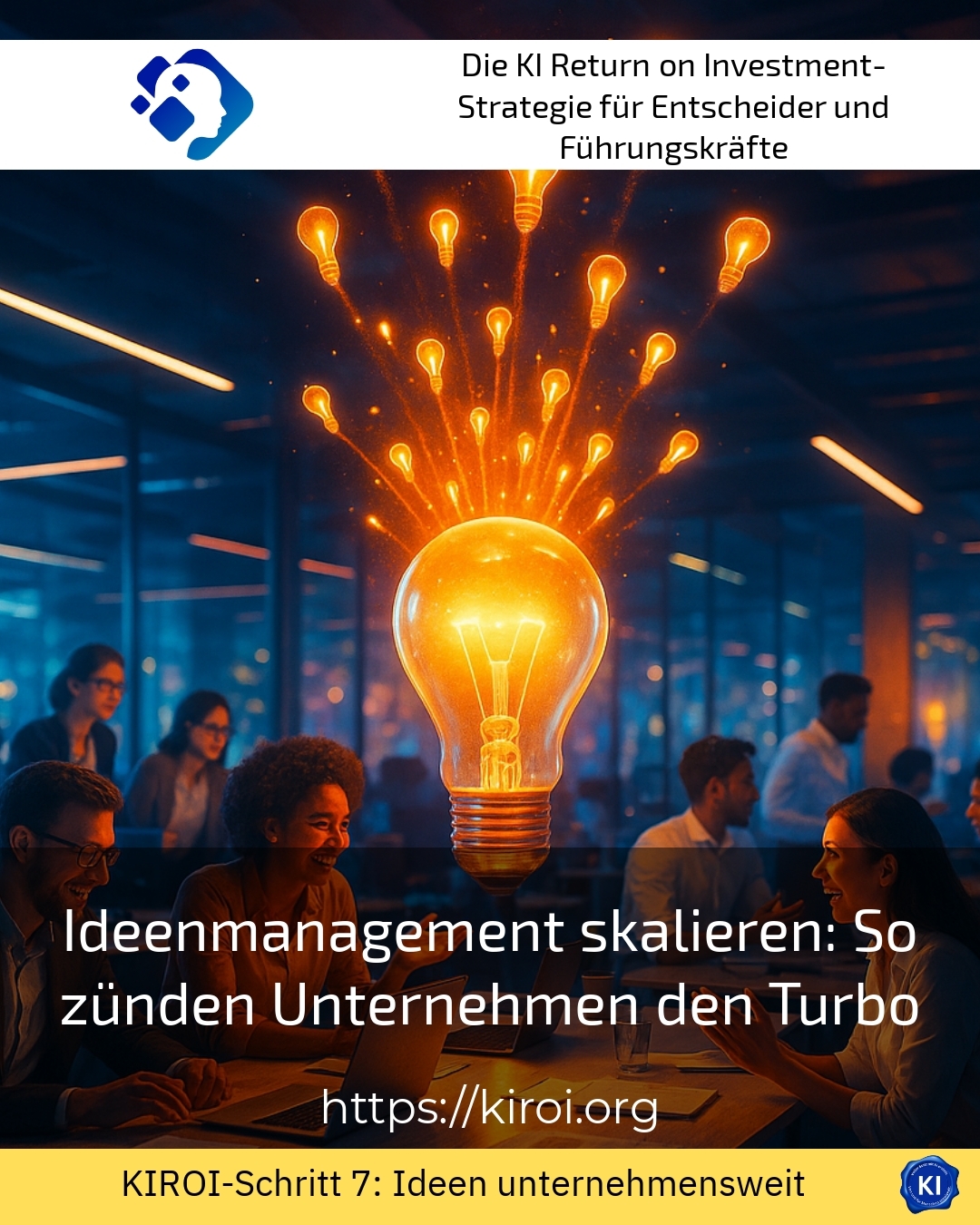
Why do so many companies fail to systematically harness creative ideas from within their own ranks, even though that is precisely where the most valuable improvement suggestions lie dormant? This question concerns both leaders and innovation managers, because Scaling ideas management It is one of the most demanding tasks in modern business management. Many organizations embark on structured creative processes with great enthusiasm, experiencing initial success and then observing the dynamics gradually diminish. The difference between mediocre results and real innovations often lies in the ability to extend proven methods to the entire organization. In this article, you will learn which strategies successful companies employ and how you can achieve the crucial breakthrough yourself.
The foundations for sustainable growth in innovation processes
Before companies can think of expanding their creative processes, they first need to establish solid foundations. These foundations encompass both technical infrastructure and cultural prerequisites that together form the backbone of any successful scaling. In the manufacturing industry, for example, production workers are in daily contact with machines and processes, so they immediately notice the slightest inefficiencies. A car parts supplier recently reported that just by structured recording of improvement suggestions from the factory floor, the rejection rate could be reduced by twelve percent. Similarly, in the logistics sector, similar patterns are evident, as warehouse workers and drivers often develop practical solutions that management simply overlooks. The retail sector, in turn, benefits enormously from the observations of sales staff, who experience customer requests and product improvements firsthand. What is crucial is that these valuable insights cannot be lost in informal conversations but can be systematically captured, evaluated, and implemented.
Creating an open innovation culture requires first and foremost the trust of employees in the seriousness of the initiative. Many employees have had negative experiences in the past because their suggestions were ignored or even mocked. Therefore, leaders must demonstrate through consistent behavior that every idea receives appreciation, regardless of the hierarchical position of the submitter. In the pharmaceutical industry, for example, laboratory assistants have repeatedly initiated process improvements that enabled significant cost savings. In healthcare, on the other hand, it impressively demonstrates how nursing staff recognize optimization potential through their daily work with the patient, which remains hidden from doctors and management. Even in the highly regulated financial sector, innovative solutions often emerge where customer advisors encounter recurring problems and develop pragmatic solutions.
Best practice with a AIROI customer
A medium-sized company in the mechanical engineering sector turned to transruptive coaching because despite high levels of innovation readiness, only a few viable proposals were submitted. The analysis revealed that employees had ideas, but did not know of a low-threshold way to submit them. Together, we developed a multi-stage system that included both digital input forms and analog idea boxes in the production halls. Particularly important was the introduction of a transparent feedback process in which each submitter received a first response within seven working days. This quick response signaled to employees that their contributions were taken seriously and motivated them to continue participating. Within nine months, the number of submitted proposals quadrupled, while at the same time the quality of the submissions significantly improved. The company was able to implement several process optimizations that together generated a six-figure amount in annual savings. This success illustrates how professional guidance in such transformation projects can make a crucial difference.
Scaling idea management: Technological enablers and digital tools
Digitalization offers numerous opportunities today to streamline creative processes and scale them up to large organizations. Modern platforms not only facilitate the easy collection of suggestions but also support their evaluation, prioritization, and implementation tracking. In the telecommunications industry, leading providers are already relying on artificial intelligence to automatically categorize submitted ideas and group similar suggestions together. This significantly reduces administrative overhead and allows innovation teams to focus on the content-related work. In the energy sector, on the other hand, digital collaboration tools are being used to enable employees from different locations to work on concepts together without having to physically meet. In construction, mobile applications have proven effective, allowing construction workers to directly document improvement suggestions on the construction site and provide them with photos.
In addition to the purely detection function, analysis tools play a central role in Scaling ideas management and its continuous optimization. Dashboards and KPIs make it visible which departments are particularly active and where additional impetus may be needed. The chemical industry, for example, uses such data to initiate targeted innovation competitions in less active areas and thus increase participation. Insurance companies have recognized that the analysis of idea sources can provide valuable insights into undiscovered problem areas that can then be proactively addressed. Mechanical engineering benefits from trend analyses that show which topics currently generate the most improvement suggestions and where the attention of the workforce is focused. Through this data-driven approach, companies can deploy their resources where they leverage the greatest leverage, rather than acting according to the “one-size-fits-all” principle.
Integration into existing system landscapes
Scale is most successfully achieved when innovation platforms are seamlessly integrated into existing IT infrastructure and do not constitute isolated island solutions. For example, connecting to ERP systems enables the automatic cost assessment of implementation proposals, which significantly speeds up the evaluation process. In the food industry, companies have linked their innovation portals to quality management systems, so that improvement ideas can be directly assigned to the relevant processes. In the textile industry, on the other hand, product development proposals are integrated directly into the PLM process, significantly shortening the time from idea to market launch. Increasingly successful examples can also be found in the public sector, where administrative staff use digital channels to propose the reduction of bureaucracy and the simplification of processes. While this integration of different systems does require initial investment, it pays off in the long run through higher efficiency and better acceptance.
Scaling cultural transformation as the key to success in idea management
Technology alone is not enough to ignite and maintain creativity and innovation in an organization. The cultural dimension plays a decisive role in whether employees actually bring their ideas forward or, for fear of negative consequences, prefer to keep them to themselves. In the aviation industry, a distinctive safety culture has developed in which any hint of potential problems is welcomed and promptly addressed. This attitude can be applied to other industries, with the focus not on error prevention but on continuous improvement. In retail, positive experiences are often reported, where store managers actively ask their teams for ideas for optimization and visibly promote their implementation. In the hospitality industry, particularly valuable improvements arise where room staff is encouraged to systematically provide guest feedback and their own observations.
Establishing a true innovation culture requires patience and consistent action over an extended period of time. Rapid successes are possible, but lasting changes only arise through repeated positive experiences for the participants. In the craft sector, for example, guild companies have achieved remarkable success by introducing regular innovation meetings where apprentices and experienced journeymen discuss improvements together. In the media industry, creative formats such as hackathons and design sprints are used to generate many ideas in a short time and to further develop the best of them. Even in traditionally hierarchical-structured sectors such as banking, a change of mindset is evident as young professionals increasingly expect and demand more participatory structures. Companies that do not meet these expectations not only risk stagnating in innovation but also losing valuable talent to more modern competitors.
Best practice with a AIROI customer
An international trading company sought support from transruptive coaching because the cultural differences between the country offices made a uniform innovation strategy difficult to implement. While European branches were already actively submitting improvement proposals, Asian locations acted much more cautiously, which had cultural reasons. The accompaniment initially included intensive discussions with local executives to understand and respectfully address the specific barriers. Together, we developed adapted communication strategies that took into account cultural specifics while still conveying the core of the innovation initiative. In some regions, anonymous submission options proved particularly effective, while elsewhere, personal recognition from supervisors had the greatest motivational effect. After one and a half years of intensive work, the company had built a global innovation network that used cultural diversity as a strength rather than as a barrier. The diverse perspectives led to more creative solutions that neither a purely European nor a purely Asian approach alone could have produced. This case illustrates impressively how professional guidance in complex transformation projects can build cultural bridges and enable sustainable success.
Leaders as role models and enablers
The role of management in Scaling ideas management This can hardly be overestimated, because leaders set the crucial signals through their behavior. When supervisors themselves submit improvement proposals and speak openly about their own learning processes, this also encourages employees to participate actively. In the automotive industry, plant managers have achieved remarkable results by being personally present in the production halls and speaking with employees about their ideas. In the pharmaceutical industry, there are reports of research leaders who free up dedicated time slots for creative experiments outside of regular project work, thus creating space for innovation. In the service sector, similar patterns are evident, with team leaders being particularly successful when they promptly comment on submitted proposals and transparently communicate the status of their processing. This personal gesture signals to the submitter that their contributions are valued and motivates them to continue contributing, even if not every idea can be implemented.
Measurability and continuous optimization of the innovation processes
What is not measured cannot be systematically improved, which is why a well-thought-out metrics system is indispensable. This is not just about the sheer number of submitted ideas, but above all about qualitative aspects such as the implementation rate and the achieved impact. For example, the consumer goods industry uses detailed evaluations to determine which product categories generate the most improvement suggestions and why this is the case. In mechanical engineering, cost savings achieved per implemented idea are often calculated to demonstrate the economic benefit of the entire program. The logistics industry, in turn, measures the lead time from submission to decision and continuously optimizes the internal processes for idea evaluation. Employee satisfaction with the innovation program should also be collected regularly, because it provides important insights into potential areas for improvement.
The insights gained must lead to concrete improvement measures to complete the cycle of continuous optimization. In the electrical industry, companies have adapted their evaluation processes several times after evaluations showed that certain ideation types were systematically disadvantaged. In the food industry, there have been successes as communication about rejected proposals has been improved and submitters can now understand why their idea is not pursued further. In healthcare, on the other hand, the analysis of implementation barriers led to structural changes that significantly shortened the path from idea to implementation. These examples illustrate that data-driven control and genuine willingness to change must work together to achieve sustainable success. Organizations that only collect their key performance indicators but do not respond to them are losing the trust of their employees and are jeopardizing the long-term success of the entire innovation program.
My AIROI Analysis
Systematic scaling of innovation processes is one of the most challenging transformation initiatives that companies can undertake today, but it also offers enormous potential for value creation. My experience from numerous accompanying projects shows that success depends on three essential factors: technological infrastructure, cultural readiness, and consistent management commitment. Many organizations underestimate the time horizon required for sustainable change and expect to achieve quick results. Transruptive coaching helps companies develop realistic expectations while still pursuing ambitious goals.
I often observe that the middle management level becomes the critical bottleneck because there are both operational pressures and strategic demands that conflict with each other. These executives need targeted support to fulfill their role as drivers of innovation without succumbing to the additional pressure. At the same time, companies must accept that not every idea is worth gold and establish robust evaluation processes that still have a motivating effect. Balancing openness and focus presents a persistent challenge that requires continuous attention.
From the AIROI perspective of the organization, I recommend starting with a clear pilot area and gathering intensive experience there before expanding. The insights gained should be carefully documented and prepared for rollout, taking into account regional and functional specificities. Scaling up idea management is most successful when companies combine patience with determination and view short-term setbacks as learning opportunities. The investment in professional guidance often pays off through faster progress and avoided misdevelopments [1].
Further links from the text above:
[1] The AIROI-method for sustainable innovation processes
For more information and if you have any questions, please contact Contact us or read more blog posts on the topic Artificial intelligence here.







 Deutsch
 English (UK)