
Have you ever wondered why most of the knowledge from expensive training courses is forgotten again after just a few weeks?
This question currently concerns countless decision-makers in organizations of all sizes. The classic model of professional qualification is facing a fundamental change. The way in which employees acquire new skills is changing fundamentally. Continuing education during work It is evolving into a crucial competitive factor. Companies increasingly recognize that isolated learning units no longer meet the demands of a dynamic business world. The pressure to continuously adapt is increasing steadily. At the same time, many organizations lack the time for extensive in-person events. The integration of learning and work is therefore becoming a strategic necessity.
The traditional model and its structural weaknesses
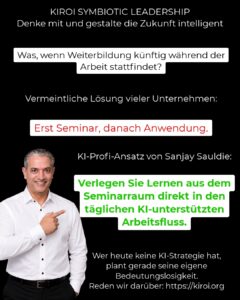
Most organizations still rely on a proven but increasingly inefficient approach. Employees leave their workplace for one or more days. They visit external events or internal training rooms. There they receive focused knowledge from experts or trainers. Then they return to their desks. The expectation is that the learned knowledge will now be applied independently. This process seems logical and has established itself over decades.
But this is precisely where the fundamental problem lies. Transferring the knowledge from the seminar room into the real world is rarely completely successful. Studies show that up to eighty percent of the content imparted is lost within a few weeks [1]. The reasons for this are manifold and of a structural nature. In the workplace, the opportunity to apply the knowledge directly is often lacking. Urgent tasks take priority over implementing new methods. Colleagues continue to work as usual and offer no support. The learned knowledge quickly fades without regular practice and application.
Another obstacle is the time lag. It often takes weeks between learning a method and its first application. During this time, the original context may already have changed. New projects start and old priorities shift. Motivation to apply decreases with each passing day. Employees then resort to familiar procedures. The invested budget for training thus largely becomes ineffective.
Continuing education during work as a strategic paradigm shift
The AIROI-methodology takes a radically different approach to competence development. It shifts learning directly into the daily workflow of employees. Intelligent systems accompany every single step of the work process. They recognize situations in which new knowledge would be helpful. At that very moment, they provide tailored support and explanations. Learning thus takes place contextually and is immediately applicable. The separation between qualification and productive activity dissolves.
This integration offers significant advantages over conventional methods. Employees learn exactly when they need the knowledge. The relevance of what they have learned is immediately apparent and motivates them to apply it. Repetitions naturally occur through recurring work situations. This way, the knowledge is significantly more durable in the memory. The organization also saves significant resources for external events.
An intelligent assistant can, for example, help with the creation of complex documents. It recognizes when certain formulations could be improved. Instead of simply making a correction, it explains the underlying principle. This way, the employee not only understands what, but also why. When performing the next similar task, he or she can independently apply the learned knowledge. Continuing education during work This is therefore carried out continuously and adapted individually.
Practical application scenarios from everyday business life
Let us first consider the situation in the commercial departments of various organizations. Employees there create extensive reports daily for internal and external recipients. Often they lack the knowledge about optimal structuring or convincing argumentation. An integrated learning system analyzes their drafts in real time. It suggests improvements and explains the underlying communication principles. The employee learns while working and simultaneously improves the result.
In technical fields, there is a similar potential for integrated learning. Engineers and developers work with complex systems and tools. New features and methods appear on the market at a rapid pace. Traditional training courses can hardly keep up with this pace. An intelligent assistant in the workflow, however, immediately recognizes when a new function would be helpful. It guides the employees through the application and explains the background. The learning takes place exactly at the moment of actual need.
In the area of customer support, too, there are numerous opportunities for this approach. Service employees face new challenges every day due to unusual requests. An intelligent system analyzes incoming messages and identifies the underlying issues. It suggests appropriate response strategies and explains their effectiveness. The employee thus gradually develops a deeper understanding of customer psychology. This form of Continuing education during work at the same time, it increases the quality of service in a measurable way.
Best practice with a AIROI customer
A medium-sized organization with several hundred employees in the administrative department faced a significant challenge when introducing new digital tools. The previous training measures showed only limited lasting effects, as the knowledge imparted quickly faded away. Transruptions coaching accompanied the project team in implementing an integrated learning approach within the daily work processes. Together, we first analyzed the most common work situations and identified those moments with the highest learning potential. Subsequently, we developed context-specific tools that appear exactly in these situations and provide brief explanations. After just a few weeks, the employees reported a significantly increased sense of competence in handling the new systems. The number of support requests decreased by more than forty percent compared to similar introduction projects in the past. At the same time, team satisfaction increased measurably as they no longer felt left alone in implementing new requirements. In addition, management received valuable insights into the actual learning needs of their employees through aggregated evaluations of the support resources used.
The role of leaders in transforming learning
Leaders bear a special responsibility in establishing new learning cultures within their teams. They must first understand the possibilities offered by integrated learning approaches. Without this understanding, the necessary support for employees is lacking. The AIROI strategy therefore always begins with the qualification of the leadership level. Leaders learn how to recognize and promote learning moments in everyday work. They develop an understanding of when employees need support.
Another important task is to create psychological safety for experimental learning. Employees must be allowed to try new methods and make mistakes in the process. These mistakes are valuable learning opportunities and not performance deficiencies. Leaders actively communicate this attitude and live it themselves. They openly share their own learning experiences with their teams. This creates an atmosphere of continuous development.
Work task planning ideally also deliberately incorporates learning aspects. Leaders do not just assign tasks based on efficiency considerations; they also take into account the development opportunities that certain activities offer for individual employees. A demanding project can be routine for an experienced employee. For a colleague, however, it offers valuable learning opportunities under real conditions. Such conscious decisions foster Continuing education during work significantly.
Technological foundations for work-integrated learning
The technical implementation of an integrated learning approach requires sophisticated systems and interfaces. Modern assistance systems analyze the work context and recognize situations with learning potential. They draw on extensive knowledge databases and select appropriate content. The presentation is unobtrusive and made at the right time. Employees decide for themselves whether to accept the offer or want to return to it later.
What is important is the seamless integration into existing work environments and tools. Employees should not have to switch between different applications. The learning offering appears directly in the familiar work context without any disruption to the media. This integration requires careful planning and technical expertise. Transruptions coaching supports organizations in the design and implementation of such solutions. We help them select the right tools and make them meaningfully connect [2].
The evaluation of learning data provides additional insights for organizational development. Aggregated analyses show which topics often require support. Human resources managers identify qualification gaps early and can take targeted countermeasures. Of course, data privacy is ensured through anonymized evaluations. Individual learning trajectories remain confidential and are solely used for personal development.
Best practice with a AIROI customer
A larger service provider with a regional presence sought ways to make the onboarding of new employees more efficient while simultaneously improving the quality. Until now, the complete onboarding process took several months and heavily involved experienced colleagues, who were therefore less available for their actual tasks. Together, we developed a concept for supported learning directly at the workplace within the framework of the Transruptions Coaching. New employees received real tasks from the outset, accompanied by an intelligent assistant system that offered immediate assistance in case of uncertainties. The experienced colleagues no longer had to answer every single question personally, as the system took on the basic explanations. Instead, they could focus on complex situations that require human expertise and cannot be answered in a standardized manner. The onboarding time was shortened by about a third while at the same time increasing competence after completing the phase. The new employees reported greater security, as they could always turn to colleagues for support without disturbing their colleagues.
Cultural conditions and change processes in organizations
The introduction of work-integrated learning approaches requires more than just technical implementation. It requires a profound cultural change across the entire organization. Learning must be understood as an integral part of daily work. Until now, the implicit assumption was that productive work and learning were separate activities. This view prevents the acceptance of integrated approaches and must be actively overcome.
Employees need explicit permission to devote time to learning during work. This permission must be clearly communicated and demonstrated by leaders. No one should have a guilty conscience when they access a learning content. Rather, this behavior shows initiative and the desire for continuous improvement. The organization benefits in the long run from employees who continuously expand their skills.
Evaluation systems and performance assessments must also reflect this change. If only short-term productivity is measured, employees have no incentive to learn. Therefore, progressive organizations integrate learning objectives into their performance agreements. They recognize the willingness to develop as an independent performance dimension. This creates a consistent incentive system that Continuing education during work promotes and rewards.
Economic considerations and benefit-cost analysis
The investment in integrated learning systems pays off relatively quickly through various effects. First, significant costs for external training events and travel expenses are eliminated. Employees no longer spend days at a time at the workplace attending seminars. The knowledge acquired no longer largely goes unused after a short time. Instead, new knowledge directly leads to better work results.
Another economic advantage lies in the organization’s faster adaptability. Market changes require rapid responses and new skills among employees. Traditional training programs require long lead times for conception and implementation. Integrated learning systems, however, can provide new content promptly. The organization thus responds more agilely to external demands and opportunities [3].
Employee retention also benefits from continuous development opportunities in the workplace. Many professionals place great value on learning opportunities when choosing their employer. Organizations with attractive development prospects attract more qualified applicants. At the same time, turnover rates decrease, as employees can pursue their career goals internally. These effects add up to significant economic benefits.
My AIROI Analysis
After closely monitoring the transformation of numerous organizations’ learning cultures, a clear pattern of successful implementations emerges. It is not primarily the technological equipment that is crucial; rather, the strategic integration of the topic into organizational development is essential. Leaders who understand and actively promote the approach of work-integrated learning achieve significantly better results. They create the necessary framework conditions and clearly communicate expectations to their teams.
The AIROI-strategy offers a structured framework for the gradual introduction of integrated learning approaches. It takes into account technical, cultural, and organizational factors alike. Without this holistic perspective, many initiatives fail due to unforeseen resistance or implementation problems. Transruptive coaching assists organizations in overcoming this complexity and establishing sustainable changes.
The future belongs to organizations that no longer view learning and working as separate activities. They integrate both aspects into a continuous development process for their employees. Intelligent systems support this as helpful companions, not as a substitute for human expertise. The combination of human creativity and machine support creates a new quality of competence development. Organizations that shape this change early secure significant competitive advantages for the years to come.
Further links from the text above:
[1] Research on Training Transfer and Retention
[2] The AIROI strategy for businesses
[3] McKinsey Insights on Workforce Skills Development
Are you a leader and would you like to learn how you can genuinely introduce AI into your company in a valuable and sustainable way, away from the hype? Take part Contact us or read more blog posts on the topic Artificial intelligence here.







 Deutsch
 English (UK)