
What actually happens when intelligent systems don’t take over your entire workplace but merely transform certain parts of your daily work – and you suddenly have more time for what really matters?
This question currently concerns numerous executives and decision-makers in almost all sectors of the economy. The public debate often focuses on headlines announcing that entire professions will soon be a thing of the past. However, many observers overlook a crucial aspect: most activities consist of a complex web of different tasks, some of which are repetitive and others highly creative. The AIROI-Master plan strategy It starts right here and offers a differentiated approach to integrating intelligent technologies into existing workflows. Rather than eliminating jobs in a blanket manner, this approach breaks down job profiles into their individual components and precisely identifies those areas where technological support creates the greatest added value.
The prevailing fear of losing one's job entirely
In many companies, there is a veritable panic over technological disruption. Employees fear that their jobs could be completely eliminated. Executives are under pressure to make quick decisions regarding automation. However, this fear often leads to hasty and poorly thought-out measures.
A typical example can be found in the field of claims processing at insurance companies. Complete departments are being closed because it is assumed that algorithms can handle the entire claims processing. In banks, entire branches are being closed because digital services are supposedly able to cover all customer needs. We are also seeing the dissolution of dispatch teams in the logistics industry, even though their experience would be irreplaceable.
Average companies respond to this development with a binary mindset: either a job remains in place or it disappears completely. However, this black-and-white perspective ignores the complexity of modern job descriptions. It overlooks the fact that even seemingly routine activities often require highly specialized knowledge and human judgment.
Why the traditional approach fails
Many organizations take an all-or-nothing approach when introducing intelligent systems. They invest enormous sums in comprehensive automation projects, which often fail or do not deliver the expected results. The reasons for this are manifold and often predictable.
First, these companies underestimate the importance of human expertise in seemingly standardized processes. An experienced customer advisor, for example, recognizes emotional nuances in conversations that no algorithm can capture. Second, complete automation often leads to loss of quality because important control mechanisms are missing. Third, companies lose valuable institutional knowledge when they replace long-time employees with technology.
In retail, for example, we see chains wanting to completely replace their cashiers with self-checkout systems. However, customers often report frustration and service issues. In call centers, the complete switch to chatbots regularly leads to dissatisfaction with complex requests. In manufacturing, too, purely automated lines are showing their limits in special cases.
The AIROI-Masterplan Strategy as a differentiated approach
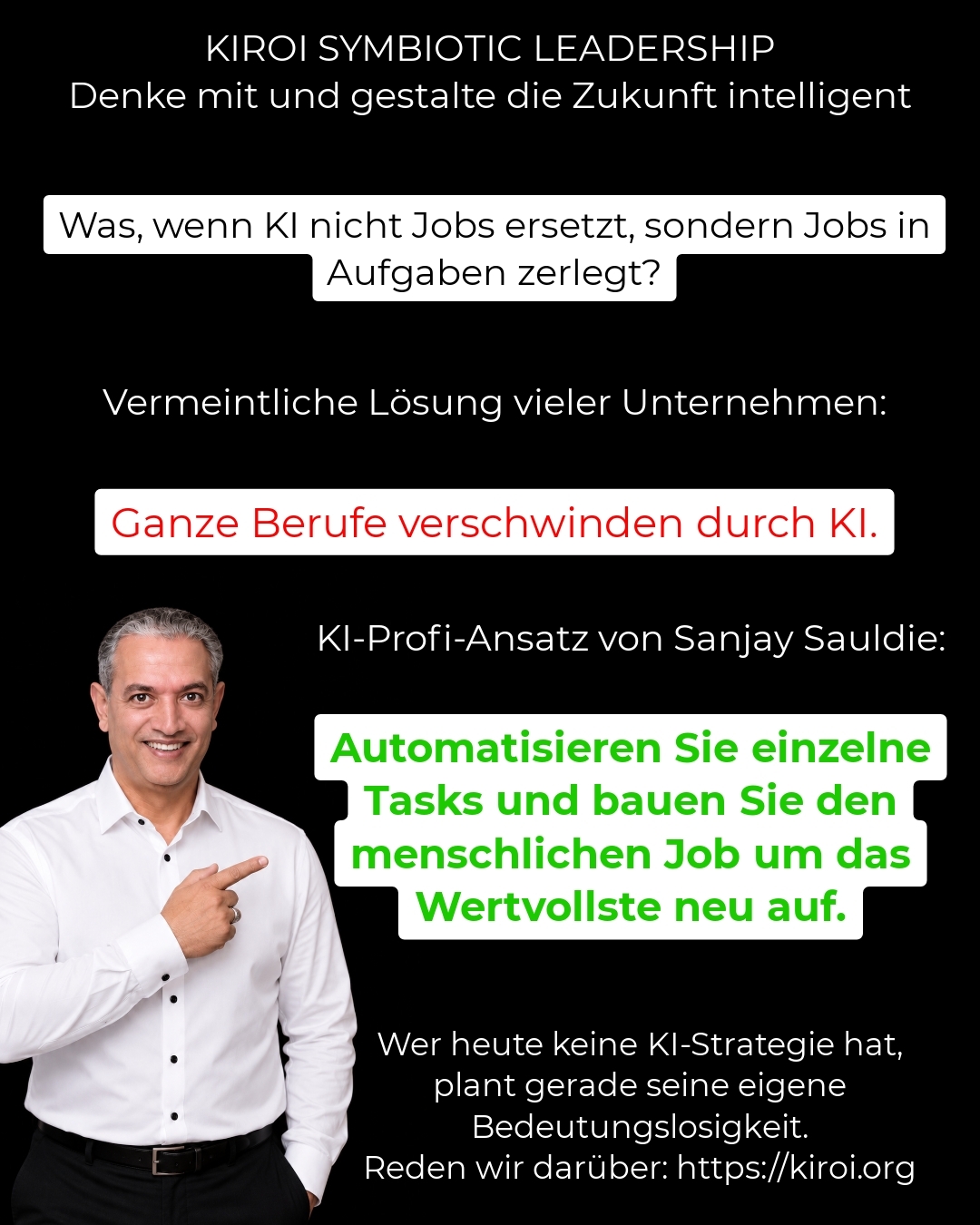
The AIROI-approach fundamentally differs from conventional automation strategies. Instead of eliminating entire professions, this method analyzes every job in detail based on its individual tasks. In doing so, activities are divided into different categories: repetitive routine tasks, creative problem solving, and interpersonal interactions.
The AIROI-Master plan strategy It recommends automating only those tasks that require little human judgment. At the same time, human employees are empowered to focus on value-adding activities. This realignment creates positions that are both technologically supported and deeply human-driven.
For example, an accountant today spends a significant portion of their working time capturing and verifying documents. This routine can be effectively automated. The time gained can be used by the accountant to provide strategic financial advice and handle complex tax issues. Similarly, personnel representatives can delegate administrative tasks to systems and focus more on employee development.
Best practice with a AIROI customer
A medium-sized company in the technical services sector faced the challenge of making its customer support more efficient without losing the personal touch that its long-standing customers so greatly appreciated. The management initially considered replacing a significant portion of the service team with automated systems in order to reduce costs and enable faster response times. As part of a transruptive coaching process, we jointly analyzed the daily tasks of the service team and identified interesting patterns in their workflows. It turned out that approximately forty percent of the working time was devoted to standardized requests that were actually automatable, while sixty percent involved complex consultations and individual problem solutions that required human expertise. Instead of eliminating positions, we implemented a hybrid model in which intelligent systems took over the initial collection and categorization of inquiries and immediately provided the relevant information to employees so that they could provide qualified advice. The service staff received training in in-depth consulting skills and additionally took on proactive customer care tasks that had previously been neglected due to a lack of time. The result exceeded all expectations: Customer satisfaction increased significantly, employees reported greater fulfillment in their work, and the company was even able to create two additional positions for high-quality consulting services.
The breakdown of jobs into individual task packages
The first step of the AIROI-method consists of a thorough analysis of existing activity profiles. Each position is then broken down into its individual components and systematically categorized. This approach often reveals surprising insights into the actual value creation of various activities.
For example, a sales representative in the field spends time on offering creation, customer visits, and reporting. The offering creation can be significantly accelerated by intelligent configurators. The reporting can be simplified by automatic data capture. The time gained can be used to focus on more intensive customer relationships and more complex sales conversations.
In healthcare, a similar pattern is evident among medical assistants. Administrative tasks such as scheduling appointments and documentation take up significant capacity. These routines are ideal for technological support. This allows the professionals to devote more time to patient care and medical assistance.
Re-focusing human strengths at the center
The AIROI-Master plan strategy Emphasizes explicitly the irreplaceable qualities of human work. Empathy, creativity, ethical judgment, and complex problem solving remain domains of the human being. These abilities even gain in importance as routine tasks are automated.
In the hospitality industry, for example, ordering systems and kitchen management can be optimized digitally. However, the sommelier, who tells an emotional story about the wine, remains irreplaceable. In the hotel industry, check-in terminals automate standard processes efficiently. The concierge, who offers individual recommendations, creates unique guest experiences, however.
We also see this dynamic clearly evident in the educational sector. Learning platforms can convey knowledge and correct practice exercises. However, the inspiring teacher who inspires enthusiasm and supports individuals individually cannot be replaced. Mentoring and personal development support are gaining even more importance in an automated world.
Practical implementation in organizations
Implementing the AIROI-method requires a systematic approach and the involvement of all stakeholders. Leaders must first develop a deep understanding of the actual workflows of their teams. Employees should be actively involved in the transformation process, as they are best equipped to carry out their tasks.
For example, an industrial company could start by analyzing the tasks of its quality control personnel. Visual inspection tasks can be partially supported by image recognition systems. However, assessing complex deviations and communicating with production still require human expertise. The inspectors become quality managers who use technology as a tool.
In the legal sector, there is a similar potential for this differentiated approach. Legal administrative staff spend a lot of time on document research and standard correspondence. Intelligent systems can speed up and simplify these tasks. The gained capacity enables more intensive client support and more complex case processing.
Best practice with a AIROI customer
A traditional family business in the manufacturing sector turned to our transruptive coaching team because it wanted to modernize its commercial management without losing long-standing employees whose expertise was invaluable to the company’s success. The challenge was to realize efficiency gains while preserving the corporate culture that was based on appreciation and long-term employment relationships. In a multi-month coaching process, we analyzed the daily tasks of the employees involved and identified significant time-wasters in the form of routine activities such as data entry, invoice checking, and inventory reconciliation that no one would miss if they were automated. The employees themselves brought valuable ideas to the table on how their jobs could be expanded to include new, more demanding tasks, including intensified supplier negotiations, process optimization, and internal consulting for other departments. After implementing intelligent systems for routine tasks, the employees reported significantly higher job satisfaction because they finally had time for the truly interesting aspects of their work. The management was delighted that productivity increased without the need to issue a single layoff, and the company positioned itself as an attractive employer in a region with a shortage of skilled workers.
Long-term benefits for companies and employees
The consistent application of AIROI-Master plan strategy it brings sustainable benefits for all involved parties. Companies benefit from more motivated employees who can focus on value-adding activities. Employees experience their work as more meaningful and develop new skills. Customers receive better service through employees who have time for their concerns.
In the trade, for example, master companies can digitize administrative tasks such as quoting and accounting. The tradespeople themselves focus on their core business and customer advice. This specialization leads to higher quality and better customer retention. At the same time, the profession becomes more attractive for young people because modern technology is part of everyday life.
Interesting application possibilities for this approach are also evident in agriculture. Precision agriculture increasingly automates monitoring and documentation tasks. Farmers can use their time more effectively for strategic decisions and sustainable management of operations. Traditional knowledge about soil and plants is combined with data-based insights to form a powerful synergy.
Support in the transformation through transruptive coaching
Successful implementation of this approach requires professional guidance and a structured process. Many executives come to us with the question of how to find the balance between automation and human work. Others seek support in communicating changes to their teams.
Clients often report uncertainty regarding the right technology selection and its integration into existing structures. They seek guidance on redesigning job profiles and developing their employees. transruptions coaching supports these complex projects related to the transformation of workplaces and processes.
Experience shows that companies that actively involve their employees in the change process achieve significantly better results. Resistance is reduced when people understand that their jobs are not disappearing but are evolving. This insight creates a positive dynamic that accelerates the entire transformation process.
My AIROI Analysis
The discussion about intelligent technologies and their impact on the workplace is characterized by extreme positions that do not reflect the complex reality and instead confuse companies and employees alike, rather than offering constructive ways forward. The AIROI-methodology offers a balanced approach that does not fall into technophobic rejection or blind automation euphoria, but intelligently combines the strengths of human and machine and thereby creates added value for all involved.
In my long-standing consulting practice, I have repeatedly observed that the most successful transformation projects are those that put people at the center and understand technology as a tool for unleashing human potential, not as a substitute for human skills and experiences. Companies that take this path report higher employee satisfaction, better service quality, and ultimately superior economic results because motivated and competent employees are the most important competitive advantage in an increasingly automated economy.
The future of work is not determined by the question of which jobs will disappear, but by how wisely we structure the division of tasks between humans and machines. Every company has the opportunity to actively shape this transformation, rather than react passively to changes imposed from the outside. The AIROI-Masterplan Strategy provides a proven framework for this, one that can be flexibly adapted to different industries and company sizes while always aiming to enhance human work and not replace it.
Further links from the text above:
[1] McKinsey – Future of Work Research
[2] World Economic Forum – The Future of Jobs Report
[3] Harvard Business Review – Artificial Intelligence Articles
[4] AIROI Master plan – Strategic AI integration
Are you a leader and would you like to learn how you can genuinely introduce AI into your company in a valuable and sustainable way, away from the hype? Take part Contact us or read more blog posts on the topic Artificial intelligence here.







 Deutsch
 English (UK)