
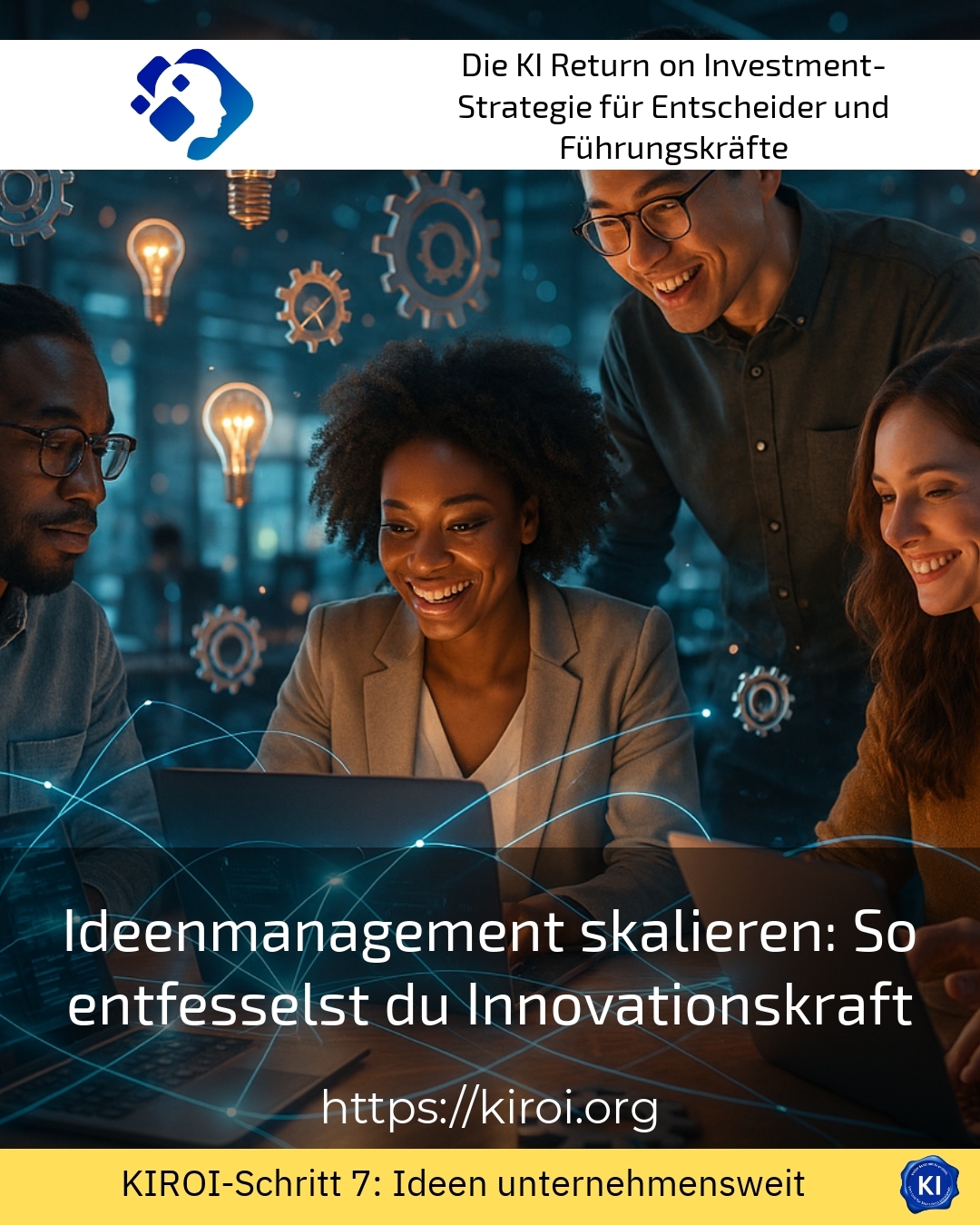
Imagine your company has thousands of brilliant minds, yet only a fraction of their ideas ever see the light of day. This waste of creative potential costs organisations not only competitive advantage, but also the motivation of their most valuable resource: their people. Scaling ideas management therefore means far more than just optimising processes – it means establishing a systematic culture of innovation that empowers every single employee to actively shape the future of the company. In this article, you will discover how to unleash this transformative power.
Why traditional approaches reach their limits
The classical methods for gathering ideas come from another era. Suggestion boxes in the canteen or annual innovation competitions are long past sufficient. These tools were designed for manageable teams. They function reasonably well with a few dozen employees. With hundreds or thousands of submissions, however, they fail miserably. Processing times practically explode. Feedback is non-existent or arrives far too late. And the frustration of the ideators grows with every ignored submission.
We experience this issue particularly clearly in the manufacturing sector. A production line often comprises hundreds of workstations. Every machine operator observes small inefficiencies daily. These observations are frequently lost within hierarchical structures. The situation is similar in the logistics industry. Warehouse workers develop intuitive suggestions for improvement. However, these rarely reach decision-makers. In the healthcare sector too, many innovations fail because of the system. Nursing staff identify potential for optimisation at the patient's bedside. However, administrative structures regularly stifle these valuable impulses.
Scaling the cornerstones of idea management
To systematically unleash innovative power, organisations require a well-conceived foundation. This foundation rests on several supporting pillars. First, a low-threshold submission facility is needed for all participants. Furthermore, a transparent evaluation process is essential. In addition, rapid feedback loops must be established. Finally, an appreciative culture of recognition is part of it.
The value of these core pillars is demonstrated particularly clearly in retail. Sales staff recognise customer needs directly at the point of sale. These insights can significantly influence assortment decisions. The gastronomy industry also benefits from this approach. Service staff take in first-hand guest feedback. Their suggestions for improvement often affect critical aspects of the customer experience. The principle works with similar success in the banking sector. Customer advisors understand the daily challenges of their clientele. Their ideas can decisively improve digital service offerings.
Use digital tools as a catalyst
Modern technologies enable completely new dimensions of idea generation and evaluation. Artificial intelligence can assist in automatically clustering similar proposals. Machine learning algorithms identify promising ideas based on defined criteria. Chatbots accompany employees as they submit and refine their concepts. These technological helpers by no means replace the human factor. Rather, they enhance it in an impressive way.
The automotive industry is already using such systems successfully. Thousands of engineers can submit their ideas on the move. Algorithms prioritise the proposals according to strategic relevance. In the pharmaceutical sector, digital platforms support research departments. Laboratory technicians document experimental observations in real time. This data feeds directly into innovation processes. The telecommunications sector also makes intensive use of such solutions. Field technicians report network problems and proposed solutions immediately.
Best practice with a AIROI customer
A medium-sized engineering company with over two thousand employees across six sites faced a monumental challenge, as the previous method of collecting ideas via email and physical forms created an administrative nightmare. Transruptions coaching accompanied the organisation over an eight-month period in completely redesigning its innovation processes. First, we jointly analysed the existing structures and identified significant bottlenecks in communication between production and the development department. Subsequently, we developed a bespoke digital platform that employees can use across various devices. The integration of voice messages was particularly important because many production staff prefer to formulate their ideas verbally. Implementation took place gradually in selected pilot areas. Within the first six months, the company recorded an increase in submitted ideas of over three hundred percent. At the same time, the average processing time fell from eight weeks to under ten days. Clients frequently report a noticeably increased engagement among their workforce following such transformations.
Scaling cultural transformation as a key to idea management
Technology alone is never enough. The true challenge lies in cultural transformation. Employees must feel safe to voice even unconventional ideas. Leaders must learn to value suggestions rather than deflect them. The entire company needs a culture of error that encourages experimentation.
The creative industries are already actively modelling this culture. Advertising agencies encourage their teams to engage in wild brainstorms. Architectural practices foster constructive discourse on designs. Software companies run hackathons as an established format for innovation. A similar shift in mindset is beginning in the education sector. Teachers are developing innovative teaching concepts in collaboration with colleagues. School administrations are opening up to pedagogical experiments. The tourism industry is undergoing comparable developments. Tour operators are incorporating customer ideas into product development. Hotels are testing new service offerings based on staff suggestions.
Redefining the role of leaders
Leaders are becoming enablers rather than decision-makers. This shift in role requires a fundamental rethink. Managers must learn to relinquish control. They should create frameworks rather than dictate results. Their new task consists in empowering teams.
We are observing this shift clearly in the energy sector. Plant managers are involving technicians in optimisation decisions. Leadership culture is undergoing a similarly fundamental change in the insurance industry. Team leaders are encouraging independent process improvements by their case handlers. The media sector is experimenting with flat hierarchies. Editorial offices are increasingly working in self-organised teams. These cultural changes take time and continuous guidance. Transruption coaching provides valuable impetus for executives here.
Measurable success through systematic evaluation
What is not measured cannot be improved. That is why scaled innovation processes require clear metrics. The number of submitted ideas forms only a starting point. More important are implementation rates and realised savings. Qualitative factors such as employee satisfaction also deserve attention.
The consumer goods industry has developed pioneering measurement systems here. Companies track the path of every idea from submission to market launch. In the transport sector, similar systems enable the optimisation of supply chains. Freight forwarders measure the impact of implemented suggestions for improvement on delivery times. The chemical industry quantifies safety improvements resulting from employee ideas with particular meticulousness. Every prevented accident confirms the value of the system.
Best practice with a AIROI customer
An international retail group with branches in over twenty countries was looking for ways to make better use of the local knowledge of its employees, as cultural differences were making knowledge sharing significantly more difficult. transruptions coaching accompanied the project team in developing a multilingual innovation platform. We worked intensively with regional managers to take cultural specificities into account. In some countries, employees prefer anonymous submissions, while other cultures expect public recognition. The platform was designed to be flexibly adaptable and allows individual settings depending on the location. The integration of gamification elements proved to be particularly successful, playfully encouraging competition between teams. Following the launch, participation in previously reserved regions rose by over two hundred percent. The best ideas are now presented in a global showcase. This success demonstrates how cultural sensitivity can support the scaling of idea management.
Overcoming resistance and winning over sceptics
Every change generates resistance. Ignoring this resistance would be a serious mistake. Instead, organisations should actively reach out to sceptics. Their concerns often contain valuable indicators of weaknesses. Integrating them into the process can turn them into advocates.
In the public sector, innovation initiatives are often met with strong scepticism. Administrative staff fear additional workload from new systems. This requires a particularly high level of patience and persuasion. The healthcare sector struggles with similar challenges. Doctors and nursing staff are under enormous time pressure. Their willingness to participate in innovation processes must be carefully fostered. Similar reservations towards digital tools exist in the trades. Traditional businesses require tailored solutions with low entry barriers.
Long-term strategies for sustainable success
Short-term projects frequently fizzle out ineffectively. A sustainable innovation culture requires long-term commitment. Organisations must create structures that endure beyond individual initiatives. Dedicated resources for innovation management are indispensable. Regular reviews and adjustments are a must.
The aviation industry demonstrates in an exemplary way how long-term innovation strategies work. Airlines continuously improve their processes on the basis of crew feedback. In mining, similarly established systems for safety optimisation exist. Miners report potential hazards via digital channels. The food industry integrates quality improvement suggestions into its production workflows. Every optimisation goes through standardised testing phases before widespread introduction.
My AIROI Analysis
The systematic unleashing of innovative power represents one of the most important strategic tasks of our time for organisations of every size. When Scaling ideas management it time and again becomes apparent that technological solutions alone are never sufficient to bring about sustainable change. The human factor remains the decisive driver of success, which is why cultural transformation must always accompany technical implementation [1].
From my consulting practice, I know that many organisations underestimate the effort required for cultural changes. They invest in platforms and software, yet neglect the training and support of their management teams. Transruption coaching steps in precisely at this point and accompanies companies holistically through the transformation process. We provide impetus for the development of a vibrant culture of innovation and help to overcome resistance [2].
Of particular importance to me is the realisation that scaling is not a one-off project. Rather, it is a continuous development process that requires constant attention and adaptation. Organisations that understand this and act accordingly will be more successful in the long term in the competitive environment. The examples from various industries impressively demonstrate the potential that lies in the systematic use of collective intelligence [3]. Those who unlock this potential will secure decisive advantages for the future.
Further links from the text above:
[1] Harvard Business Review – Insights on Innovation Management
[2] McKinsey – The Eight Essentials of Innovation
[3] Forbes – Innovation and Technology News
For more information and if you have any questions, please contact Contact us or read more blog posts on the topic Artificial intelligence here.









 Deutsch
  English (UK)