
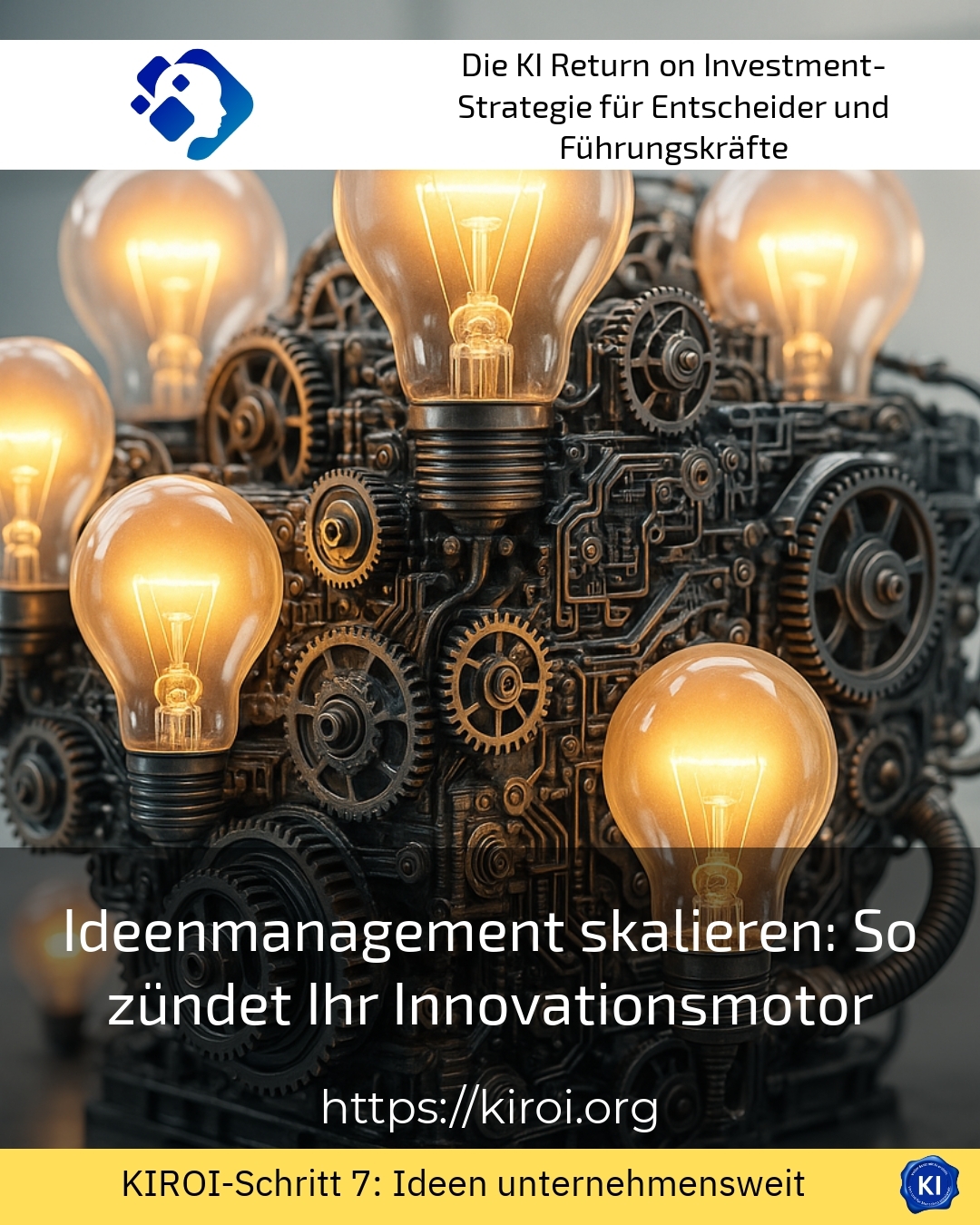
Imagine your company possesses a vast treasure trove of creative thoughts, yet no one is unearthing it. This is precisely where the topic of Scaling idea management: How to ignite your innovation engine and unfolds its transformative power. Many organisations struggle daily with the challenge of systematically harnessing the creativity of their workforce. The good news is: there are proven ways to get this dormant innovation engine running. In this article, you will learn how to take a structured approach and which impulses can help you along the way.
The foundations for a high-performance innovation engine
Before a company can scale its ideas management, it first requires a solid foundation. This foundation consists of several supporting pillars that must interlock. First, you need a clear vision of where the journey should lead. In addition, you require dedicated leaders who actively drive the change forward. Finally, an open corporate culture that views mistakes as learning opportunities is indispensable.
In practice, it frequently becomes apparent that companies fail precisely because of these fundamental prerequisites. For example, a medium-sized mechanical engineering firm introduced a digital ideas portal. However, the response was lacking because the employees were afraid of negative consequences. It was only when the management board itself submitted its first ideas that the situation changed. Another example comes from the logistics sector, where a company initially started small pilot projects. These projects generated visible successes and also won over sceptical departments. A third example concerns an energy supplier that communicated its innovation goals transparently. As a result, the employees understood for the first time why their ideas are valuable.
Best practice with a AIROI customer
An internationally active trading company approached transruptions-Coaching with a specific concern. The management level reported a flood of submitted proposals, which were, however, barely processed. The employees did not feel heard and increasingly withdrew. As part of the accompaniment, we first analysed the existing processes and identified several bottlenecks. It turned out that the evaluation criteria were vaguely formulated and too many committees were involved. Together, we developed a leaner procedure with clear responsibilities and timeframes. In addition, we established a feedback system that informed submitters about the status of their ideas. Within six months, the implementation rate increased by more than threefold. The employees frequently reported a strengthened sense of appreciation and belonging. This example illustrates how important transparent structures are for a functioning innovation engine.
Scaling ideation management: Choosing the right tools
The selection of suitable instruments is a decisive factor in the success of your scaling efforts. This is not primarily about technical solutions, but rather about the appropriate combination of different approaches. Digital platforms can simplify and accelerate the submission process [1]. At the same time, personal formats such as innovation workshops remain indispensable for more complex issues. The art lies in meaningfully combining both worlds.
For example, a financial services provider relied on a combination of app-based submission and monthly face-to-face meetings. As a result, the company reached both digitally savvy younger employees and experienced specialists. A pharmaceutical company, in turn, used gamification elements to increase participation. Points, awards and small prizes motivated the workforce to take an active part. A third example is provided by an automotive supplier that formed cross-departmental innovation teams. These teams met regularly and developed ideas together before submitting them.
Technological support for the innovation engine
Modern technologies can significantly support the scaling of innovation processes. Artificial intelligence, for example, helps to identify and merge similar ideas [2]. As a result, companies avoid duplication of effort and pool their resources more effectively. Cloud-based systems also enable cross-location collaboration in real time. Nevertheless, you should always view technology as a means to an end.
A telecommunications provider implemented AI-supported analysis of its ideas database. The system identified patterns and trends that would have escaped human reviewers. An insurance company, on the other hand, used virtual reality for innovation workshops. Participants were able to experience and evaluate new service concepts in simulated environments. A food manufacturer relied on automated workflows that forwarded ideas immediately to the relevant departments.
Putting people first: Culture as a success factor when scaling
All tools and processes remain ineffective if the corporate culture is not right. People must feel safe to express creative thoughts and make unusual suggestions. This psychological safety does not happen overnight, but requires continuous work. Managers play a central role in this as role models and enablers. They must listen actively, give constructive feedback and visibly celebrate successes.
For example, a technology corporation introduced so-called failure conferences. There, managers reported openly on failed projects and their insights from them. A retailer established a mentoring programme that connected experienced innovators with newcomers. A construction company set up physical innovation spaces that invited creative experimentation. These examples illustrate how diverse cultural measures can be designed.
Best practice with a AIROI customer
A traditional industrial company sought support in transforming its innovation culture. The workforce was characterised by hierarchical thinking and a zero-error mentality. As part of the support provided by transruptions coaching, we developed a multi-stage culture programme. Initially, we ran leadership workshops to instil the mindset for open innovation. Subsequently, we established formats for cross-departmental exchange and joint experimentation. The introduction of a monthly innovation breakfast with the executive board proved particularly effective. There, employees presented their ideas directly and received immediate feedback. The atmosphere gradually changed from reserve to active engagement and enthusiasm. Clients frequently report similar experiences when they drive cultural change consistently. The key lies in perseverance and the willingness to accept setbacks as part of the journey.
Scaling idea management through decentralised structures
Centralised innovation departments quickly reach their limits in growing organisations. A promising alternative consists in the decentralisation of innovation responsibility. In this approach, innovation ambassadors are established across various corporate divisions, acting as multipliers. These ambassadors gather ideas, provide initial assessments and foster local exchange. At the same time, they remain connected with a central coordination office.
For example, a chemical company appointed an innovation officer in each plant with a fixed time budget. These officers met quarterly to share experiences and for strategic alignment. A healthcare provider formed interdisciplinary innovation circles that autonomously drove projects forward. A media company established a network of voluntary innovation scouts across all editorial departments.
Creating measurability: monitoring the innovation engine
What is not measured cannot be systematically improved. Therefore, you need suitable key performance indicators to evaluate the progress of your scaling efforts. Quantitative metrics, such as the number of submitted ideas, provide a preliminary indication. However, qualitative indicators, such as the implementation rate or the economic benefit of realised proposals, are more important [3]. Balancing both perspectives requires careful consideration.
For example, a consumer goods manufacturer developed its own innovation index from several weighted factors. This index was regularly discussed by the management team and guided resource allocation. A mobility provider conducted staff surveys on the innovation climate and linked the results with leadership targets. A software company tracked the time from idea submission to market launch and continuously optimised the process.
My AIROI Analysis
The systematic consideration of the topic reveals several key insights for businesses of any size. First, it becomes apparent that the successful scaling of innovation processes is not a one-off initiative. Rather, it is a continuous development that requires patience and perseverance. The technological component plays a supporting, but by no means dominant, role in this. Instead, the decisive factor is the willingness to initiate and sustain cultural changes.
From a AIROI perspective, I recommend a step-by-step approach with clear milestones. Start by taking an honest stock of your current situation and capabilities. Then identify pilot areas where you can trial new approaches. Learn from these experiences and adapt your approach accordingly. Only then should you roll out successful practices to other areas of the organisation.
Guidance through transruptions coaching can provide valuable impetus and offer orientation. External perspectives often help to identify blind spots and break up entrenched thought patterns. At the same time, the responsibility for change always lies with the organisation itself. Sustainable change only arises when it is driven and lived from within.
Further links from the text above:
[1] Harvard Business Review – Innovation Insights
[2] McKinsey – Innovation Strategy
[3] Forbes – Innovation News and Analysis
For more information and if you have any questions, please contact Contact us or read more blog posts on the topic Artificial intelligence here.










 Deutsch
  English (UK)