
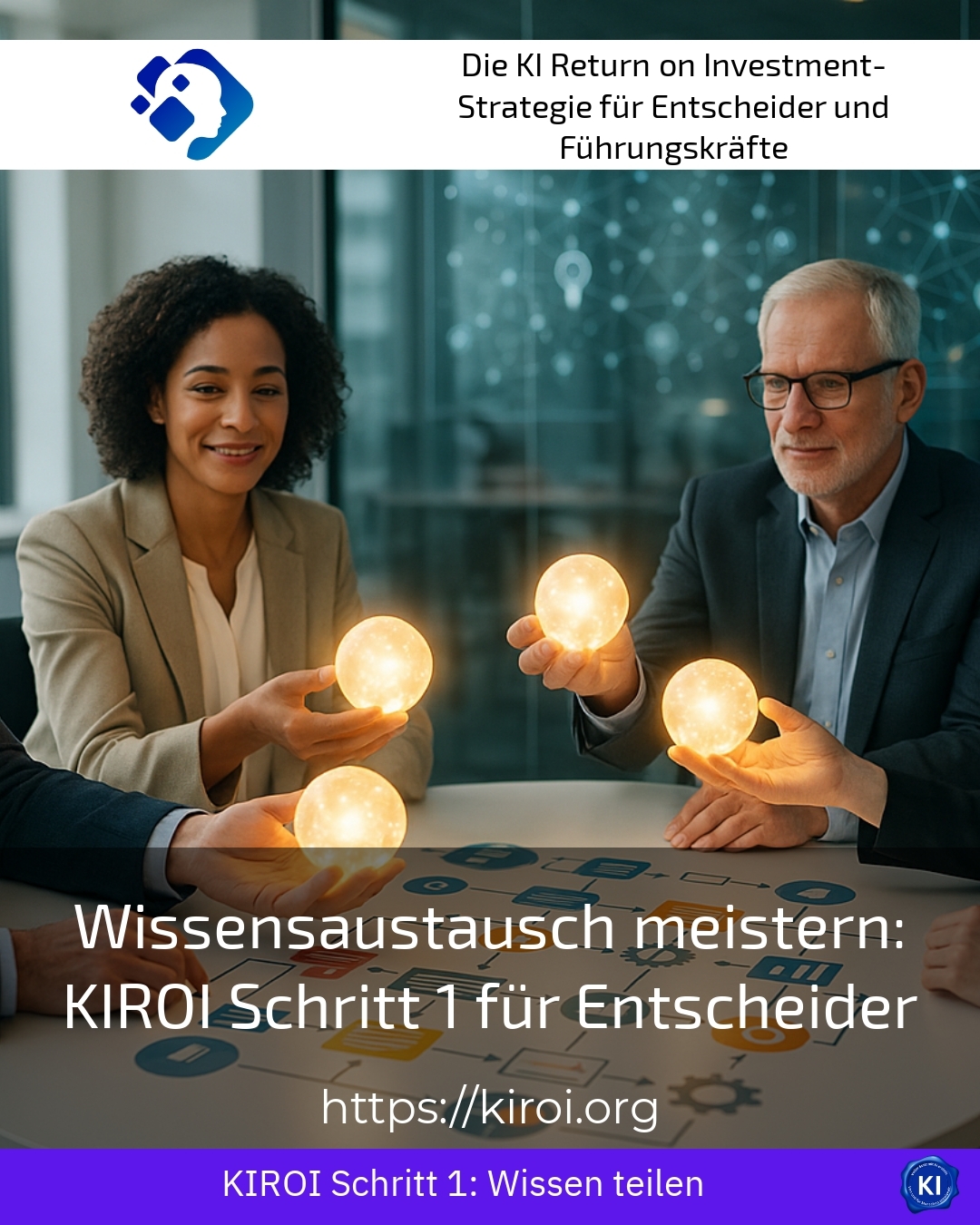
Knowledge exchange as the key to sustainable corporate development
Knowledge sharing plays a central role in the modern working world and is an important success factor for leaders looking to make their organisations fit for the future. This is not simply about passing on information, but about fostering a vibrant culture in which employees have learned to share their knowledge effectively and situationally. Many decision-makers face the challenge not only of introducing individual tools, but of creating structures that sustainably support and keep knowledge sharing flexible in everyday life.
Support in the development of tailor-made knowledge exchange methods
In practice, knowledge exchange needs to be organised on an individual basis. The variety of available formats ranges from classic mentoring programmes and webinars to hybrid learning settings that intelligently combine digital and face-to-face phases. Decision-makers often report that a purely technical implementation is not sufficient. Instead, modern support approaches help to develop specific, context-dependent solutions. The focus here is on fostering an open learning culture that motivates employees and enables them to strengthen each other.
AIROI BEST PRACTICE at company XYZ (name changed due to NDA contract) Through coaching, a structured framework was created within a technical company, enabling the systematic sharing of expertise. Informal meetings were established as knowledge-sharing formats, as were digital platforms that allowed employees to communicate seamlessly across different locations. This combination not only improved networking but also led to noticeably better support for complex projects.
Understanding knowledge exchange as a cultural and communicative process
Knowledge sharing is often mistakenly viewed as a purely technical subject. However, the core lies in the culture of cooperation and communication. Leaders who want to support their team in knowledge sharing benefit from not relying on ready-made solutions, but rather from designing the process as one of growth and learning. In doing so, they provide impulses to question established patterns of thought and action. Especially in dynamic industries, such as manufacturing, it is crucial that employees have easy access to relevant experts and can apply this knowledge flexibly.
AIROI BEST PRACTICE at company XYZ (name changed due to NDA contract) In a production environment, internal information flows were redesigned so that employees could access expert knowledge at any time. Regular, hybrid workshops promoted exchange, leading to improved problem-solving skills within the team. The combination of digital and analogue formats made it possible to share knowledge situationally and easily.
Shaping knowledge exchange across different industries
The approach of systematically supporting knowledge exchange is proving beneficial across all industries. In engineering, teams often seek ways to network better with each other and learn from one another. Service companies are implementing hybrid learning to combine in-person meetings with digital formats, thereby responding flexibly to customer needs. Companies in manufacturing are focusing on optimising information flows so that employees can quickly access the knowledge they need and apply it efficiently.
AIROI BEST PRACTICE at company XYZ (name changed due to NDA contract) In a service company, a concept for hybrid learning was developed through guided coaching, which regularly combines digital learning modules with in-person workshops. Employees were able to learn at their own pace and then exchange ideas within the team. This approach promoted acceptance and led to a lively knowledge transfer that became firmly established in everyday work.
My analysis
Knowledge sharing should not be seen as a technical project, but as part of a living corporate culture. Decision-makers benefit from support that fosters the learning process and provides impetus to develop individual, sustainable structures. Such support creates room for experimentation and the gradual adaptation of methods to the specific company reality. This transforms knowledge sharing into a valuable instrument that helps organisations act flexibly and successfully in a constantly changing environment.
Further links from the text above:
[1] AIROI Step 1: Knowledge sharing as a success factor for leaders
[3] Rethinking knowledge transfer: Step 1 to success with AIROI
[4] How to write SEO blog posts that rank and convert
For more information and if you have any questions, please contact Contact us on the topic or read more blog posts on the topic Artificial Intelligence Blog here.










 Deutsch
  English (UK)