
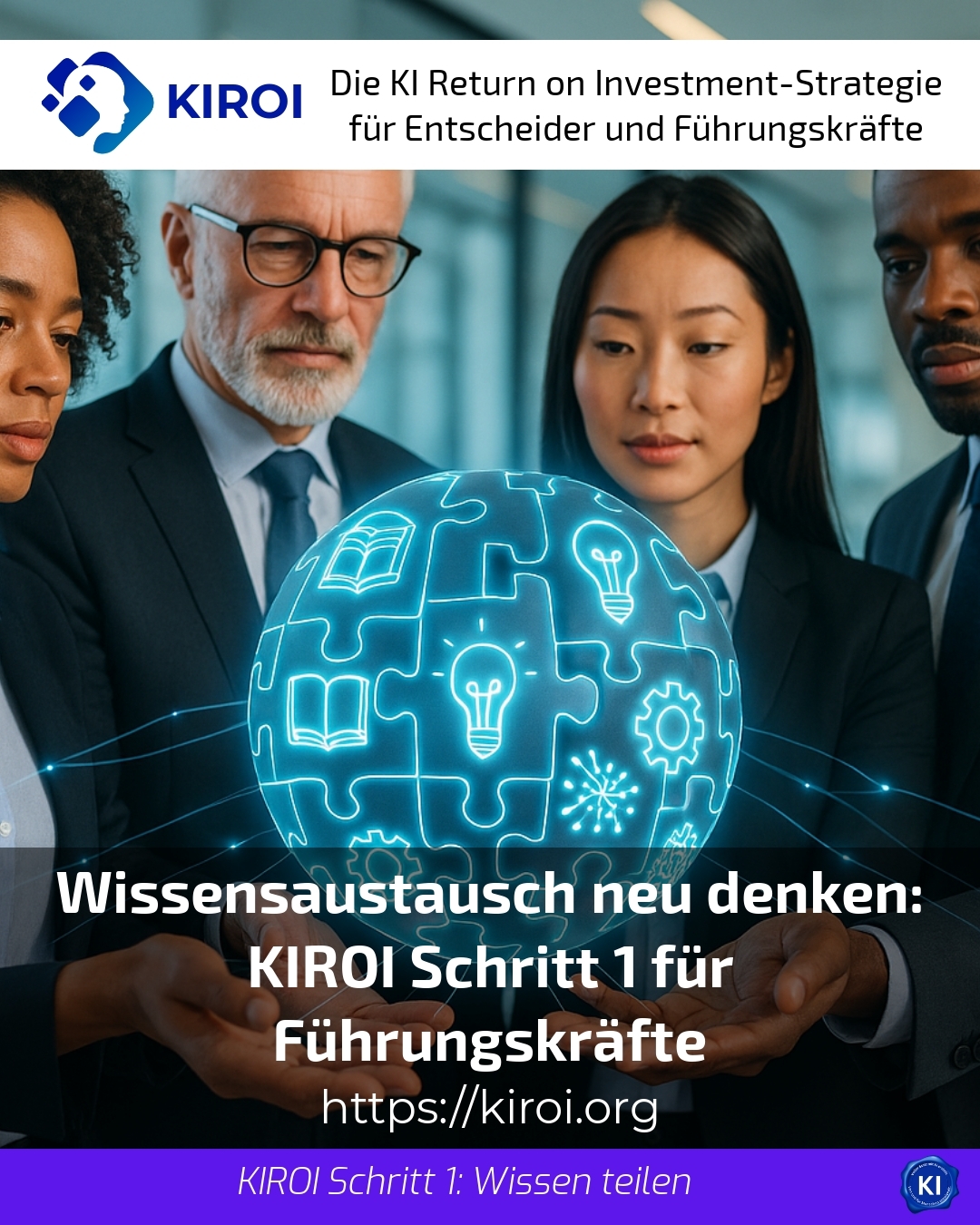
Rethinking knowledge sharing: Mentoring as the first step for leaders
Knowledge sharing today is more than just passing on information. In complex corporate environments, leaders require a modern approach that goes far beyond traditional methods. Many leaders approach me with questions: How can I truly make knowledge sharing within the team dynamic? How can I create structures that don't just work once, but have a lasting impact? This is precisely where the guidance within the KIROI Step 1 approach comes in.
Understanding knowledge exchange as a cultural and communicative process
Knowledge sharing doesn't just mean passing on data or facts. It's more about creating a culture where people are motivated to share knowledge purposefully and situationally. Leaders often report that it's not about quick solutions, but about supporting and guiding the development of suitable methods. In this way, leaders can not only provide technical tools but, above all, **provide impetus** to break down ingrained ways of thinking and try out new concepts.
In the field of technology, a frequently mentioned concern is that teams should network and learn from each other more effectively. In the service industry, leaders are looking for ways to meaningfully integrate hybrid learning, such as combining in-person meetings with digital workshops. In manufacturing companies, the challenge often lies in structuring information flows so that employees can easily access relevant expert knowledge and use it effectively in their daily work.
KIROI BEST PRACTICE at company XYZ (name changed due to NDA contract)
As part of a technical company, coaching created a framework in which employees could systematically exchange their expertise. A wide range of formats, from informal meetings to digital platforms, were introduced. Networking improved significantly, and at the same time, collegial support in complex projects was considerably strengthened. This increased flexibility in dealing with challenges, which is crucial in a dynamic industry.
Applying a variety of methods in a targeted way and adapting them to the organisation
The range of tools for knowledge exchange is vast. From storytelling and mentoring to online webinars or hybrid formats, leaders face the task of choosing precisely the tools that suit their team and the subject matter. The most significant potential arises when methods are not applied rigidly but are adapted to the specific situation and room is left for experimentation.
In the service sector, for instance, targeted mentoring programmes have been shown to foster knowledge transfer between experienced experts and junior staff. At the same time, production teams are increasingly using digital platforms to make knowledge accessible across different locations. Another approach from the technical field is the introduction of regular, short knowledge sprints where current challenges and solutions are shared.
KIROI BEST PRACTICE at company XYZ (name changed due to NDA contract)
In a service company, a hybrid learning structure was designed as part of the onboarding process. Face-to-face workshops were purposefully linked with webinars to ensure flexible and continuous employee engagement. Managers reported increased learning motivation and a more open approach to knowledge sharing, which strengthened team trust and innovative capacity.
Support as the key to sustainable change
The initial support focuses not on presenting ready-made solutions, but on empowering leaders and teams through input to shape their own sustainable knowledge-sharing culture. This approach creates space for experimentation and dialogue, which is indispensable in today's corporate world. Many leaders report how this support opens up new perspectives and improves internal processes.
In a production environment, support proves its worth by helping to react flexibly to market changes and new technologies – with targeted knowledge transfer processes introduced step by step. In the technical field, this strengthens the ability to learn quickly and nimbly. In the service sector too, support creates the conditions for knowledge exchange to flourish as a natural and valuable part of the daily work routine.
KIROI BEST PRACTICE at company XYZ (name changed due to NDA contract)
A production company used the coaching to analyse internal knowledge flows and develop new exchange formats. Through individual support, managers were able to gently guide their teams towards new communication channels. The result was a sustainable, self-organised learning culture that provided security and adaptability, especially in times of significant market changes.
My analysis
Rethinking knowledge exchange primarily means fostering a culture and communication that go beyond technical solutions. Support in the initial step is crucial to individually guide leaders and teams on the path to a vibrant learning culture. KIROI coaching supports people, provides impetus, and promotes the development of precisely tailored structures. This open and sustainable approach is precisely what is needed in dynamic industries like technology, manufacturing, and services in order to remain flexible and future-proof.
Further links from the text above:
KIROI Step 1: Knowledge sharing as a success factor for leaders [1]
Rethinking knowledge transfer: Step 1 to success with KIROI [3]
For more information and if you have any questions, please contact Contact us on or read further blog posts on the topic Artificial Intelligence Blog here.











 Deutsch
  English (UK)