
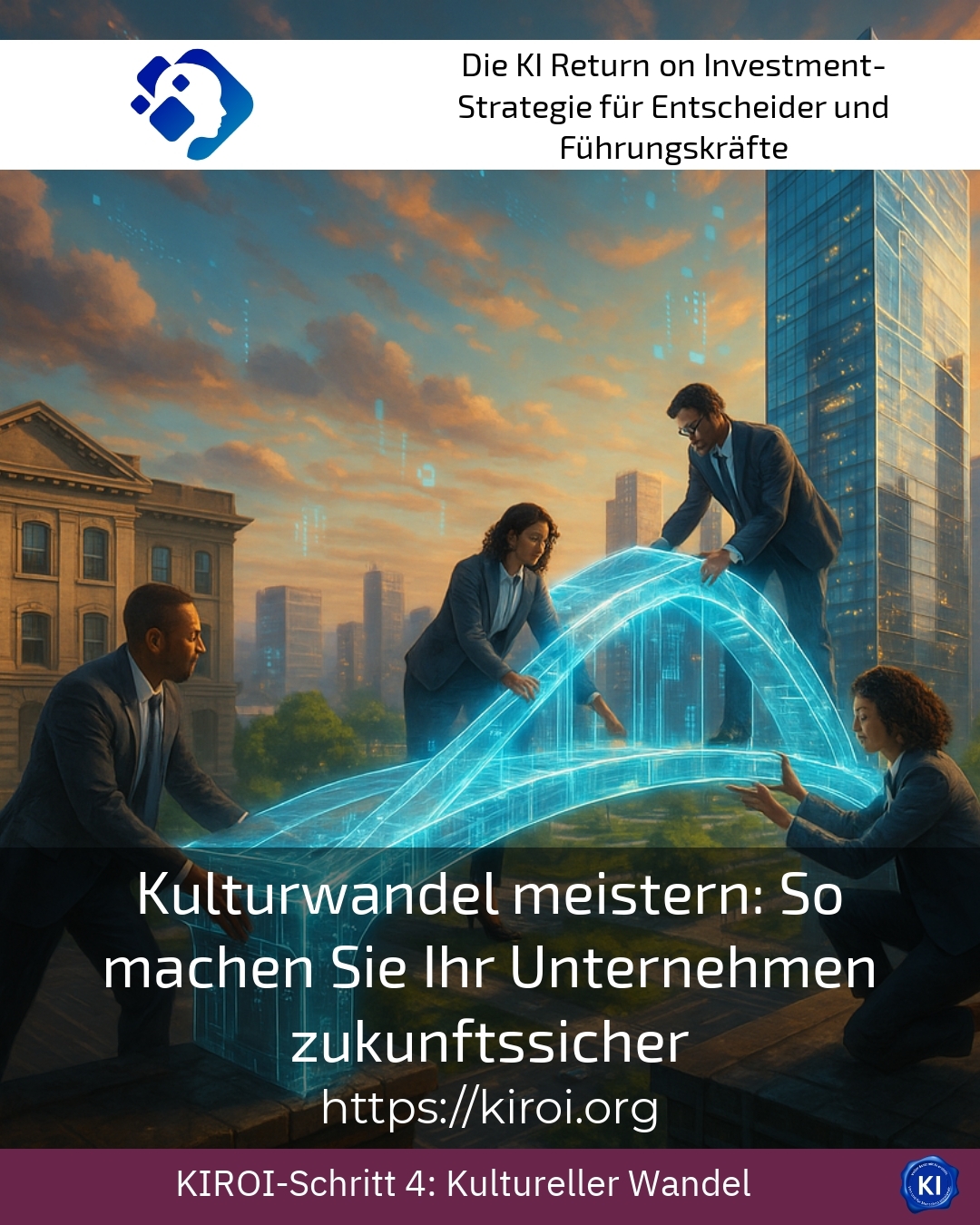
Imagine your company is facing an invisible wall, blocking all progress and rendering even the best strategies ineffective. This wall is not made of concrete, but of outdated mindsets, ingrained routines, and a corporate culture that no longer fits the dynamic business world. Mastering cultural change means much more today than just introducing new processes or implementing modern technologies. It's about fundamentally transforming the foundation of your organisation without losing its identity. Many leaders report similar challenges when they come to us for transruption coaching. They are looking for ways to take their teams along on the journey and anchor sustainable changes.
Recognising and overcoming invisible barriers
Before profound transformation can succeed, companies must first understand which invisible forces are hindering change. Often, it's not the obvious factors such as budget or time that slow down change. Rather, subtle dynamics play a crucial role that have solidified within the organisation over years. In the automotive industry, for example, traditional manufacturers struggle with a legacy of hierarchical structures and lengthy decision-making processes. A supplier from southern Germany realised that while its engineers were technically brilliant, they perceived any deviation from the established process as a threat. This realisation was the first step towards a comprehensive realignment.
A similar pattern is seen in mechanical engineering when companies try to introduce agile methods without questioning the underlying beliefs. A medium-sized plant manufacturer found that although their employees participated in training, they subsequently fell back into old patterns of behaviour. The solution lay not in further training, but in systematic work on shared values and convictions. We also regularly observe in the logistics industry how freight forwarders and fulfilment service providers fail due to invisible barriers. A large logistics company invested considerable sums in digital platforms, yet dispatchers continued to use their familiar Excel spreadsheets and telephone chains.
Best practice with a AIROI customer
A traditional family business in the metalworking industry turned to our transruptions coaching because several digitalisation projects had failed. The management had already invested in modern ERP systems and automated production facilities, but the expected efficiency gains had not materialised. In our joint analysis, we identified a deep gap between the management's vision and the daily realities on the shop floor. The foremen and shift supervisors felt left out and saw the new technologies as a threat to their expertise. We supported the company over several months with a structured dialogue process that involved all hierarchical levels. This not only resulted in concrete suggestions for improvement from the workforce, but also a new understanding of the common goals. The employees became active shapers of change instead of just passively enduring it. This transformation of the inner attitude ultimately led to the technical systems being able to realise their full potential.
Mastering cultural change through new leadership approaches
The role of leaders is fundamentally changing in times of transformation. Classic command-and-control structures are reaching their limits if organisations are to become flexible and adaptable. In the pharmaceutical industry, we often observe how research heads must balance scientific excellence with entrepreneurial thinking. A biotechnology company from the Rhine-Main region developed a leadership model together with us that connects both worlds. In doing so, leaders learned to relinquish control while simultaneously providing clear direction. In the financial sector, banks and insurance companies face the challenge of aligning regulatory requirements with innovative working methods.
A regional savings bank recognised that its leadership culture was unsuitable for digital transformation. Branch managers were accustomed to receiving and implementing instructions, but the new competitive situation demanded independent action and customer-oriented thinking. Through targeted support, they developed a new self-image as coaches of their teams. In the energy industry, on the other hand, managers must bridge the gap between operating existing infrastructure and building new business models. A municipal energy supplier used our transruption coaching approaches to prepare its leadership team for this dual challenge. The managers learned to tolerate ambiguity and navigate their teams through uncertain times [1].
Mastering the importance of psychological safety for cultural change
Without psychological safety, every attempt at change remains superficial and at risk. Employees need to feel that they can make mistakes and talk openly about difficulties. In healthcare, for example, the importance of this concept is particularly evident. A hospital chain implemented a new quality management system, but the nurses hardly reported any near misses or suggestions for improvement. The cause was a culture of blame that had grown over decades. It was only when management began to openly discuss their own mistakes that the staff's behaviour changed.
In the IT sector, we encounter similar patterns when software developers are reluctant to point out problems early on. A medium-sized software company regularly lost projects because delays were communicated too late. The developers feared negative consequences and tried to solve problems independently until they escalated. By establishing a learning culture for mistakes, the company was able to significantly improve its project performance. Psychological safety also plays an important role in skilled trades when companies want to grow and build professional structures [2]. An electrical installation company with over fifty employees struggled with high turnover among young skilled workers. The analysis showed that experienced journeymen withheld knowledge and publicly embarrassed newcomers for mistakes.
Communication as the key to sustainable transformation
The way companies communicate about change is crucial to their success. Many organisations underestimate the effort involved in communication and are then surprised by resistance and misunderstandings. In the media industry, we often see publishers and broadcasters confusing their workforces with contradictory messages. A regional media company announced a digital transformation while at the same time revealing cost-cutting measures in the newsroom. Employees interpreted this as hidden job cuts and blocked any proposals for change. Only a consistent and transparent communication strategy was able to restore trust.
In retail, businesses face the challenge of aligning their centrally organised branches towards a common path. A drugstore chain wanted to roll out its omnichannel concept, but branch managers received differing information from various head office departments. The confusion led to inconsistent customer experiences and frustrated employees. We supported the company in building a unified communication architecture that synchronised all channels. In the construction industry, conversely, fluctuating project teams and decentralised construction sites make it difficult to convey a shared vision. With our guidance, a construction group developed a cascade system that transported core messages from management down to the site foreman on the construction site [3].
Best practice with a AIROI customer
An international textile manufacturer with production sites in several countries was looking for support for its sustainability strategy. The management had formulated ambitious goals, but there was scepticism and a lack of understanding in the factories. The production managers mainly saw additional costs and restrictions, while the strategic importance for market positioning was not recognised. As part of our transruption coaching, we jointly developed a multi-stage communication campaign that took local characteristics into account. Ambassadors were identified for each location who communicated the vision in their local language and with culturally adapted examples. The integration of success stories from other industries that showed how sustainability can become a competitive advantage was particularly effective. Employees began to contribute their own ideas on how resources could be conserved and processes optimised. After a year, not only had communication improved, but measurable progress had also been made towards the sustainability goals. The company even won an industry award for its innovative employee participation in the green transformation.
Leveraging resistance to master cultural change
Resistance to change is not a disruption to be overcome, but a valuable source of information. People rarely resist change itself, but rather what they fear losing in the process. In the tourism industry, a tour operator experienced massive resistance from its experienced employees to the introduction of an AI-powered consulting platform. The travel consultants feared being replaced by algorithms and seeing their expertise devalued. Only when management sought dialogue and took their specific fears seriously did paths open up for constructive collaboration.
Similar dynamics can be observed in the hospitality industry when hotels and restaurants want to modernise their service concepts. One hotel group introduced digital check-in terminals, which met with fierce protest from receptionists. They felt their role as hosts was threatened and feared for their jobs. Through intensive discussions and the joint development of a new understanding of service, the employees became advocates for change. In the transport sector, on the other hand, we often encounter resistance when implementing telematics systems and GPS tracking. Professional drivers perceive the monitoring as distrust and react with passive resistance [4]. A logistics company found a creative solution by involving the drivers in the design of the systems.
Sustainable embedding of the new corporate culture
The greatest challenge in cultural transformations lies not in initiating change, but in its permanent embedding. Many companies experience a relapse into old patterns after initial euphoria as soon as external pressure subsides. In the chemical industry, we observed with a specialty chemical manufacturer how a promising innovation programme fizzled out after the change of board. The new leaders set different priorities, and the painstakingly built structures eroded within a few months. Companies must therefore develop mechanisms that stabilise change independently of individuals.
The food retail sector demonstrates the importance of integration into existing systems and processes. A supermarket chain had successfully established a customer-focused service culture, yet the remuneration system continued to reward primarily sales figures. This discrepancy led to frustration and a gradual relapse into old behaviours. Only the adaptation of incentive systems to the new values ensured long-term success. In the telecommunications industry, we often see how technical updates can jeopardise cultural achievements. A mobile network provider had introduced agile working methods, but the introduction of a new IT system forced Waterfall processes once again. The organisation had to learn to understand technical and cultural transformation as a connected task [5].
Mastering cultural change through continuous learning
Successful transformations are not one-off projects, but permanent learning processes that must be embedded in the DNA of the organisation. In the insurance industry, a health insurer recognised that while its claims handlers were technically excellently trained, they lacked regular experience in dealing with change. The company established regular reflection sessions and experimentation spaces where new approaches could be tested. This learning infrastructure proved to be a key success factor for subsequent digitalisation projects.
In mechanical engineering, a tool manufacturer used our transruption coaching methods to build a systematic feedback culture. The foremen learned to reflect with their teams after every project on what had gone well and what could be improved. This seemingly simple practice gradually changed the entire working atmosphere and made the company more adaptable. Examples of successful learning cultures can also be found in the aviation industry, which is traditionally heavily regulated and process-oriented. An aircraft maintenance company developed a system that systematically recorded and implemented suggestions for improvement from the workforce. Employees experienced that their ideas were valued and became increasingly actively involved.
My AIROI Analysis
Transforming corporate culture is one of the most challenging tasks facing leaders today. My experience from numerous engagements shows that success depends crucially on three factors: leadership's willingness to engage in genuine self-reflection, the consistent involvement of all hierarchical levels, and the stamina required for sustainable change. Many companies underestimate the time investment and expect quick results, which are simply not realistic for cultural changes. The AIROI methodology offers a structured framework that considers both hard factors such as processes and systems, and soft factors such as values and beliefs.
I particularly often observe that companies implement technical solutions too early, without having created the necessary cultural prerequisites. The best software and the most modern technology remain ineffective if people are not prepared to adopt and use them meaningfully. At the same time, it is evident that cultural work remains abstract and lacks binding power if it does not have concrete links to projects and processes. The art lies in the balance between these two dimensions, which can mutually reinforce each other. I therefore recommend that companies always link cultural transformation to concrete initiatives where new behaviours can be tested and anchored. Transruption coaching offers valuable impulses and support in successfully navigating this challenging path.
Further links from the text above:
[1] Harvard Business Review – Organizational Culture
[2] McKinsey – Insights on People and Organisational Performance
[3] Gallup – Workplace Insights
[4] MIT Sloan Management Review – Organizational Behaviour
[5] Boston Consulting Group – People Strategy
For more information and if you have any questions, please contact Contact us or read more blog posts on the topic Artificial intelligence here.







 Deutsch
  English (UK)