
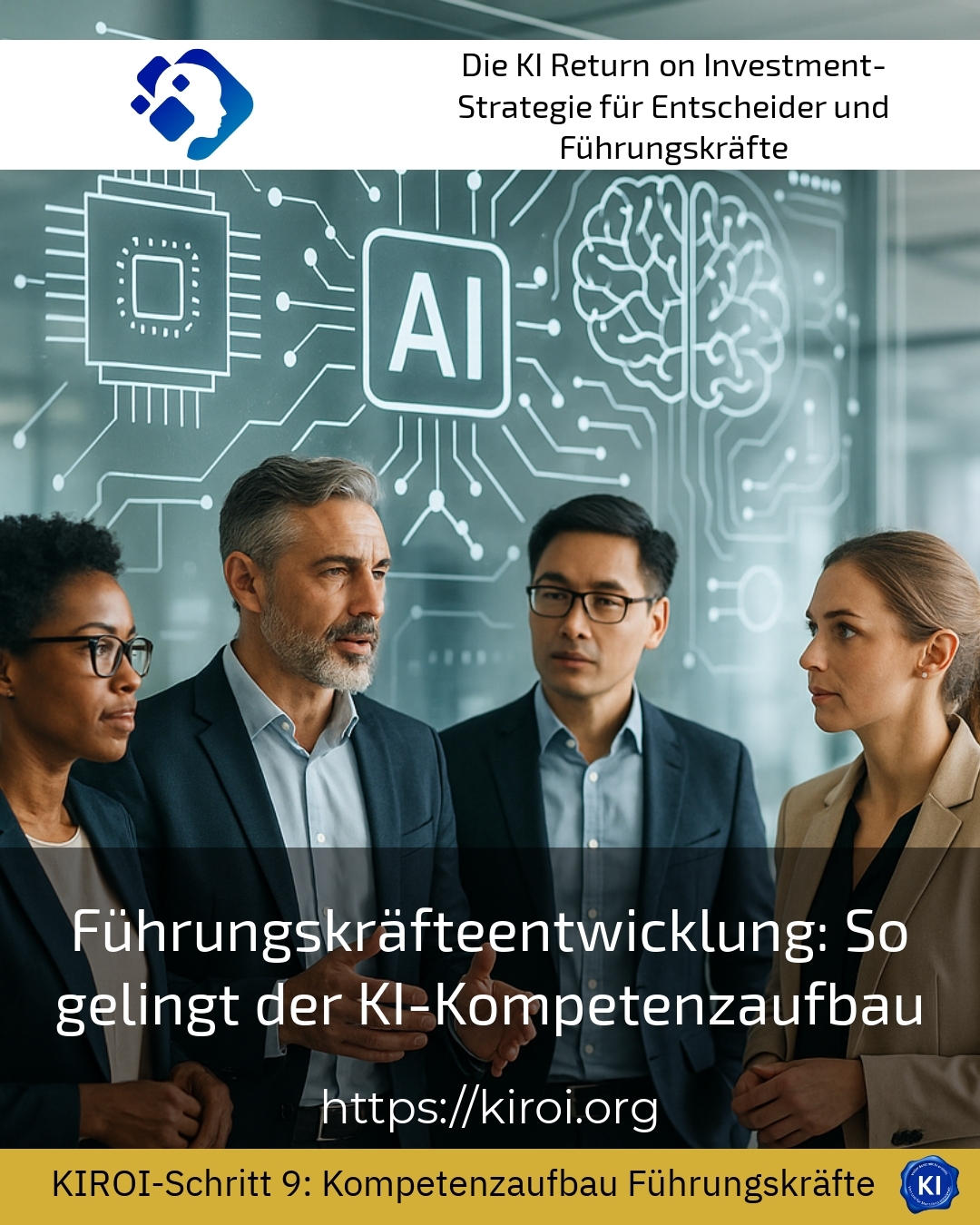
The digital transformation is rapidly changing the entire world of work, and one skill in particular is increasingly coming into focus for personnel development: the confident use of intelligent technologies. Those in positions of responsibility today face the exciting challenge not only of rethinking operational processes but also of fundamentally evolving their own understanding of leadership. Leadership Development: How to Succeed in Building AI Competence is no longer an optional additional qualification, but is increasingly becoming a core competence for successful managers and decision-makers. But how can this transformation be achieved in practice, and what concrete steps lead to sustainable success? In this article, you will learn why now is the right time to address this topic, and what proven approaches can help you.
Why building leadership competence is crucial now
The world of work is undergoing a fundamental upheaval. Intelligent systems are increasingly taking over repetitive tasks. At the same time, entirely new fields of activity and requirements are emerging. Managers must actively shape these changes. They can no longer rely on proven methods. Instead, they need new tools and approaches. The ability to guide teams through change processes is gaining enormous importance. Those who do not keep pace here risk falling behind [1].
In many companies, we observe an interesting discrepancy. On the one hand, organisations are investing significant sums in new technologies. On the other hand, they often neglect the accompanying training of their leadership teams. This gap leads to frustration and unexploited potential. Employees feel left alone with new tools. Managers are unable to provide competent guidance. Transruption coaching addresses exactly this point and supports organisations in the systematic development of their leadership culture.
One example vividly illustrates this challenge. A medium-sized manufacturing company implemented an intelligent planning system. The technology worked flawlessly. Nevertheless, the hoped-for efficiency gains did not materialise. The cause lay in the lack of understanding from management. The shift managers did not know how to interpret the system's recommendations. The situation only changed after a targeted training measure. Productivity increased significantly within a few months.
The Fundamentals of Leadership Development in the Digital Age
Successful qualification programmes are based on a few fundamental principles. First, there needs to be a clear understanding of the individual starting position. Not every manager starts at the same point. Some already have extensive technical knowledge. Others are approaching the topic for the first time. A differentiated approach systematically takes these differences into account [2].
The AIROI Masterplan model offers a structured framework here. It distinguishes between different competence levels and development paths. Leaders can determine their own position. They then receive tailored development offers. This individualised approach significantly increases motivation and willingness to learn. People learn best when the content is relevant to them.
Another important principle is the connection of theory and practice. Pure knowledge transfer is not enough. Managers must be able to apply what they have learned immediately. Therefore, successful programmes integrate practical exercises and projects. Participants work on real challenges from their daily work. This creates a direct benefit for the organisation.
Best practice with a AIROI customer
An international logistics company was faced with a complex challenge, as middle management showed considerable resistance to the introduction of intelligent scheduling systems. The concerns ranged from fears of job losses to fundamental scepticism towards technological change. As part of an accompanying programme lasting several months, we jointly developed a structured qualification approach. Firstly, we held detailed discussions with all the managers involved in order to identify their individual concerns and wishes. On this basis, we designed a modular learning programme that taught both technical basics and change management skills. The establishment of learning tandems, in which technology-savvy and less experienced managers worked together, proved particularly effective. After completing the programme, the participants reported a significant increase in self-confidence in dealing with the new systems. Acceptance of the technology increased measurably and the implementation was successfully completed. This example impressively demonstrates how important the human component is in technological change projects.
Leadership Development: How to Successfully Build AI Competence Through Practical Application
The theory is important, but practice determines success. Leaders must be able to try out new tools themselves. They need a safe space for experiments. Mistakes should be seen as learning opportunities. Developing this attitude often requires a cultural change.
In the manufacturing industry, we are observing particularly exciting developments. Production managers are using intelligent analysis tools for process optimisation. They can predict machine failures and act proactively. Quality managers are relying on automated inspection systems. The results are impressive, but only if managers can handle them competently [3].
An automotive supplier implemented an intelligent quality assurance system. The error rate initially did not decrease as expected. The cause lay in the lack of integration from management. The plant managers did not understand how they were supposed to interpret the system data. After an intensive coaching programme, the situation changed. The managers learned to make data-based decisions. The error rate eventually fell by more than twenty percent.
Methodological approaches for sustainable learning success
Adults learn differently from children or adolescents. They bring extensive experience with them. This experience can be both a resource and an obstacle. Successful learning programmes build on existing knowledge. They create connections between what is known and what is new. This leads to stable learning structures.
The concept of experiential learning has proven particularly effective. Executives work on real-world problems from their work environment. They develop solutions and implement them. Afterwards, they reflect on their experiences together with colleagues. These reflection loops ensure that what has been learned is sustained.
In a trading company, management jointly developed new analysis methods. They used intelligent tools for evaluating customer data. The insights were directly incorporated into assortment planning. Sales in the participating branches increased noticeably. At the same time, management's confidence in using data-driven methods grew.
The role of corporate culture in competence building
Individual qualification alone is not enough. The corporate culture must support change. Leaders need room for experimentation and learning. They must be allowed to make mistakes without fear of negative consequences. Such a learning culture does not arise by itself. It must be actively shaped and nurtured [4].
The management team plays a central role in this. They must lead the cultural change by example and actively promote it. When executives themselves work with new tools, it sends a strong signal. The willingness to develop oneself is contagious. Employees at all levels feel encouraged.
A mechanical engineering company launched a company-wide learning programme. The executive board personally participated in the training sessions. This gesture had an enormous symbolic impact. Participation rates in voluntary offerings increased significantly. The quality of discussions noticeably improved. The company developed a genuine learning culture.
Leadership development in the context of change processes
Technological changes are always also cultural changes. People react to change with different emotions. Some are enthusiastic and curious. Others feel insecure or threatened. Leaders must be able to recognise these different reactions and respond to them.
Transruption coaching offers valuable support here. It helps leaders to understand their own reactions. It provides tools for guiding teams through change processes. The combination of self-reflection and methodological competence is particularly effective. Leaders gain confidence and the ability to act.
In a financial services company, we accompanied a comprehensive transformation process. The client advisory managers faced significant challenges. Intelligent systems were to take over some of their previous tasks. At the same time, new demands were arising for customer relationships. The coaching programme helped the managers to see these changes as an opportunity. They developed a new perspective on their role.
Best practice with a AIROI customer
A medium-sized company in the medical technology sector wanted to systematically qualify its managers for the digital future. The initial situation was challenging, as many of the experienced engineers and technicians in management positions were sceptical about new technological developments. They had built up decades of expertise in their specialist area and initially saw no need for additional training. Together with the HR department, we developed a low-threshold entry-level format that was tailored to the specific needs of this target group. Instead of starting with theoretical basics, we began with concrete application examples from quality management. The managers quickly recognised the practical benefits of intelligent analysis tools for their daily work. As the programme progressed, we gradually expanded the focus to include strategic issues and leadership topics. The participants became internal multipliers and passed on what they had learnt to their teams. At the end of the process, not only had the technical knowledge been expanded, but the fundamental attitude towards change had also changed. The managers reported a new self-image as active shapers of digital change.
Practical Tools for Everyday Management
Leaders require concrete tools for their daily work. Abstract concepts alone offer little help. The art lies in translating complex methods into practical instructions for action. The AIROI master plan model offers a structured framework with seven sequential stages.
An important tool is structured self-reflection. Leaders learn to systematically analyse their own behaviour. They recognise patterns and habits. They identify areas for development and set concrete goals. This ability to reflect is the basis for continuous further development [5].
A chemical company introduced regular reflection sessions for managers. Participants shared their experiences with new technologies. They learned from each other and supported one another. The quality of leadership improved measurably. Employee surveys showed higher satisfaction with direct management.
Leadership Development: How to Successfully Build AI Competencies Sustainably
Sustainability is a crucial factor for success. One-off training sessions often fizzle out without long-term impact. Successful programmes focus on continuous support and deepening knowledge. They create structures for regular exchange and joint learning. Integration into day-to-day work is particularly important in this regard.
Peer-learning groups have proven to be an effective format. Leaders meet regularly to exchange experiences. They work through current challenges together. They give each other feedback and support. This collegial consultation meaningfully supplements formal training offers.
An energy supplier established a network of leaders from various business units. The participants met monthly to exchange ideas on digital topics. Together, they developed solution approaches for cross-departmental challenges. Collaboration across departmental boundaries improved significantly. The company benefited from faster knowledge transfer.
The importance of leadership development for future viability
The demands on leaders will continue to increase. Technological developments are accelerating continuously. New tools and methods are emerging at ever shorter intervals. Lifelong learning is becoming a fundamental requirement for successful leadership. Organisations must create the appropriate framework conditions.
At the same time, human competencies are gaining importance. Empathy, creativity, and ethical judgement cannot be automated. The leaders of the future will combine technical proficiency with human strengths. They will use intelligent tools for support. However, the ultimate responsibility will always remain with humans.
A pharmaceutical company developed a forward-thinking competence model for its executives. It combined technical skills with social and ethical competencies. The qualification programmes were adapted accordingly. The executives learned to make complex decisions under uncertainty. They developed a reflective relationship with technological possibilities and limitations.
My AIROI Analysis
The systematic qualification of managers for the digital future is one of the most important investments that organisations can make today, and experience from numerous accompanying projects shows that success depends largely on the quality of implementation. The AIROI master plan model offers a proven framework for designing such qualification processes by combining individual development paths with organisational requirements, taking into account both technical and human aspects. I believe it is particularly important to recognise that simply imparting knowledge is not enough to bring about sustainable change, as managers must be able to apply and reflect on what they have learned in their day-to-day work in order to develop real competence. The combination of structured learning formats, practical application and continuous support has proven to be particularly effective in numerous projects. Organisations that follow this path consistently often report positive side effects such as improved cooperation between departments and a strengthened culture of innovation. Investing in leadership development therefore pays off on several levels and creates the basis for sustainable competitiveness. transruption coaching can support organisations in successfully shaping this path and optimally developing the individual potential of their managers.
Further links from the text above:
[1] Harvard Business Review – Leading and Managing People
[2] McKinsey – Insights on People and Organisational Performance
[3] Gartner – Human Resources Research
[4] Forbes – Leadership Section
[5] Deloitte – Global Human Capital Trends
For more information and if you have any questions, please contact Contact us or read more blog posts on the topic Artificial intelligence here.






 Deutsch
  English (UK)