
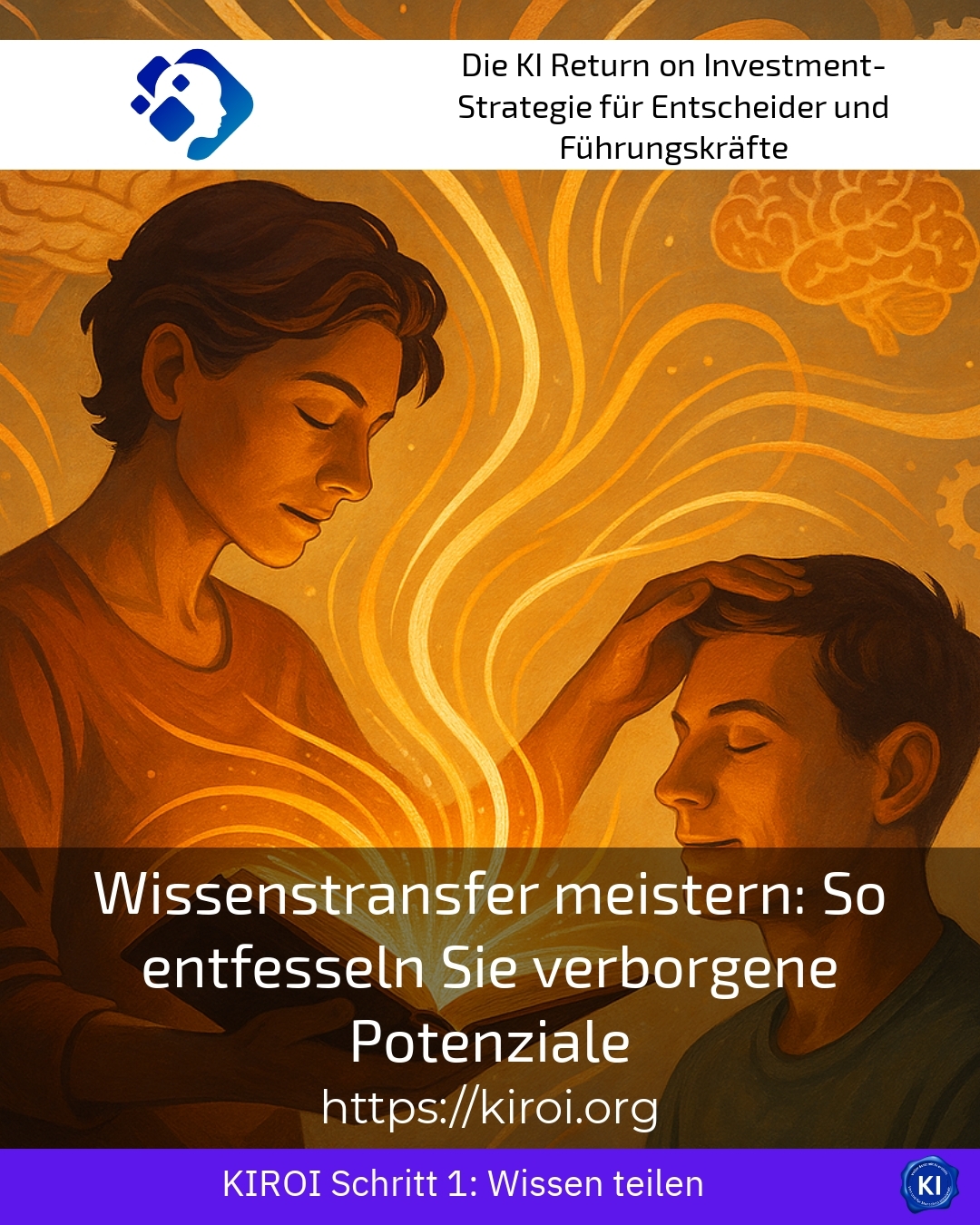
Imagine a treasure lies dormant within your company, waiting to be unearthed. Experienced employees leave, taking decades of knowledge with them. New colleagues start from scratch, even though solutions already exist. Many organisations are all too familiar with this scenario. Mastering knowledge transfer means systematically activating hidden potential. It's about making expertise visible and passing it on purposefully. Both technical tools and human factors play a crucial role in this. In this article, you will learn how to successfully manage this process.
The Invisible Resource: Why Tacit Knowledge Is Often Lost
In virtually every organisation, there exists a vast amount of so-called tacit knowledge. This knowledge resides in the minds of experienced professionals. It has been built up and refined over years. Frequently, the bearers themselves do not realise how valuable their insights are. They act intuitively and solve problems seemingly effortlessly. However, as soon as these individuals leave the company, a painful gap emerges.
An industrial engineering company experienced precisely this phenomenon. A long-serving technician retired. Suddenly, no one could fix certain faults on a special piece of equipment anymore. The documentation was incomplete and didn't help. The company had to call in external consultants. Costs increased significantly, and valuable production time was lost. This case shows how important systematic knowledge transfer is.
We regularly encounter similar challenges in the healthcare sector too. Experienced nurses have a keen sense for patients' needs. They often recognise subtle changes in a patient's condition earlier than measuring devices. This intuition is difficult to capture in manuals. Nevertheless, targeted mentoring can help pass on such skills to younger colleagues [1].
Mastering knowledge transfer in project management: creating structures
Successful project teams develop unique ways of working throughout their collaboration. They know which shortcuts work and which pitfalls lie in wait. However, teams often disband after project completion. The knowledge gained then disperses across the company and is quickly forgotten. Structured debriefs and so-called "lessons learned" sessions can provide a remedy here. These formats make it possible to document important insights and make them usable for future projects.
A software company introduced regular retrospectives and documented the results. This significantly shortened the onboarding times for new team members. Errors that previously occurred repeatedly could be systematically avoided. The team reported noticeably improved collaboration and higher satisfaction.
Best practice with a AIROI customer
A medium-sized logistics company was faced with a particular challenge in the area of knowledge transfer. Several experienced dispatchers were approaching retirement age. Their knowledge of complex route planning and customer relationships was not documented anywhere. The company turned to transruptions coaching to support this transition. Together we developed a structured mentoring programme. The experienced employees were appointed as internal knowledge carriers. They received special training to enable them to articulate their tacit knowledge. At the same time, we introduced digital tools for documentation. We paid particular attention to low-threshold usability. The older employees should not feel overwhelmed. Extensive collections of knowledge were created within six months. These included not only process descriptions, but also personal tips and experiences. The younger colleagues were able to access this treasure trove. They asked specific questions and deepened their understanding in personal discussions. The result was impressive: the training period for new dispatchers was reduced by around forty per cent. Customers also reported a consistently high quality of service. The company was able to master the generational change without any major frictional losses.
Technology as a Supporter: Using Digital Tools Sensibly
Modern technologies can significantly facilitate the exchange of expertise. Knowledge management systems, internal wikis, and collaborative platforms offer diverse possibilities. They enable information to be stored centrally and made easily accessible. Search functions help to quickly find relevant content. Comment functions promote dialogue and the further development of ideas.
However, practice shows that technology alone is not enough. A financial service provider invested considerable sums in a modern knowledge portal. Nevertheless, hardly anyone actively used the platform. Employees perceived the input as an additional burden. A clear strategy and incentives for participation were lacking. Only when the company established a culture of knowledge sharing did this change. Managers led by example. They publicly shared their own insights and recognised the contributions of others [2].
We are experiencing similar developments in the trades with increasing interest. An electrical installation company introduced video tutorials. Experienced journeymen filmed themselves performing tricky work steps. These videos were made available on an internal platform. Apprentices could watch the processes repeatedly and learn from them. The quality of work improved noticeably, and errors occurred less frequently.
Mastering knowledge transfer through mentoring programmes
Personal relationships remain a key factor in the exchange of expertise. Mentoring programmes create a protected environment for in-depth discussions. Experienced professionals can pass on their knowledge in a trusting setting. At the same time, they themselves benefit from the fresh perspectives of younger colleagues. This mutual enrichment strengthens the entire team.
A pharmaceutical company established a structured mentoring system for laboratory staff. New employees were assigned to experienced scientists. Regular meetings allowed for intensive exchange. The mentors received special training in communication skills. They learned to articulate their often unconscious knowledge and explain it clearly. The programme led to significantly faster integration of new team members.
Such approaches can also be beneficial in retail. A department store introduced tandem partnerships between experienced and new sales staff. The experienced staff shared their knowledge of customer preferences and sales strategies. The new staff brought in current trends and digital skills. Both sides benefited from this collaboration and developed further.
Cultural change as a foundation: aligning the organisation for exchange
Sustainable changes require more than individual measures. They demand a fundamental shift in corporate culture. Knowledge must no longer be seen as a source of power. Instead, an attitude of generosity and sharing should be fostered. Leaders play a crucial role as role models in this.
A consulting firm realised that its consultants were withholding knowledge. They feared becoming interchangeable through sharing. Management responded by adjusting the remuneration system. From then on, contributions to knowledge sharing were also factored into performance reviews. Employees who actively shared received recognition and career opportunities. Within a few months, the atmosphere had fundamentally changed [3].
In the restaurant industry, we are observing interesting developments in knowledge sharing. An upscale restaurant introduced regular team tastings. During these, chefs shared their techniques and recipes. Service staff learned the stories behind the dishes. This joint learning strengthened cohesion and significantly improved the guest experience.
Best practice with a AIROI customer
A traditional construction company approached us with a complex challenge. The company had specialised knowledge in the restoration of listed buildings. However, this knowledge was only available among a few older master craftsmen. Younger employees showed little interest in systematically taking on this expertise. The management feared the loss of an important unique selling point. As part of the transruptions coaching support, we first analysed the existing barriers. It turned out that the young specialists were definitely interested. However, they felt that the way in which knowledge was communicated was outdated and not very appealing. Together, we developed new formats that catered to both generations. We organised construction site workshops that focused on practical learning. The experienced foremen demonstrated their techniques on site and explained the background. At the same time, younger employees documented the processes using modern media. Professional instructional videos and illustrated instructions were created. These were made available on an internal platform and continuously expanded. After a year, there was a clear change in the corporate culture. The generations were working more closely together and appreciated each other more. The specialised knowledge was secured and actively developed further. The company was able to successfully maintain its market position in the field of monument restoration.
Unleashing Hidden Potential: The Path to the Learning Organisation
Organisations that learn systematically adapt more quickly to change. They leverage the collective intelligence of their members and continuously improve. This approach goes beyond traditional training. It integrates learning into the daily workflow, making it an inherent part of the job.
An energy provider established so-called Communities of Practice. In these groups, specialists from various departments discussed common topics. They discussed challenges, shared approaches to solutions, and learned from each other. Participation was voluntary, but interest grew steadily. The communities developed into important sources of innovation for the entire company.
In the automotive industry, companies are increasingly using digital twins for knowledge preservation. These virtual representations of machines and processes store empirical data. New employees can train on them without incurring real risks. Errors are analysed in the simulation and improvements are implemented directly [4].
Mastering knowledge transfer in times of demographic change
Demographic change significantly increases the urgency for systematic knowledge management. In many sectors, numerous experienced specialists will be retiring in the coming years. At the same time, it is becoming more difficult to recruit qualified junior staff. Companies must therefore act proactively and create structures in good time.
A municipal water supplier launched a comprehensive knowledge retention programme. Structured handovers began five years before key employees were expected to retire. Experienced professionals were given time and resources for documentation and transfer of knowledge. Younger colleagues were involved early on. This long-term approach enabled a smooth transition without any loss of quality.
The craft sector is showing particularly clear effects of demographic change. A roofing company lost several experienced journeymen within a few years. The owner decided on an innovative approach to knowledge retention. He invited retired employees to regular specialist discussions. These meetings were documented and used for training. In this way, valuable practical knowledge remained with the company even after they retired.
My AIROI Analysis
The systematic sharing of expertise represents one of the most important challenges for organisations. My analysis shows that successful companies combine several factors. They create technical infrastructures that facilitate and document exchange. At the same time, they invest in personal formats such as mentoring and communities of practice. Above all, however, they work on their culture and promote an attitude of generous sharing.
The examples from various industries illustrate that there is no universal solution. Each organisation must find its own path and adapt it to its needs. Professional support from transruption coaching can provide valuable impetus. We help companies analyse their specific challenges and develop suitable strategies.
The factor of time seems particularly important to me. Mastering knowledge transfer requires stamina and continuous commitment. Short-term projects rarely yield sustainable results. Instead, it needs permanent integration into business processes. Managers must take the issue seriously and provide appropriate resources.
Digitalisation offers new opportunities and tools. Artificial intelligence can help structure and make knowledge accessible. Virtual reality enables immersive learning experiences. Nevertheless, the human factor remains crucial. Genuine knowledge transfer can only occur if people are willing to share and learn. Fostering this willingness is one of the most important tasks of modern leadership.
Further links from the text above:
[1] Fundamentals of Knowledge Management at a Glance
[2] Digital Transformation and Knowledge Management in Companies
[3] Corporate culture as a success factor for knowledge transfer
[4] Digital Twins in Industrial Applications
For more information and if you have any questions, please contact Contact us or read more blog posts on the topic Artificial intelligence here.






 Deutsch
  English (UK)