
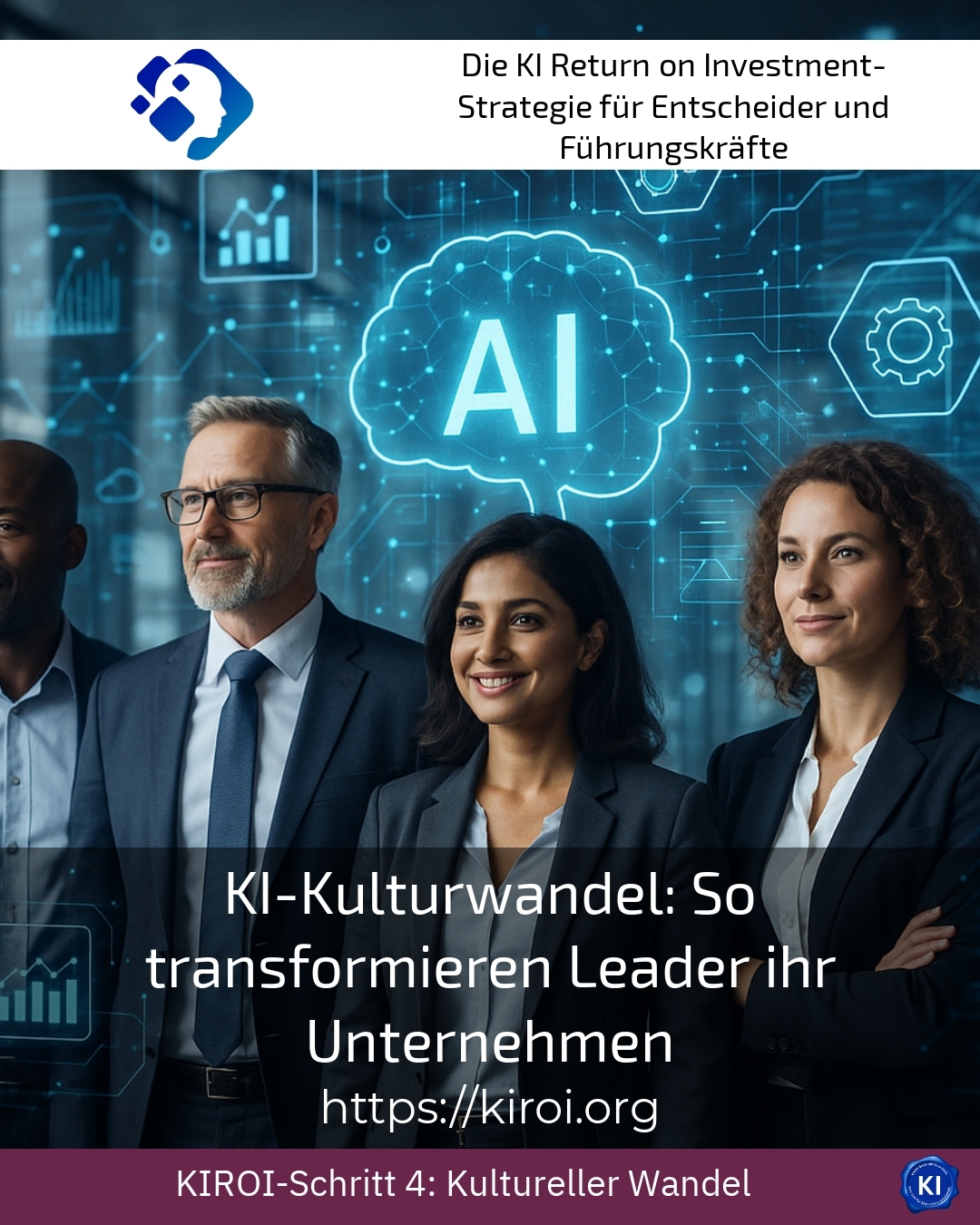
The business world is changing faster than ever before. Leaders face a fundamental challenge. They must navigate their organisations through profound transformation. The AI cultural change This doesn't just concern technology and processes. It touches the very core of every organisation: the people and their mindsets. Many leaders are currently wondering how to successfully shape this change. The answer doesn't lie in quick technical solutions. Rather, it requires a fundamental transformation of the corporate culture. In this post, you'll learn which strategies really work and how you can take your team along on this journey.
Why the AI cultural shift becomes a leadership task
Transformation always begins in people's minds. Technology alone does not change companies. It is leaders who make the difference. They shape their teams' attitudes towards change. At the same time, they create the framework for innovation and experimentation. Clients often report resistance in their organisations. This resistance often stems from fear and uncertainty. Leaders must therefore first build trust and create clarity.
A medium-sized manufacturing company faced precisely this challenge. Management wanted to introduce intelligent automation. However, the workforce reacted with scepticism and resistance. It was only when the leadership team began to communicate openly that the mood changed. Employees were involved in decision-making processes. This gradually led to a new culture of openness.
Another example features a retail trading company. There, the introduction of analysis tools initially led to uncertainty. The store managers feared that their experience would be devalued. The company management responded with training and personal discussions. As a result, the local managers recognised the added value of the new tools. They became ambassadors for change within their teams.
Similar patterns are also evident in healthcare. A clinic group wanted to support its diagnostics with modern technologies. The medical staff were initially critical of this. However, through intensive support and clear communication, integration was successful. Today, the doctors use the new possibilities as a valuable decision-making aid [1].
The role of values and vision in AI culture change
Every successful transformation needs a clear vision. This vision must be embodied by leadership. Values such as openness, a willingness to learn, and courage play a central role. Leaders must authentically embody these values. Only then can they convince and bring their teams along. Purely technical arguments are not enough. People follow people, not machines or algorithms.
A financial services provider recognised this truth after initial setbacks. Initially, management had focused solely on efficiency gains. The employees didn't feel addressed by this. The dynamic only changed when the company's leadership emphasised the human dimension. The new vision placed people at the centre. Technology was to support, not replace.
In the logistics industry, a family-run business demonstrated remarkable foresight. The management formulated a vision for the next generation. This vision impressively combined tradition with innovation. The long-serving employees felt valued and included. At the same time, younger talent was attracted to the company.
A media company also successfully went through this process. The editorial team faced fundamental changes to their working methods. The editor-in-chief developed a new identity together with the team. This identity combined journalistic quality with technological innovation. This created a culture that sees change as an opportunity [2].
Best practice with a AIROI customer An established industrial company with several thousand employees sought support from transruptions coaching for a comprehensive transformation process. The middle-level managers showed considerable resistance to the planned changes. As part of the support, intensive discussions were initially held with all those involved. It turned out that many fears were based on a lack of information. The coaching impulses helped the management to develop a new communication strategy. Regular dialogue formats were introduced in which opportunities and challenges were discussed openly. The managers received individual support in developing new skills. After six months, the mood in the company had changed fundamentally. The previously critical voices had become active supporters of change. The company was able to achieve its transformation goals much faster than originally planned. Experience shows that professional support can make a decisive contribution to the success of such projects.
Skills development as the key to success
Transformation requires new skills at all levels. Leaders must continuously develop their own competencies. At the same time, they are responsible for the development of their teams. Lifelong learning is becoming a fundamental requirement for successful careers. Companies must provide appropriate frameworks and resources. Organisations often underestimate the scope of this task.
A technology group invested heavily in the further training of its workforce. Every employee received access to extensive learning platforms and programmes. Managers completed special training courses on supporting their teams. This investment paid off within a short period. The company's innovative strength increased measurably.
In the insurance sector, one company showed particular creativity in leadership development. Internal communities of practice were established. Here, employees from different departments exchange ideas regularly. Knowledge transfer takes place on an equal footing and in a very practical way. This initiative has sustainably changed the corporate culture.
Smaller businesses can also benefit from such approaches. An advertising agency introduced weekly learning circles. Each team member regularly shares new insights with colleagues there. This creates a culture of shared growth and curiosity [3].
How leaders can actively drive the AI culture shift
Successful transformation requires concrete actions and clear priorities. Leaders must act strategically while remaining flexible. Change rarely proceeds linearly or predictably. Adaptability and resilience become crucial leadership qualities. It is important to make small successes visible. These successes motivate teams and build trust in the process.
An energy supplier focused on pilot projects in selected areas. The insights gained were systematically documented and shared. Successful approaches were then gradually rolled out to other areas. This approach minimised risks and maximised learning. Employees experienced the change as manageable and influenceable.
In the automotive industry, a supplier took a similar path. The company first identified the most pressing areas of application. Initial experience was gathered and evaluated there. Management communicated transparently about successes and failures. This openness strengthened the workforce's trust in the transformation process.
A pharmaceutical company opted for a participative approach for its transformation. Employees from all hierarchical levels were involved in the planning. Their ideas and concerns were directly incorporated into strategy development. The result was a widely supported transformation plan. Implementation therefore proceeded significantly more smoothly than in comparable projects [4].
Dealing with resistance and fears
Changes can cause anxiety and uncertainty in many people. These reactions are completely normal and humanly understandable. Leaders should take them seriously and deal with them constructively. Resistance often contains valuable information about underlying problems. Open dialogue helps to identify and solve these problems. Pressure and coercion, on the other hand, usually lead to increased rejection.
An authority experienced this dynamic when modernising its processes. Long-serving employees feared the loss of their expertise. The leadership level responded with individual conversations and offers of support. Employees were assured that their experience would remain valuable. Technology was intended to facilitate their work, not replace their competence.
A similar picture emerged in the banking sector at a regional institution. The advisors feared for their customer relationships and their relevance. Through intensive training and support, they regained their confidence. They recognised that the new tools could improve the quality of their advice. The initial resistance transformed into genuine enthusiasm.
An established company in mechanical engineering also went through this process. The experienced engineers were sceptical of new methods. Management invested time in personal discussions and explanations. Ultimately, the sceptics became the most convinced proponents of change [5].
Best practice with a AIROI customer A medium-sized service company came to transruption coaching with a specific problem. The management had already made several attempts at transformation, all of which had failed. The employees reacted to every new initiative with resignation and cynicism. As part of the coaching, a thorough analysis of the previous attempts was first carried out. This revealed typical patterns of failed change processes. Communication had been too abstract and there had been too little involvement of those affected. Together, a new approach was developed that put people at the centre. Small, manageable steps towards change replaced the big announcements. Successes were celebrated and failures were used as learning opportunities. Managers received regular impulses to reflect on their own behaviour. After a year, the corporate culture had changed fundamentally. Employees now met change with curiosity instead of rejection. This example illustrates how professional support can help with such cultural transformation projects.
Sustainable anchoring of change in the organisation
Genuine transformation is demonstrated in lasting changes to company culture. One-off initiatives and projects are not sufficient for this. The change must be embedded in structures, processes, and behaviours. Leaders play a crucial role as role models in this regard. They must live the new values and ways of working on a daily basis. Only then will abstract concepts become lived reality.
A telecommunications company embedded the change in its leadership guidelines. The assessment of leaders was adjusted accordingly. Those who actively drove the change were rewarded and promoted. This clear signal changed behaviour at all levels. The transformation therefore gained noticeable momentum.
In the food industry, a concern went down a similar path. The company values were rephrased and communicated. Regular reflection sessions helped to anchor them in everyday life. The employees experienced that the values were taken seriously. Thus, a new company identity gradually emerged.
An educational provider also integrated the change into its core structures. The curricula were revised and modernised. The lecturers were given scope for experimentation and innovation. The organisation learned to understand change as a permanent process [6].
The importance of networks and partnerships
No single company can manage transformation alone. Networks and partnerships are therefore gaining importance. Exchanging ideas with other organisations accelerates collective learning. Collaborations with universities and research institutions bring new impetus. Working with specialist consultants can also offer valuable support.
An industrial association established a working group on the topic of transformation. The participating companies share their experiences and findings there. This peer consultation has helped all those involved. Concrete cooperation projects often arise from such networks.
A similar development is apparent in the trades, concerning the guilds. Joint training programmes reduce costs for individual businesses. The exchange of experience between masters enriches all participants. This makes change manageable even for smaller companies.
A university is closely cooperating with regional companies on transformation projects. Students work on real-world challenges from practice. The companies benefit from fresh ideas and scientific expertise. These partnerships create added value for all involved [7].
My AIROI Analysis
The support of numerous transformation projects has brought important insights. The AI cultural change This only succeeds if people are at the centre. Technology is a tool, not an end in itself. Leaders must internalise and communicate this perspective. Without genuine commitment from the top, most initiatives fail. Company leadership must visibly lead by example in driving change.
Communication proves to be a crucial success factor in all projects. Openness and transparency build trust and reduce anxieties. Employees want to understand why changes are necessary. They want to have the opportunity to help shape the process. Participation increases acceptance and improves the quality of solutions.
Developing competencies deserves special attention in any transformation process. People need to acquire the skills they require for the new world of work. This investment pays off multiple times over. Well-qualified employees are more motivated and productive. They actively drive change within their areas.
Patience and perseverance are indispensable virtues in cultural transformations. Real change takes time and continuous attention. Quick successes are possible, but lasting embedment requires persistence. Leaders should have and communicate realistic expectations. Setbacks are part of the process and offer learning opportunities.
The experience with transruption coaching demonstrates the value of professional guidance. External perspectives help to identify and overcome blind spots. External impetus can resolve stuck situations. The combination of internal expertise and external support proves to be particularly effective.
Further links from the text above:
[1] McKinsey: Culture change that sticks
[2] Harvard Business Review: The Leader’s Guide to Corporate Culture
[3] World Economic Forum: Reskilling Revolution
[4] MIT Sloan: Leading with Next-Generation KPIs
[5] BCG: Overcoming Resistance to Digital Transformation
[6] Gartner: Organisational Change Management
[7] Deloitte: Global Human Capital Trends
For more information and if you have any questions, please contact Contact us or read more blog posts on the topic Artificial intelligence here.







 Deutsch
  English (UK)