
Have you ever had a brilliant app idea but discarded it because professional development seemed unaffordable? The idea that only people with years of programming experience can create their own digital solutions persists in many minds. But this is where a revolutionary approach makes a fundamental difference: it transforms the relationship between creative vision and technical implementation. Vibe Coding It is increasingly enabling non-programmers to turn their ideas into functional applications without relying on expensive external services. This development raises fundamental questions that go far beyond technical aspects and affect the entire ecosystem of software development.
The democratization of software development through Vibe Coding
In the traditional world of application development, a clear division of labor prevailed for a long time. Businesspeople had ideas. Programmers implemented them. In between, misunderstandings and budget overruns often occurred. A medium-sized retailer that wanted to digitize its warehouse system often had to invest sums in the hundreds of thousands of euros. A physiotherapy practice with the desire to develop its own appointment booking app faced similar challenges. Even craft businesses that wanted to automate their order processing experienced regular budget shocks.
The new approach fundamentally changes this dynamic. It enables domain experts to translate their domain-specific knowledge directly into code. They communicate in natural language with intelligent systems. These systems then generate functional program code. An architecture firm can, for example, develop its own project management tools. A restaurant can design its own reservation system according to its own specifications. Even law firms report that they were able to independently implement internal document management solutions.
Best practice with a AIROI customer An established engineering firm specializing in building technology faced the challenge of making its project documentation more efficient. The existing standard solutions on the market only partially met the specific requirements of the industry. External software development was estimated at over 80,000 euros, which significantly exceeded the budget of the medium-sized company. As part of a transruptive support program, we worked together to develop an alternative approach. The company’s technical director, although lacking formal programming skills, developed a customized documentation platform using modern assistance systems within six weeks. This solution integrated automatic reporting, photo documentation with location assignment, and an interface with the existing accounting system. The total costs for training, support, and necessary infrastructure amounted to less than 15,000 euros. Today, the entire team uses this proprietary development daily and reports significant time savings in project execution.
Vibe Coding in practical use in various industries
The application areas of this new development methodology extend across virtually all economic sectors. In healthcare, practice managers develop individual patient communication systems. These take data protection requirements into account from the outset. In the education sector, teachers design interactive learning platforms based on pedagogical insights. These platforms precisely meet the needs of their student population.
The development in the manufacturing sector seems particularly interesting. There are increasingly being developed customized solutions for quality control and production monitoring. A mechanical engineering company recently reported on a self-developed predictive maintenance application that monitors critical system parameters and warns early of potential failures. The development was carried out entirely in-house by a technical employee without any formal IT training.
Notable progress is also being made in the logistics and freight forwarding sector. Transport service providers are optimizing their route planning using self-developed algorithms. Warehouses are implementing inventory management systems according to their own process logics. Courier services are developing tracking solutions that are perfectly tailored to their business models. All these examples illustrate the transformative potential of this development.
Recognizing boundaries and opportunities in Vibe Coding
Despite all the euphoria, a nuanced approach is essential. Not every application is suited to this approach to development. Highly complex systems with safety-critical requirements continue to require professional expertise. Banks will not develop their core banking systems in this way. Airlines will not fully program their booking systems themselves. Medical applications are also subject to strict regulatory requirements.
Nevertheless, there is a vast spectrum of use cases in between. Internal tools, prototypes, and industry-specific specialized solutions offer ideal entry points. An estate agent develops an object management system according to their own criteria. An event manager creates a guest management system with individual functions. A farming business programs an harvest logistics application for its specific processes.
Best practice with a AIROI customer A tax advisory firm with a nationwide client base sought a way to optimize communication with clients. Existing office software solutions offered basic functionality but did not meet the company’s specific workflow requirements. The management decided on an experimental approach as part of our transruptive support. A business employee without technical background was temporarily released for three months to develop a client portal solution. The support included weekly coaching sessions and methodological support. The result significantly exceeded all expectations. The portal enables secure document exchange functions, automatic deadline monitoring, and integrated video conferencing. Clients can upload documents and track the status of their cases. The law firm reports a reduction in telephone inquiries by about 40 percent since the introduction of the system.
Skills development as the key to success
The successful implementation of these new possibilities requires targeted development of skills. It is not about classical programming but about structured thinking. Process understanding, logical problem solving, and precise requirements formulation are key factors. These skills can be trained and systematically developed.
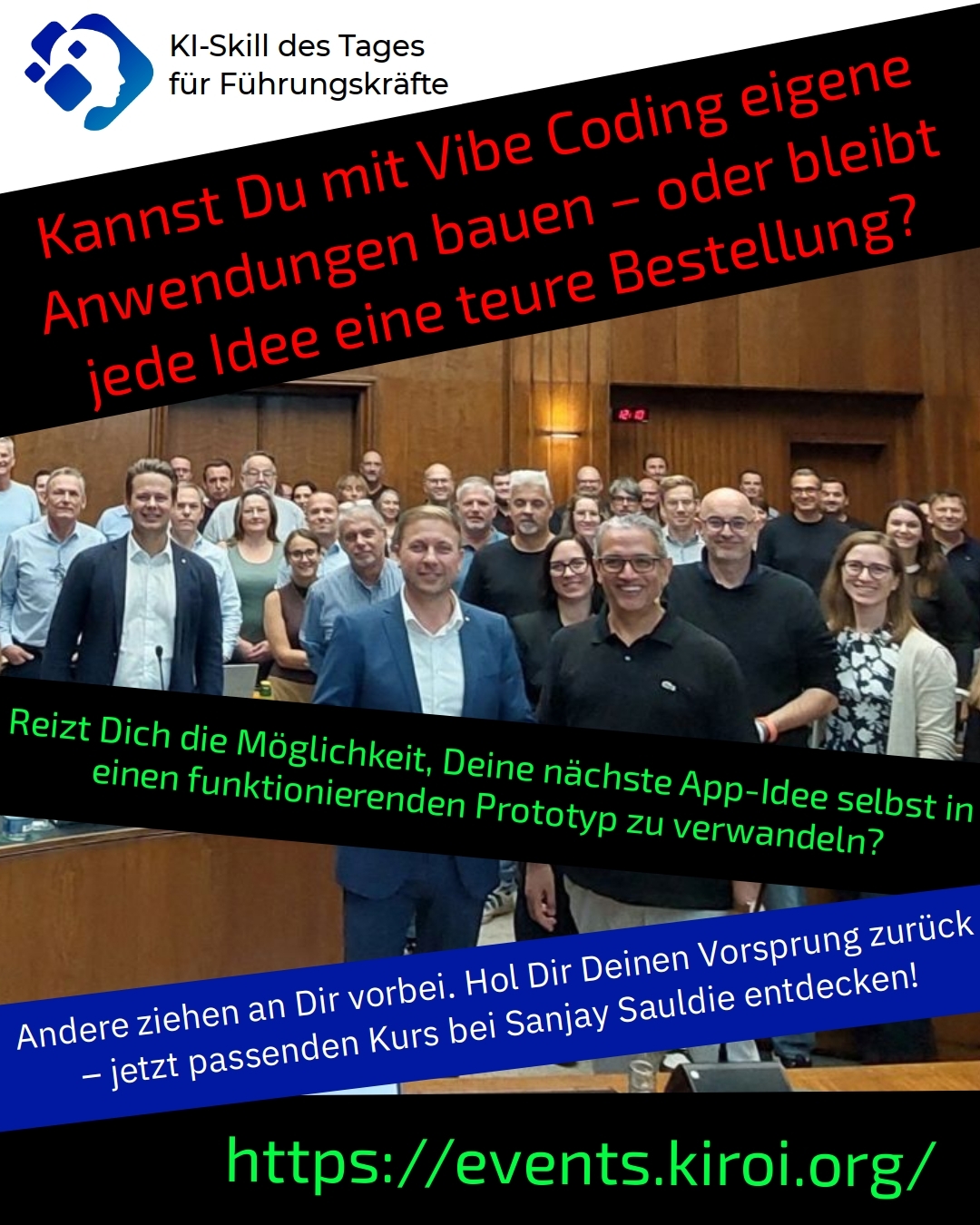
Take your existing skills to the professional level – just as over 8,000 people from over 500 companies have already done with Sanjay Sauldie! https://events.kiroi.org/ [1] you will find structured continuing education programs that impart exactly these competencies and enable you to utilize the new technological opportunities profitably.
The learning curve is surprisingly steep. Many participants report rapid successes. A hotelier developed a functional concierge service bot within two weeks. A business consultant created a project tracking dashboard for her client mandates. A dentist programmed a recall system for his patients’ preventive examinations. These examples demonstrate the enormous potential with the right guidance.
Vibe Coding changes collaboration fundamentally
An often underestimated aspect concerns the changed collaboration between departments and IT. Traditionally, there existed a linguistic and conceptual gap here. Expert specialists described their requirements. IT specialists interpreted them to the best of their knowledge. The result rarely fully corresponded to the original intentions.
The new approach enables a more direct implementation of professional expertise. A sales manager can customize his CRM system according to his own sales logic. A quality manager implements inspection protocols based on his process knowledge. An purchasing manager develops supplier evaluation systems according to industry-specific criteria. This immediacy eliminates numerous translation losses.
At the same time, new collaboration models are emerging. Professional developers are increasingly taking on advisory and quality assurance functions. They support expert specialists with more complex requirements and verify the security aspects of created solutions. This partnership on equal terms proves particularly productive.
My AIROI Analysis
The question of whether self-developed solutions can replace expensive orders cannot be answered in a general way. It depends on numerous factors that must be evaluated individually. However, my observations from accompanying numerous transformation projects paint a clear picture. For a significant portion of business use cases, the new approach offers economically attractive alternatives.
The key success factors lie less in technical details than in methodological aspects. Those who learn to formulate requirements precisely achieve better results. Those who approach iteratively and continuously test develop more robust solutions. Those who realistically assess the limits of what is feasible avoid costly detours. These competencies can be acquired and systematically developed.
The development seems particularly promising for prototyping purposes. Companies can quickly and cost-effectively validate ideas. They receive functional demonstrators for investor discussions in the shortest time possible. They test market acceptance before large budgets are allocated. This agility provides significant competitive advantages.
The transruptions accompaniment position itself as valuable support for these projects. It provides impulses for structured approaches and methodological clarity. It accompanies the development of competence and helps to realistically assess possibilities. Often, participants report that this orientation was precisely what made the crucial difference.
My assessment: The future belongs to hybrid models. Standard tasks are increasingly being solved by empowered subject matter experts themselves. Complex specialized requirements remain the domain of professional developers. In between, a dynamic spectrum of new possibilities is emerging. Those who actively shape this development will benefit from it. Those who ignore it risk strategic disadvantages in a changing market environment.
Further links from the text above:
[1] AIROI Events – Further education and competence development
For more information and if you have any questions, please contact Contact us or read more blog posts on the topic Artificial intelligence here.








 Deutsch
 English (UK)