
Will your profession in financial analysis soon be taken over by intelligent systems, and which activities will remain truly indispensable in a human capacity?
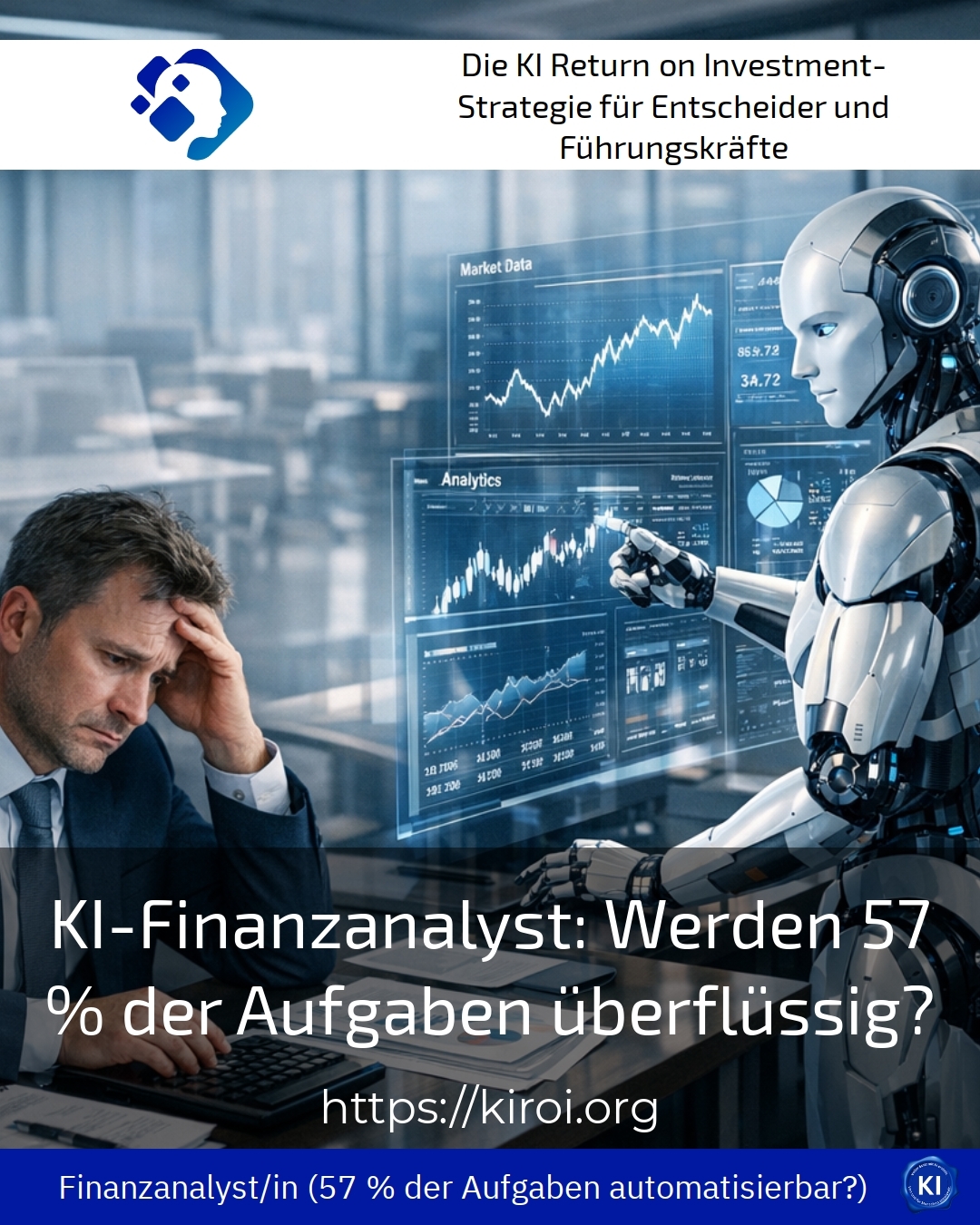
This question currently concerns numerous experts across the entire financial sector, as current surveys by the Institute for Employment Research show on its platform [1] that more than half of all typical tasks in this professional field would already be technologically substitutable today. The AI financial analyst This thus stands for a development that fundamentally changes many traditional professional roles. Nevertheless, this number does not in any way mean the end of human expertise, but rather a profound change. Intelligent algorithms take over repetitive evaluations and data analyses. However, strategic advice and relationship management remain firmly in human hands. This is where transruptive coaching comes in and supports companies in this transformation.
What the figures from Job-Futuromat actually mean
The platform of the Institute for Employment Research systematically examines which professional activities can be replaced by modern technologies, providing differentiated insights into the future of individual professions. A substitutability potential of 57 percent may at first sound threatening. However, upon closer inspection, a more complex picture emerges. Not every task that can be automated is actually automated. Economic, legal, and social factors play a crucial role.
In practice, this means that the machine-based analysis of quarterly figures is already more efficient today than through human analysis. Similarly, algorithms can extract market trends from millions of data points. The creation of standardized reports and presentations is also increasingly automated. However, interpreting these results in a customer context still requires human judgment. For example, credit institutions have long been relying on automated credit checks. Investment firms use algorithmic trading strategies for specific portfolio segments. Insurance companies analyze risk profiles using machine learning algorithms. All of these applications demonstrate the potential, but also the limitations of technological solutions.
Concrete changes in the working day for the AI financial analyst
The daily work in banks, insurance companies and investment firms is changing noticeably, as intelligent systems increasingly take on routine tasks, creating new spaces for value-added activities. Previously, professionals spent hours manually entering data and verifying its plausibility. Today, systems complete these tasks in fractions of a second. The time gained now flows into customer consultation and strategic planning.
A tangible example is lending to commercial banks, where previously several employees spent days reviewing documents; today, however, algorithmic systems provide initial assessments within minutes. Similarly, portfolio analysis involves identifying correlations and risks in a matter of seconds using machine learning. In the area of regulatory reporting, automated processes also significantly relieve the workload of professionals. This development frees up time for more complex advisory services. It also enables more intensive customer relationships. And it simultaneously requires new competencies from all involved parties.
Best practice with a AIROI customer
A medium-sized financial services company with over 200 employees faced the challenge of modernizing its analysis processes while preparing the workforce for the new requirements. The company entrusted us with guiding this transformation project, with the focus on combining technological implementation with human development. First, together with the management and team leaders, we analyzed all work processes in financial analysis, identifying 23 different activity clusters with varying automation potential. In the second step, we developed a customized training program that enabled employees to effectively use the new technological tools and redefine their own role. The approach of recruiting experienced professionals as internal multipliers who passed on their knowledge to younger colleagues proved particularly successful. After twelve months, the management reported an increase in productivity while simultaneously increasing employee satisfaction, because people were now able to focus on more challenging and fulfilling tasks.
Which competencies will remain indispensable in the future
Although technological systems develop impressive analytical capabilities, there are areas where human abilities will remain indispensable for the foreseeable future. The ability to communicate complex matters in an understandable way is definitely one of them. Equally important is the ethical judgment ability when making difficult decisions. And finally, the ability to build trust and maintain relationships remains a profoundly human domain.
Private equity firms still value experts who can add industry knowledge and intuition to their corporate evaluations. Asset managers need advisors who understand their clients’ individual life circumstances. Rating agencies rely on analysts who can assess qualitative factors beyond numbers. These examples illustrate why the AI financial analyst To be understood as a tool and not as a substitute. The technology supports and expands human abilities. However, it does not completely replace them. Often, clients in our coaching processes report that this very realization has a liberating effect.
The role of transruption coaching in digital transformation
Processes of this magnitude require professional guidance because technological disruptions always have emotional and organizational dimensions as well. Transruptions coaching positions itself as a support for precisely such projects. We provide guidance for the realignment of teams and organizations. We support leaders in navigating their employees through uncertain times.
In the financial sector, clients often come to us concerned that their expertise could lose value. Asset managers wonder how to remain relevant. Compliance specialists worry about their future role. Relationship managers in private banks want to understand how their professional image is evolving. We take all these concerns seriously and support people on their individual journey. We use proven methods and current insights. We combine technological understanding with psychological expertise.
Strategies for successful adaptation to the AI financial analyst
Those who proactively prepare for change can see the transformation as an opportunity and open up new areas of expertise early on. Continuous training is the key to success. Fundamental knowledge of data analysis and machine learning is becoming increasingly valuable. At the same time, soft skills are gaining importance.
Hedge fund managers are already investing in training their teams to handle algorithmic systems. Corporate finance departments at large companies are building interdisciplinary teams that combine technical and business expertise. Accounting firms are specifically recruiting employees with programming skills and integrating them into their traditional audit teams. These developments are paving the way for a future where humans and machines work productively together. The key lies in the right preparation. And that is exactly what we support our clients with.
Best practice with a AIROI customer
A regional bank with a traditional corporate culture approached us because the management had recognized that the digitalization of financial analysis was inevitable, but at the same time it was feeling resistance within the workforce. Our task was to design a change process that took into account both the technological and the human aspects. We began with a comprehensive inventory and conducted numerous one-on-one interviews with employees from various levels and departments. It became clear that many fears were based on a lack of information and a lack of involvement. In workshops, we worked together with the teams to develop future scenarios and identified concrete development opportunities for each individual. Particularly important was the realization that long-standing employees possessed implicit knowledge that was essential for the successful implementation of new systems. Ultimately, the bank was able to introduce a digital analytics platform while maintaining the expertise of its experienced professionals and using it purposefully, which led to significantly higher acceptance and faster adoption of the new technologies.
My AIROI Analysis
The data from Job-Futuromat illustrate an inevitable development that affects every profession in the financial sector, but they do not tell the whole story. A substitutability potential of 57 percent does not mean job destruction on the same scale. Rather, it represents a shift in job profiles towards more demanding and people-centric tasks. The AI financial analyst becomes an indispensable tool that complements and expands human expertise, rather than replacing it.
From my experience in guiding numerous transformation projects, I can report that organizations are successful when they understand technology as an enabler and simultaneously invest in their people. The financial sector continues to need professionals with judgment, empathy, and strategic thinking. These competencies cannot be automated. Those who start developing early and building new skills will benefit from this development. The fear of change is understandable, but unfounded if one actively engages in the changes. Transruptive coaching provides valuable support for individuals and organizations. Together, we create a future where people and technology optimally leverage their respective strengths.
Further links from the text above:
[1] Job-Futuromat of the Institute for Employment Research
For more information and if you have any questions, please contact Contact us or read more blog posts on the topic Artificial intelligence here.







 Deutsch
 English (UK)