
Have you ever wondered why your company isn’t working more efficiently despite investing in expensive technology? The answer might surprise you. Because often the problem isn’t lack of innovation, but a fundamental thinking error: we seek complex solutions for simple challenges. The AIROI-approach offers a refreshingly pragmatic perspective that moves many executives to rethink. In a world characterized by digital transformation and technological progress, we sometimes forget the obvious. Not every problem requires a highly complex solution. Sometimes a clear rule, a well-thought-out process, or simply common sense is enough. This post shows you how to recognize the difference and use your resources purposefully.
The phenomenon of technological overreaction in modern organizations
In numerous industries, we observe a recurring pattern that proves to be particularly costly. Average companies tend to reflexively look for a technological solution for every problem that arises. However, this approach often leads to oversized projects that consume more resources than they save. For example, a medium-sized logistics service provider invested substantial sums in an intelligent route planning system. The real problem, however, was a lack of communication between dispatch and drivers. A simple checklist and daily short meetings would have achieved the same effect.
Similar examples can be found in the manufacturing industry, where companies implement complex predictive maintenance systems even though regular manual inspections would suffice. A mechanical engineering company reported on a predictive maintenance system whose implementation took two years. The actual failure rate of the machines had hardly changed during this time, because the basic maintenance intervals were already optimally set. In retail, retailers invest in elaborate inventory management solutions, while a well-thought-out reorder rule based on simple thresholds would have fulfilled the same purpose.
This tendency towards technological overreaction has several causes. First, there is a certain pressure to appear modern and innovative. Second, there is often a lack of understanding of what problems are actually complex and what only appear complex. Third, there is a knowledge gap regarding the actual capabilities of different technologies. Many decision-makers do not fully understand when a rule-based solution is sufficient and when truly learning algorithms are required.
AIROI The philosophy: Simplicity as a strategic advantage
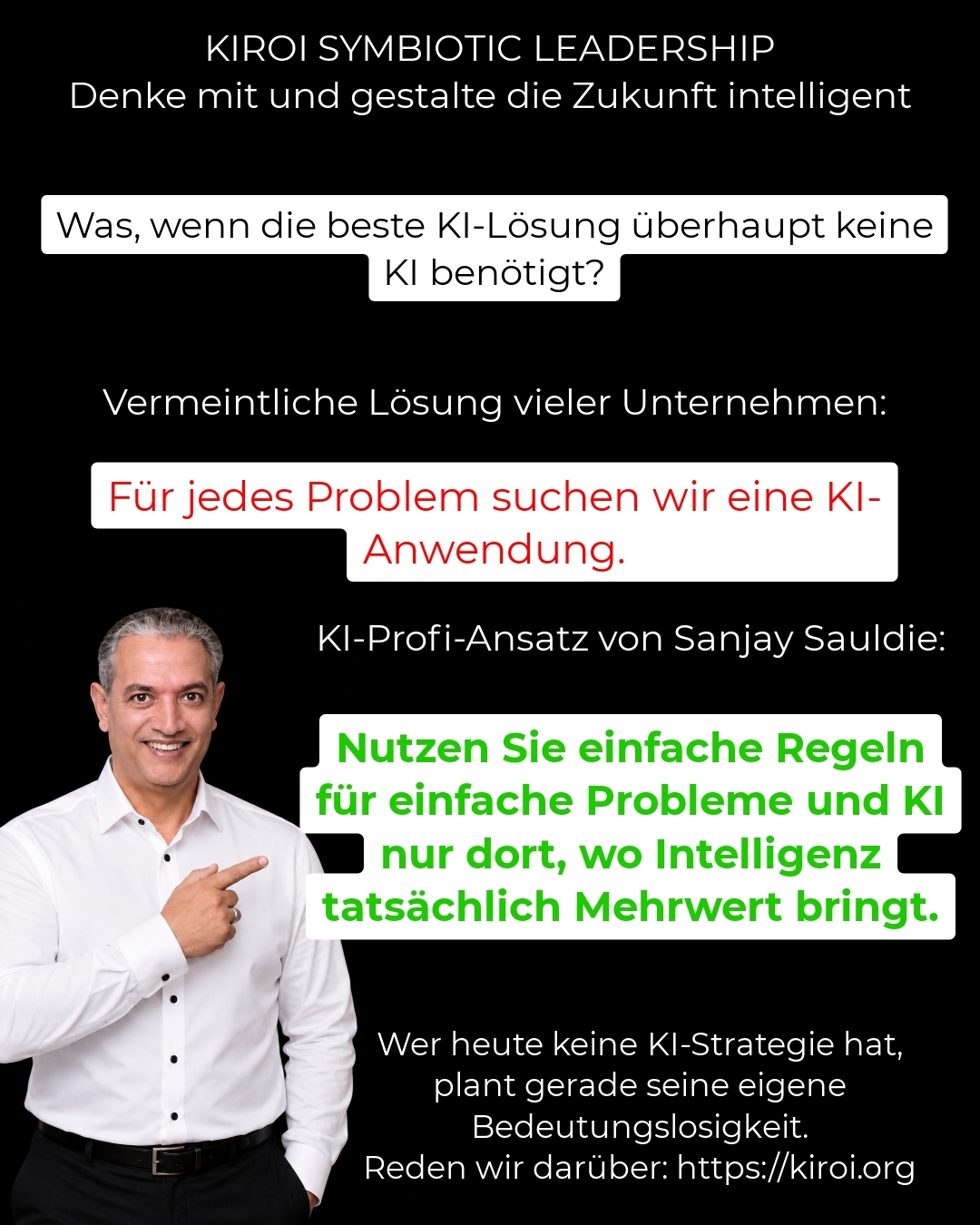
The AIROI-approach follows a fundamentally different philosophy that is based on a simple principle: Use simple rules for simple problems and only deploy advanced technologies where intelligence actually adds value. This distinction may sound trivial, but in practice it requires significant analytical skills and the willingness to question established patterns of thinking.
A financial services provider applied this principle to fraud detection. Instead of immediately implementing a complex machine learning model, the team first analyzed the most common fraud patterns. It turned out that over seventy percent of all fraudulent transactions could be detected through five simple rules. Only for the remaining cases was a learning algorithm developed. The result was a solution that was implemented faster, required less maintenance, and was more transparent in its decisions.
In the insurance industry, a similar picture emerges. An insurance company revised its claims settlement process. Instead of a fully automated solution, it established a tiered model. Standard cases are automatically processed through clear rules. More complex cases are forwarded to claims handlers. Only in particularly complex situations does a support system come into play, which recognizes patterns and issues recommendations. This hybrid approach combines the strengths of both worlds while simultaneously avoiding their weaknesses.
Best practice with a AIROI customer
An international trading company faced the challenge of optimizing its pricing and responding faster to market changes. The original plan included a comprehensive dynamic pricing system that would process real-time data from various sources and make automatic adjustments to prices. The estimated implementation costs amounted to seven figures, and the project duration was estimated at eighteen months. As part of the AIROI follow-up, the team first analyzed the actual requirements and found that ninety percent of the price adjustments followed predictable patterns. Seasonal fluctuations, competitive prices, and inventory levels determined the majority of decisions. For these cases, the team developed a rule-based system with clear if-then logic that was ready for use within three months. Only for ten percent of the more complex situations was a supporting system implemented that provides recommendations and informs human decision-makers. The result exceeded all expectations: the implementation time was reduced by seventy percent, costs were reduced by sixty percent, and employees retained control over strategic pricing decisions. Additionally, the system was significantly more maintenance-free and transparent in its operation.
The practical distinction: When are simple rules sufficient?
The decision whether a problem should be solved with simple rules or with more complex methods requires careful analysis. The AIROI-approach provides a structured decision framework for this. First, you should determine whether the problem is clearly definable and whether the relevant influencing factors are known. If both questions can be answered with yes, a rule-based solution is often sufficient.
In personnel recruitment, this is particularly evident. The pre-selection of applications can be done through clear criteria such as qualifications, years of experience, and specific knowledge. An energy provider implemented a simple scoring system for the initial screening of applications. The criteria were transparent, the applicants understood the process, and the personnel department saved significant time. More complex assessments such as assessing soft skills or cultural fit were reserved for personal interviews.
Similar principles apply in customer service. A telecommunications provider found that eighty percent of all customer inquiries fell into ten categories. For these, the company developed structured response templates and clear escalation rules. Only in case of complex technical problems or unusual complaints was further support activated. The average processing time decreased, customer satisfaction increased, and employees were able to focus on the truly challenging cases.
Where advanced technologies actually create added value according to the AIROI-approach
After we have explored the limits of simpler solutions, the question arises as to when the use of more complex methods is justified. The AIROI-approach identifies several scenarios in which advanced technologies can offer real added value. First, they are suitable for situations with high data complexity, where human analysts would be overwhelmed. Second, they are valuable in rapidly changing environments where rigid rules cannot keep up. Third, they offer advantages in pattern recognition tasks that are not intuitively accessible to humans.
A pharmaceutical company used these criteria in the analysis of clinical trials. Evaluating adverse event reports required identifying subtle patterns among large volumes of text. A text analytics system provided real added value here by identifying potential connections that would have escaped human readers. In the quality control of a automotive supplier, an image analytics system detected microscopic defects in components faster and more reliably than trained inspectors. The decision to use this solution was based on the clear realization that human capabilities were reaching their limits here.
An energy utility employed advanced analysis methods in its network load forecasting. The multitude of influencing factors, ranging from weather data to holidays and local events, made simple rules insufficient. Here, a learning system created real added value by modeling the complex interactions and enabling more precise predictions. The decision was well-considered and based on a thorough analysis of the complexity of the problem.
The hybrid strategy: integrating simplicity and complexity
The AIROI-approach often recommends a hybrid strategy that combines the best of both worlds. This strategy starts with simple rules and selectively adds more complex components where this demonstrably brings added value. Such an approach is not only more cost-effective in implementation but also more robust in operation and more transparent in its decisions.
A bank implemented this principle in its lending practices. The first stage consisted of clear rules regarding income, employment status, and credit history. These rules were transparent and met regulatory requirements for clarity. The second stage was applied in case of exceptions and analyzed additional factors. A case officer made the final decision, supported by the recommendations of the system. This combination of regulations, analytical support, and human expertise proved particularly robust.
In healthcare, a similar pattern emerges. A hospital optimized staffing planning through a combination of simple rules for standard cases and more advanced methods for complex situations. The basic planning followed clear criteria such as treatment duration and resource availability. For emergencies and unforeseen events, a supportive system was activated that simulated various scenarios and provided action recommendations. The doctors and nurses always retained final decision-making authority.
My AIROI Analysis
In my opinion, the greatest strength of the AIROI-approach lies in its pragmatic approach. It frees organizations from the obligation to solve every problem with the latest technological developments, instead enabling a differentiated view of the actual requirements. The examples from various industries clearly show that this distinction can have significant effects on project costs, implementation times, and ultimately on business success.
What I find particularly remarkable is the realization that simplicity often goes hand in hand with greater transparency and better control. In a time when regulatory requirements for accountability and fairness are increasing, this aspect gains in importance. Rule-based systems can be easier to explain, verify, and adapt than complex models whose internal logic is even difficult for experts to understand. The AIROI-approach thus addresses not only economic but also ethical and regulatory aspects.
The hybrid strategy seems particularly promising to me. It allows organizations to respond flexibly to changing requirements and to gradually develop their systems. Instead of investing in large-scale transformation projects, companies can start with simple solutions and build them up purposefully. This evolutionary approach reduces risks and enables continuous learning. The transruptive coaching support for such projects has proven valuable because it helps leaders make the right decisions and take their teams along the way.
Further links from the text above:
[1] AIROI-Strategy for intelligent technology decisions
[2] Transruptions support in digital transformation projects
[3] Hybrid intelligence in corporate management
You are a leader and would like to learn how to truly implement AI in your company in a valuable and sustainable way, away from the hype? Contact us:Contact us or read more blog posts on the topic Artificial intelligence here.









 Deutsch
 English (UK)