
Will the job of financial analyst soon be replaced by intelligent algorithms, and what does that mean for the thousands of professionals in this industry?
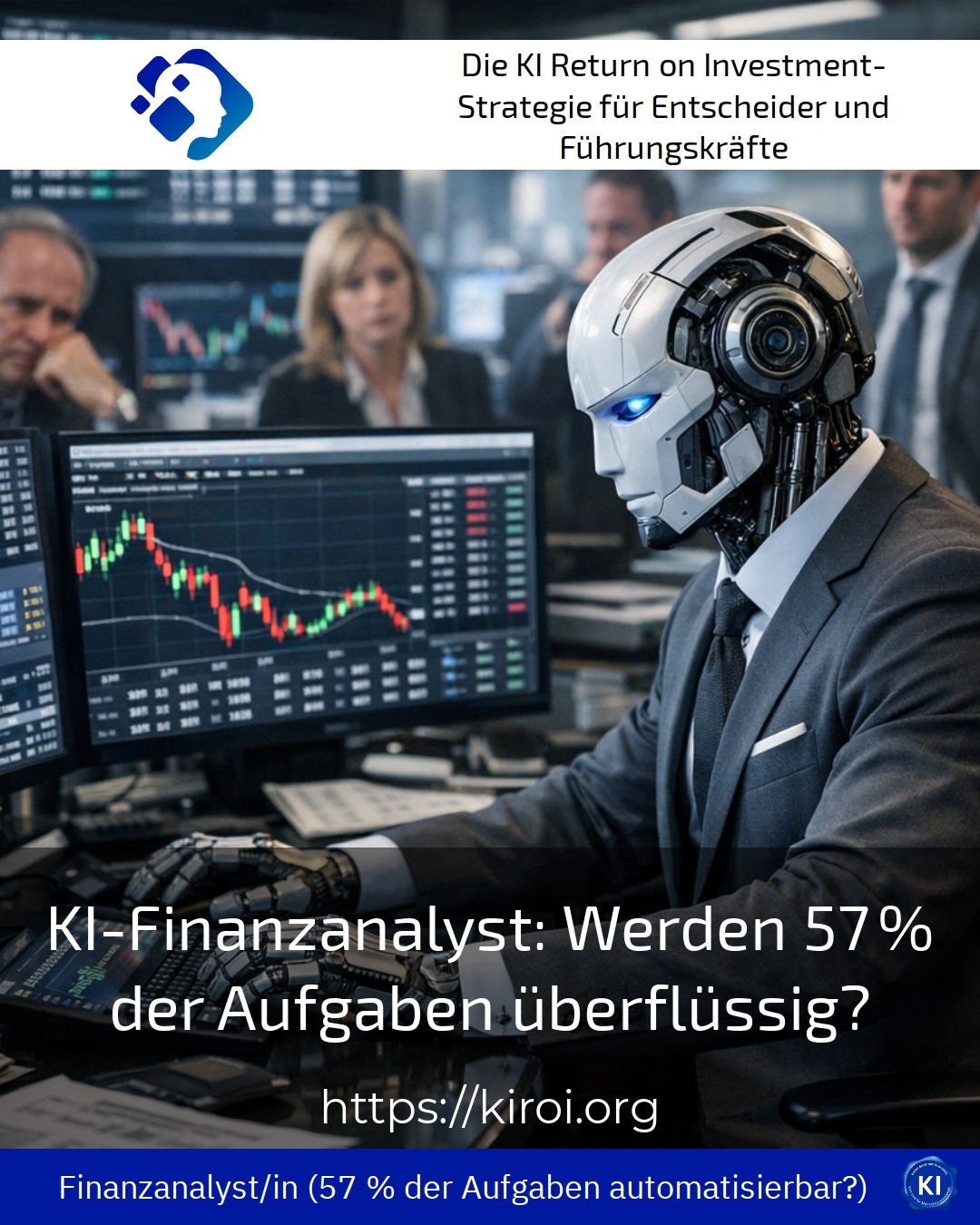
This question currently concerns numerous experts in the financial world, because the figures from the Job Future report show a remarkable development [1]. The AI financial analyst It is increasingly coming to the forefront of the discussion because automated systems can now take on a significant portion of traditional analytical tasks. Many professionals are therefore wondering whether their professional future is still secure. The transformation affects not only individual areas of responsibility, but fundamentally changes the entire professional image.
Understanding the automation potential in the financial sector
The Institute for Labour Market and Occupational Research has created a tool with the Job-Futureometer that makes the substitutability of professions transparent. The 57 percent determined refer to core activities that could be replaced by technological solutions. This does not involve a complete replacement of humans, but rather a change in the division of tasks. The AI financial analyst As a supporting system, it handles repetitive and data-intensive processes.
The analysis of quarterly reports represents a classic example of automated tasks. Algorithms can evaluate hundreds of business reports in just a few minutes and extract relevant metrics. The same applies to monitoring market movements in real time. Automated trading systems react to price changes faster than any human analyst could ever be. The creation of standardized investment recommendations is also increasingly automated. This results in portfolio recommendations based on historical data and risk profiles.
The AI financial analyst in everyday practice
In practice, intelligent systems are already changing the way financial services are conducted today. Robo-advisors advise private investors on investment strategies and create individual recommendations. Algorithms scour news portals for relevant information to make investment decisions. Credit institutions are using machine learning to assess credit risks. These developments reflect the profound changes that have taken place in the industry.
The analysis of balance sheet figures now takes place in fractions of a second. Systems detect patterns in financial data that human analysts would be unable to detect. The prediction of stock price developments uses complex neural networks. Fraud detection systems automatically identify suspicious transactions in real time. These technological advances significantly increase efficiency.
Best practice with a AIROI customer
A medium-sized wealth management company approached us with a specific challenge. The analysts spent a large part of their working time manually analyzing company reports. This time-consuming activity drained valuable resources and prevented strategic work. As part of our transruptive coaching support, we developed a transformation roadmap together. We implemented a system for automated preliminary analysis of business reports. The employees received training on effective use of the new tools. Within six months, the company was able to double its analysis capacity. At the same time, the satisfaction of the analysts increased, as they could now focus on more demanding tasks. Customer service gained depth and quality, which was reflected in measurable business results. This example shows how well-thought-out support can be achieved for projects involving intelligent technologies.
Which activities remain reserved for human professionals?
Despite all technological advancements, there are areas where human expertise remains indispensable. Interpreting complex economic policy contexts requires experience and intuition. Customer relationships are based on trust and personal communication. Ethical evaluations of investment decisions require human judgment. The AI financial analyst It supports here, but does not replace the human element.
Consulting companies on mergers and acquisitions requires strategic thinking. Negotiations over terms for large projects require empathy and persuasive power. The development of innovative financial products requires creativity. These skills cannot be fully replicated by machines. People bring contextual knowledge that algorithms lack.
New competence requirements in the age of intelligent systems
The changes require an adaptation of professional qualifications. Financial professionals must understand how automated systems work. Critical evaluation of machine analyses becomes a core competency. Data analysis skills are gaining in importance because interpreting results is crucial. Soft skills such as communication and emotional intelligence become more valuable.
The ability to collaborate across disciplines distinguishes successful professionals from others. Project management skills enable the management of complex transformation processes. Lifelong learning becomes a fundamental prerequisite for professional success. This development affects both entry-level professionals and experienced analysts alike. The industry is undergoing a profound transformation.
Best practice with a AIROI customer
A private bank with a long tradition faced the challenge of preparing its analytical teams for the digital future. The senior management realized that resistance to change could only be overcome by involving employees. Together with our transruptive coaching team, we developed a comprehensive qualification program. The analysts learned to critically question and supplement machine analyses. Workshops provided the basics of data analysis and machine learning. The employees became active agents of transformation rather than passive participants. After a year, clients often reported an increased level of job satisfaction. The bank was able to improve its competitive position and reach new customer groups. This project shows how important the human dimension is in technological change.
The role of transruption coaching in transformation
Companies and professionals need guidance in this profound transformation. The purely technical implementation of new systems is too short-sighted. Successful transformation takes into account organizational and cultural factors equally. Transruptions coaching positions itself as guidance for projects surrounding these complex changes. External impulses can break through entrenched patterns of thinking.
Many professionals come to us with fears of professional obsolescence. Others seek guidance in reorienting their careers. Executives ask for strategies to help their teams navigate the transformation journey. These diverse concerns require individual approaches. A one-size-fits-all solution does not exist in this context.
Balancing the opportunities and risks of technological development
Automation offers significant opportunities for the financial sector. More detailed analyses lead to better investment decisions. Cost savings enable more attractive terms for customers. Faster response times improve competitiveness. AI financial analyst As a tool, this can help unlock these benefits.
At the same time, there are risks that should not be ignored. Systemic errors in algorithms can have far-reaching consequences. Focusing on a few technology providers creates dependencies. Job losses in certain sectors are not to be ruled out. A balanced approach takes into account both sides of this development.
The question of the fair distribution of productivity gains also arises. Regulatory frameworks must keep pace with technological development. Data protection and algorithmic transparency are gaining in importance. These societal aspects will significantly influence the future development of the industry.
My AIROI Analysis
The figures from Job Futuremate illustrate an irreversible development in the financial sector. However, the 57 percent of tasks that can be automated do not mean the end of skilled work in this field. Rather, a shift towards higher-value tasks is evident, requiring human strengths such as creativity, empathy, and strategic thinking. Companies that actively shape this transformation will emerge as winners.
For professionals, proactive engagement with technological possibilities is recommended. Training in data analysis and the understanding of automated systems creates future security. The combination of traditional financial expertise and technological know-how will be particularly valuable. These hybrid competencies differentiate sought-after specialists from more replaceable generalists.
The human component remains central because financial markets are ultimately shaped by people. Algorithms can recognize patterns, but cannot capture the full complexity of economic relationships. The future belongs to the collaboration between humans and machines, not to complete automation. Companies and individuals who master this partnership will benefit from the changes. Guidance from experienced coaches can significantly facilitate this path and help avoid stumbling blocks.
Further links from the text above:
[1] Job-Futuromat of the Institute for Employment Research
For more information and if you have any questions, please contact Contact us or read more blog posts on the topic Artificial intelligence here.








 Deutsch
 English (UK)