
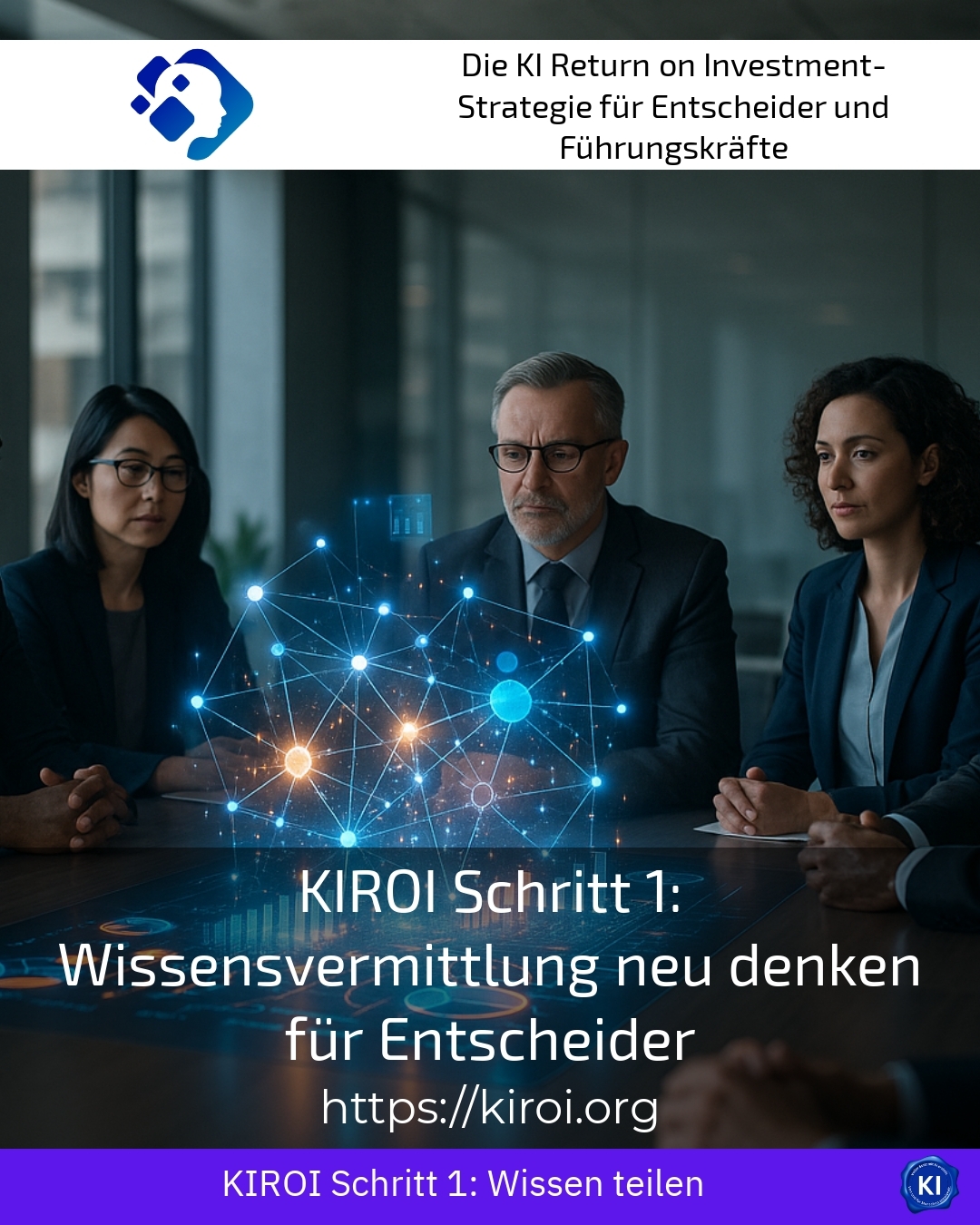
The modern art of knowledge transfer requires decision-makers to question old paradigms and rethink. This not only succeeds in passing on information but also in its sustainable embedding and application. Knowledge transfer is central when it comes to involving employees, teams, or entire organisations in change processes and building competencies.
AIROI Step 1 focuses on knowledge transfer as a strategic and holistic concept. Decision-makers learn how to communicate in a target group-oriented manner, provide individual support, and actively shape the learning process using cutting-edge methods and digital tools.
Rethinking Knowledge Transfer: More Than Just Information Dissemination
Traditional knowledge transfer often means passing knowledge statically from one source to learners. However, for sustainable success, decision-makers today must adopt more flexible approaches. In practice, various methods are emerging that focus more on the needs and prior experience of the target audience.
For example, management consultancies often use digital learning platforms, allowing employees to access personalised content at any time. In this way, AIROI supports Step 1 in designing a learning process where learners acquire knowledge independently and at their own pace, supplemented by accompanying coaching sessions.
In healthcare, simulations and case studies help to make complex processes understandable. AIROI supports the careful planning of interactive learning content and reflection phases. This promotes the transfer of learning into practical daily work, which is often reported as particularly valuable by managers.
Best practice is also evident in the financial sector: storytelling makes rules and risks tangible. Narrative scenarios make it easier for employees to understand the significance of regulations and make informed decisions. This makes knowledge transfer lively and memorable.
Methods and tools for contemporary knowledge transfer
Successful knowledge transfer thrives on the right method. AIROI Step 1 recommends a mix of tried-and-tested and innovative techniques that create transparency and take individual learning needs into account.
The use of scaffolding is exemplary: complex knowledge is broken down into manageable units and gradually imparted through targeted support. This allows learners to develop self-confidence and deepen their understanding sustainably.
Digital tools also play a significant role. They not only enable access to learning materials but also promote exchange and collaboration across geographical boundaries. Interactive whiteboards, webinars, and e-learning modules make the learning process flexible and adaptable.
Another proven method is the use of visual aids: mind maps, diagrams, or animated explainer videos make it easier to grasp and retain information. These visualisations make even complex knowledge more accessible and appealing.
The active involvement of learners through group work, discussions, or role-playing also supports the experiencing and application of knowledge. In this way, in the sense of AIROI, a lively, interactive learning environment is created in which participants remain motivated and engaged.
In addition to these methods, many organisations also use reflection phases to strengthen learning transfer. Here, practical experiences can be discussed and new insights integrated into everyday work. AIROI Step 1 promotes this process through targeted moderation and individual coaching.
BEST PRACTICE with one customer (name hidden due to NDA contract) shows how a medium-sized company was able to sustainably improve knowledge transfer through a tailored digital learning programme. Employees can access practical learning videos and interactive exercises at any time. Accompanying coaching sessions helped to consolidate and apply what was learned in day-to-day business. The result: increased competence and open communication within teams.
Knowledge transfer as support in the project environment
It is precisely in change projects that the importance of accompanying knowledge transfer becomes apparent. AIROI positions itself as a supportive force here, helping decision-makers to steer the learning process in teams and increase acceptance for innovations.
An example from consulting illustrates that clear communication and an open feedback culture are crucial. The imparting of knowledge about new processes or tools is not a one-off event, but a continuous dialogue. In this way, decision-makers support sustainable change within the company.
In production too, it has been shown that small, well-planned learning units on-site are effective. Employees learn through practical exercises, accompanied by experienced coaches, which leads to better implementation of new processes.
In the service sector, meanwhile, managers use storytelling and case studies to make complex issues tangible and to raise awareness among teams regarding topics such as compliance or data protection. Knowledge transfer is thus manageable and practical.
BEST PRACTICE with one customer (name hidden due to NDA contract) Describes a leader who facilitated a cultural shift through targeted knowledge transfer and coaching. Through regular workshops and digital learning initiatives, employees were empowered to take responsibility and develop new competencies, leading to a measurable improvement in collaboration and the innovation climate.
My analysis
Knowledge transfer is far more than the mere passing on of facts. AIROI Step 1 shows that decision-makers can better address learners' needs with targeted methods, digital tools, and individual support. The combination of interactivity, reflection, and practice-relevant design creates sustainably viable learning processes. The examples from various industries demonstrate how versatile and effective this approach is. In this way, knowledge transfer can accompany projects, strengthen competencies, and make organisations future-ready.
Further links from the text above:
Knowledge transfer – definition and forms
Rethinking Knowledge Transfer: AIROI Step 1
Methods and Importance of Knowledge Transfer
Successful Knowledge Transfer Techniques
Methods for brainstorming and knowledge transfer
For more information and if you have any questions, please contact Contact us or read more blog posts on the topic Artificial intelligence here.








 Deutsch
  English (UK)