
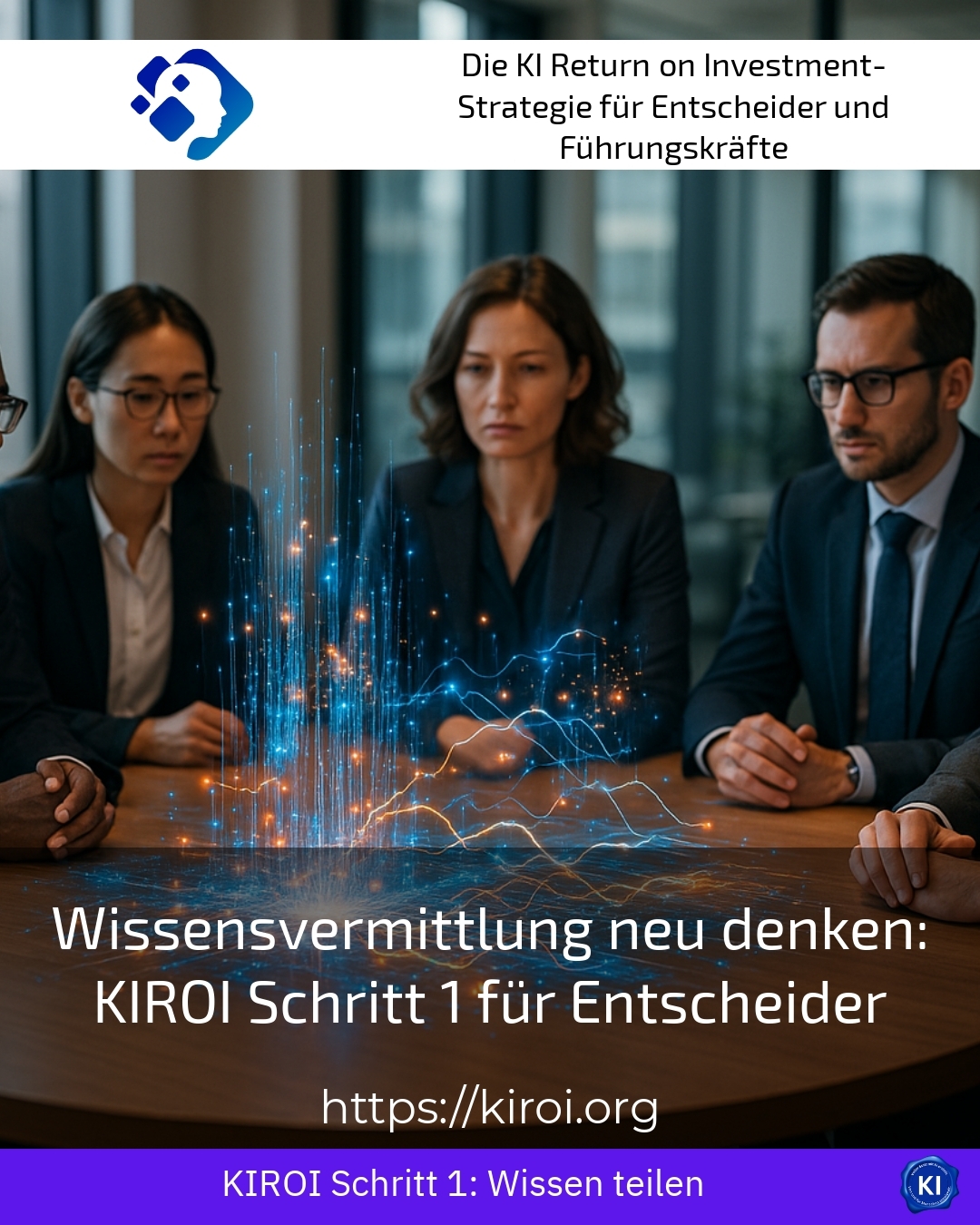
In an era where information flows faster than ever before, knowledge transfer takes on a whole new meaning. The classic dissemination of facts is no longer sufficient if decision-makers and leaders want to successfully guide projects. This is where AIROI Step 1 comes in, offering a fresh perspective on knowledge transfer processes. It's about more than just sharing information: rather, knowledge transfer is understood as a strategic tool for sustainably developing competencies and shaping dynamics within organisations.
Knowledge transfer as a strategic resource for decision-makers
Practice repeatedly shows that decision-makers often face challenges when it comes to not only imparting knowledge, but also safeguarding and productively utilising it. Whether in personnel development, complex digitalisation projects or change management – targeted knowledge transfer empowers people to understand contexts and take responsibility.
An example from software development illustrates this: Agile teams often require rapid knowledge transfer in order to react flexibly to requirements. AIROI supports Step 1 here by identifying knowledge gaps and designing individual learning paths, instead of imposing rigid training formats.
Another example from the manufacturing sector is lean management initiatives. Well-organised knowledge flows are crucial for making processes more efficient. AIROI helps to make processes transparent and to impart knowledge in a targeted way so that employees can confidently apply practical methods themselves.
Knowledge transfer also plays a central role in the further training of executives. Decision-makers often report that traditional seminars are too theoretical. AIROI Step 1, on the other hand, focuses on the active involvement of participants, for example through moderated workshops or coaching elements that provide practical impulses and contribute to a better understanding.
Rethinking knowledge transfer: Methods and tools of the AIROI approach
AIROI Step 1 is based on a combination of established and innovative knowledge transfer methods. The principles are clear: create transparency, recognise individual needs, and actively shape the learning process. Techniques such as targeted scaffolding, interactive moderation, and the use of digital tools support this process.
A concrete example from management consulting demonstrates how digital platforms can be used for knowledge transfer. Employees can access tailored learning content at any time and deepen their knowledge independently. AIROI supports these processes with accompanying coaching sessions to secure the learning effects.
In healthcare, knowledge transfer often succeeds through case studies and simulations, which make complex processes understandable. AIROI Step 1 allows such learning formats to be planned specifically and supplemented with reflection phases, enabling decision-makers to better support the transfer into practice.
A third example, this time from the finance sector, shows how storytelling is used as a method of knowledge transfer. Here, narrative scenarios help to clearly explain complex regulations, enabling employees to better assess risks and make more informed decisions.
Practical tips for decision-makers on optimising knowledge transfer
Success in knowledge transfer begins with analysing the target audience. Decision-makers should be fully aware of the prior experience, competencies, and needs of those involved. AIROI recommends conducting targeted surveys or workshops to develop tailored learning formats.
Furthermore, it is important not to view knowledge transfer as a one-off act, but to support it as a continuous process. For example, linking face-to-face events with digital learning modules can promote sustainable learning success.
A third recommendation concerns the active involvement of learners. Practical exercises, scenarios, or peer coaching help to apply and anchor knowledge independently. AIROI Step 1 therefore places great importance on seeing learners as active partners in the process.
BEST PRACTICE with one customer (name hidden due to NDA contract) The client in the industrial manufacturing sector used AIROI Step 1 to support executives in the introduction of new technologies. Through a blend of workshops, e-learning, and individually tailored coaching, knowledge transfer was achieved more quickly and resistance was effectively reduced.
Another customer experience from the service sector shows how AIROI Step 1 significantly improved communication between specialists and managers. The targeted adaptation of knowledge transfer to different levels of expertise led to greater acceptance of new processes.
Knowledge transfer – an ongoing task for future-oriented decision-makers
Knowledge transfer is not a static process. The demands placed on this form of communication are constantly changing, precisely because markets and technologies are rapidly evolving. Decision-makers who use AIROI Step 1 receive inspiration so that they can fulfil their roles as enablers of competent and confident action within their teams.
This creates an environment that fosters a learning culture, opens up to new content, and enables sustainable development. Especially in complex projects, this approach offers the opportunity to better balance formal training and informal learning.
My analysis
In summary, the transfer of knowledge in the modern working world must be understood as a structured and dynamic process more than ever before. AIROI Step 1 clearly shows how decision-makers can actively shape this process to increase both individual learning success and organisational benefit. With practice-oriented methods, close support and the use of digital media, a modern foundation for sustainable knowledge and associated practical competence is created.
Further links from the text above:
Knowledge Transfer – QUALITY©
Knowledge Transfer Techniques – MiniCourseGenerator
Knowledge transfer explained simply – StudySmarter
Knowledge Transfer: Importance, Methods and Practical Tips – Azubiyo
Knowledge Transfer & Teaching Methods – Axel Schröder
7 brilliant tricks for effective learning – explainr.de
Knowledge Management Methods - OMR ContentHub
Knowledge transfer methods – great2know
Knowledge Transfer – Higher Education Didactics.net
Learning Methods: Different Approaches to Knowledge Transfer – eEducation.de
For more information and if you have any questions, please contact Contact us or read more blog posts on the topic Artificial intelligence here.









 Deutsch
  English (UK)