
Why do so many leaders fail to unleash the full potential of intelligent technologies in their organisations, even though the tools have long been available?
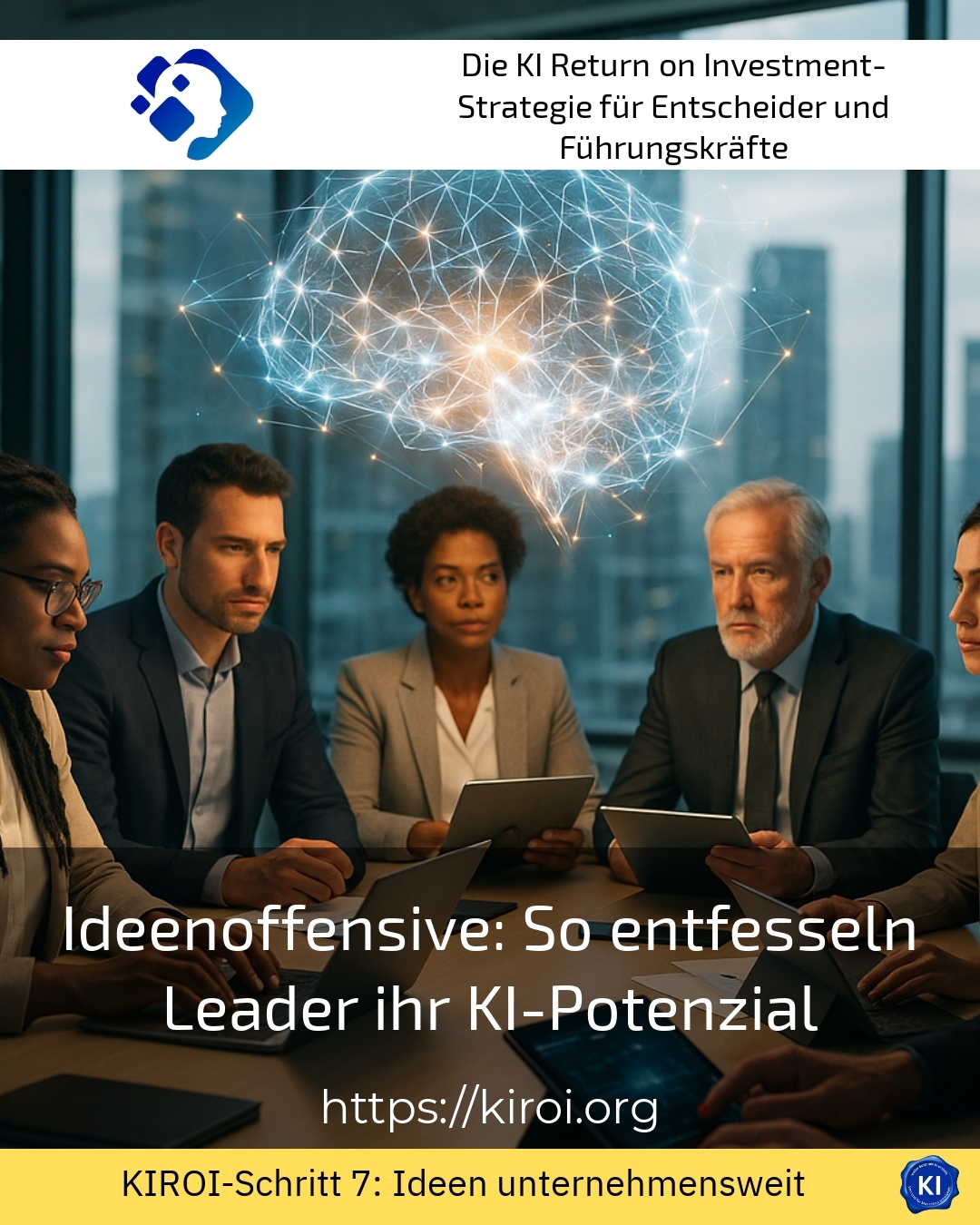
This question occupies decision-makers in almost all branches of industry. The answer often does not lie in the technology itself. Rather, it is hidden in the way people think and act. A genuine Ideas offensive: How leaders unleash their AI potential therefore begins in the mind. It requires courage, curiosity and the willingness to question entrenched patterns. Many leaders report that they initially sought orientation. Transruption coaching accompanies precisely this journey and provides valuable impetus for change.
The importance of a new leadership approach for the ideas offensive
Today, leadership means far more than simply managing processes and resources. In a world that is changing rapidly, leaders must act as pathfinders. They create spaces for creative thinking and experimental action. A medium-sized mechanical engineering company from southern Germany, for example, recognised that traditional hierarchies were blocking innovation. The management therefore opted for flatter structures and regular idea workshops. The result positively surprised everyone involved.
Another example comes from the logistics sector. A freight forwarding company with over five hundred employees introduced weekly innovation sessions. There, all staff members could put forward suggestions, regardless of their position. The response was impressive and led to measurable improvements. A hospital in the Ruhr region also took a similar path. The nursing management organised monthly future discussions with the entire team. This resulted in pragmatic solutions for everyday life on the wards.
These examples show that real change must start from the top. Leaders set the framework and model openness. They encourage their teams to express unconventional ideas too. Only in this way can a culture be created in which intelligent systems can unleash their full potential.
How leaders unleash their AI potential through a systematic approach
Systematics and creativity are not mutually exclusive. On the contrary, they complement each other in a fruitful way. A structured approach helps to develop concrete projects from vague ideas. A retail company from Hamburg relied on a three-stage process. First, teams collected problems from day-to-day business. Subsequently, experts evaluated the automation potential of each challenge. Finally, everyone jointly prioritised the most promising approaches.
An energy supplier from the Rhineland chose a different path. It held an internal competition for innovative application ideas. The best proposals received a budget for pilot projects. In this way, practical solutions were created directly from the workforce. An insurance company from Frankfurt also experimented with new formats. It invited external catalysts and organised two-day creative workshops. During these, the participants developed over thirty concrete project outlines.
Best practice with a AIROI customer A long-established family business in the food industry was facing a unique challenge. The third generation had taken over the leadership and wanted to gently modernise the company while preserving the tried-and-tested corporate culture. transruptions coaching accompanied the new management team through this sensitive transformation process over several months. Together, we developed a roadmap that combined traditional values with forward-looking methods. The workforce was involved right from the start and was able to contribute its own suggestions. It quickly became apparent that many employees already had innovative ideas that had not been heard before. Through regular reflection sessions and structured experiments, several promising pilot projects emerged. The intelligent analysis of production data led to a significant reduction in waste. In addition, employee satisfaction improved measurably because people finally felt they were being taken seriously. Today, the company reports a palpable sense of optimism across all departments.
Cultural change as the foundation of the ideas offensive: How leaders sustainably unleash their AI potential
Technology alone does not change organisations. People do this through their daily actions and decisions. That is why every successful transformation needs a viable cultural foundation. An automotive supplier from Bavaria invested heavily in the further training of its managers. They learned to accept uncertainty as a normal part of innovation. They developed skills in handling experimental projects and iterative processes.
A telecommunications provider went a step further. It established so-called innovation ambassadors across all business areas. These multipliers carried new ways of thinking into their teams and gathered feedback from practice. This created a vibrant network that continuously learned from one another. A pharmaceutical company from the Black Forest also focused on cultural change. Human resources devised a programme specifically for middle management. Methods were taught there to foster psychological safety in teams.
Clients frequently report that it was precisely the soft factors that proved decisive. The best technology is of little use if people are afraid of change. That is why transruptions coaching does not merely accompany strategic questions. It also supports leaders in creating an atmosphere of trust.
Practical Tools for Daily Leadership Work
Theoretical knowledge must be translated into concrete action. For this, leaders need practical tools and proven methods. For example, a construction company from North Rhine-Westphalia introduced daily short reflections [1]. Every morning, each team discussed for five minutes which tasks might be suitable for intelligent support. This simple routine significantly sharpened awareness of optimisation potential.
A media company from Berlin used a different technique. It established so-called learning partnerships between experienced managers and younger talent. Both sides benefited from this exchange in different ways. The older participants gained fresh perspectives on technological possibilities. The younger ones learned how to navigate complex change processes with political savvy. A chemical company from central Germany also developed its own methods. It created a catalogue of questions that was worked through for every investment decision.
These tools must be tailored to the organisation in question. There is no one-size-fits-all solution for all companies and sectors. The AIROI Master Plan concept provides a flexible framework that can be customised [2]. This results in bespoke approaches for different starting points.
Overcoming obstacles and using resistance productively
Change always generates resistance too. Clever leaders understand this dynamic and use it constructively. A financial services provider from Stuttgart had interesting experiences. Initially, many employees categorically rejected new technologies. The management decided to take these concerns seriously and discuss them openly. In the process, it turned out that behind the rejection there were often justified worries.
A textile company in Saxony experienced something similar. The production management feared they would lose importance through automation. However, a detailed discussion clarified that their expertise became even more important precisely because of this. In future, they were to design the interface between human and machine. A hospital in Lower Saxony also reported initial difficulties. The medical staff initially saw intelligent systems as a threat to their own competence.
Transruptions coaching supports leaders in mastering such situations with confidence. It provides impulses for appreciative communication and constructive dialogue, enabling resistance to be transformed into productive energy.
Best practice with a AIROI customer A medium-sized plant engineering company was going through a difficult phase. The industry was changing rapidly and competitive pressure was constantly increasing. The management recognised that fundamental changes were necessary in order to remain successful in the long term. However, there was a great deal of uncertainty among the workforce regarding the future of the company. Many employees feared for their jobs and therefore blocked change initiatives. As part of the transruption coaching, we jointly developed a communication strategy that combined transparency with empathy. The management provided regular updates on the status of the transformation and actively sought feedback. At the same time, training opportunities were created that opened up new prospects for the employees. The establishment of an innovation laboratory, where teams could try out new ideas, was particularly effective. This resulted in several prototypes for improved service offerings, which are now successfully on the market. The mood in the company shifted from fear to cautious optimism. Today, managers report that the initial resistance ultimately led to better solutions.
The role of experiments and learning loops
Innovation rarely happens through a masterstroke. Rather, it develops through many small steps and continuous learning. A retailer from the Ruhr region made this experience very clear [3]. They started with a modest pilot project in just one branch. Insights were gathered and mistakes were made there without affecting the entire company.
A software company from Munich chose a similar approach. It established two-week experimentation cycles for selected teams. After each cycle, results were presented and insights documented. This created a growing body of knowledge from which everyone could benefit. A hotel group from Switzerland also experimented with new formats. It initially tested intelligent concierge services at just one location.
This iterative approach significantly reduces risks. At the same time, it remarkably accelerates organisational learning. Leaders should therefore create spaces for controlled failure. Only in this way can truly innovative solutions emerge.
My AIROI Analysis
The examples and experiences described illustrate a central point. The ability to unleash the potential of intelligent technologies depends significantly on the leadership culture. Technical competence is naturally important and should not be underestimated. However, without a corresponding mindset among decision-makers, many possibilities remain unutilised.
My analysis of the various projects and accompaniments shows clear patterns of success. Organisations that focus on participation and transparency at an early stage achieve better results. They manage to transform initial resistance into constructive energy. Furthermore, they develop a greater adaptability to changing framework conditions. The Ideas offensive: How leaders unleash their AI potential therefore requires holistic thinking.
At the same time, I observe typical pitfalls that keep recurring. Many managers underestimate the time required for genuine cultural change. They expect quick results and become impatient when these fail to materialise. Others delegate the subject entirely to specialist departments instead of taking responsibility themselves. Both frequently lead to unsatisfactory results.
The AIROI framework provides a tried-and-tested framework for this complex challenge. It combines strategic perspectives with practical tools for day-to-day use. At the same time, it remains flexible enough to be adapted to different contexts. Support from experienced coaches can significantly accelerate the transformation process. It helps to avoid typical pitfalls and to learn from the experiences of others. This makes the journey towards a smarter future easier and more successful for everyone involved.
Further links from the text above:
[1] Harvard Business Review – Leadership Insights
[2] AIROI Master Plan – Strategy Development for Smart Technologies
[3] McKinsey Digital Insights – Transformation Best Practices
For more information and if you have any questions, please contact Contact us or read more blog posts on the topic Artificial intelligence here.










 Deutsch
  English (UK)