
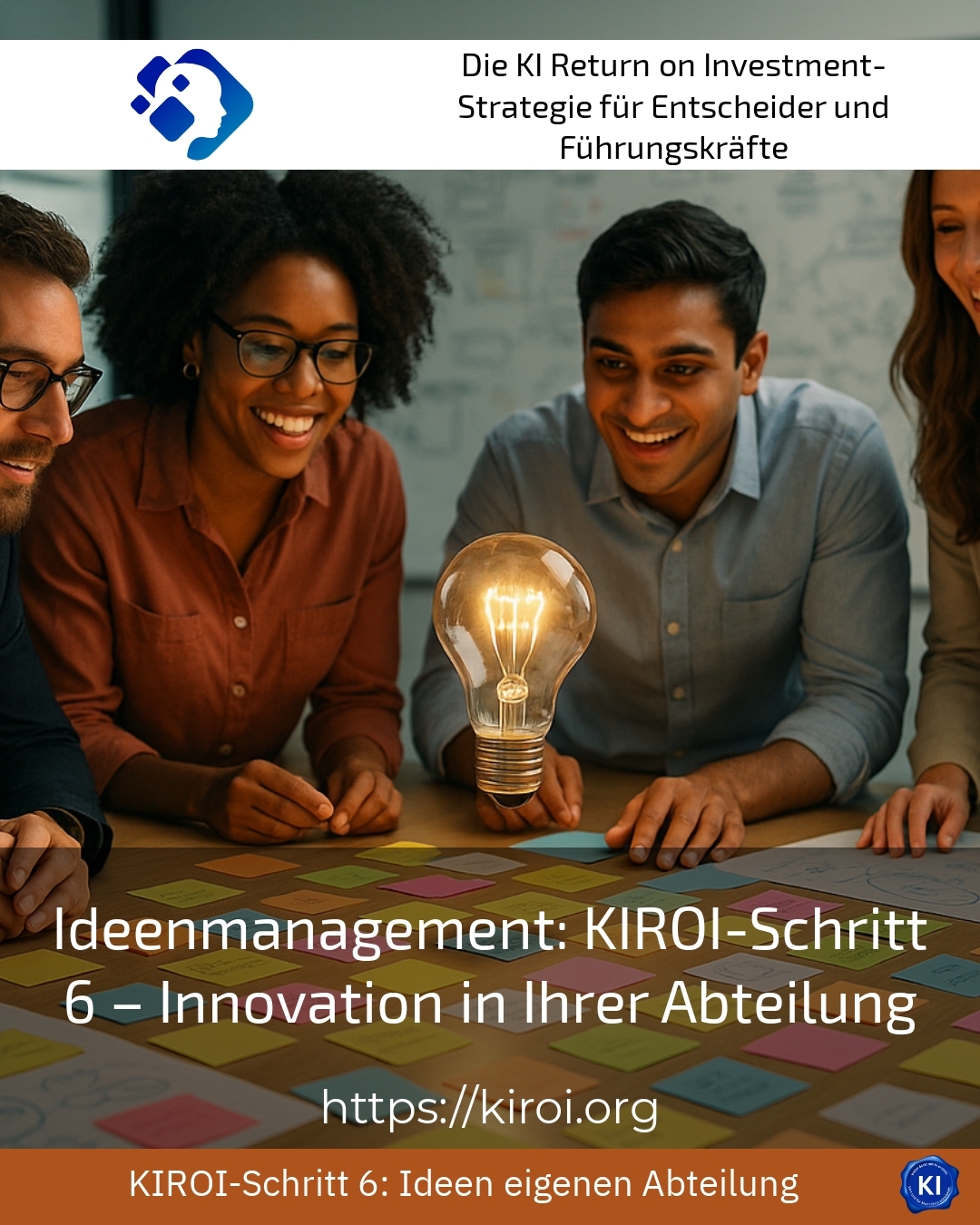
Ideas management is a key lever for creating sustainable momentum for change and development within your team – and at all levels. Many companies are finding that traditional methods are no longer sufficient to truly unlock the innovative power of their employees. This is precisely why a systematic approach like KIROI Step 6 is gaining importance, as it understands ideas management as a structured process that is guided from the initial idea to implementation. This creates real potential for change that has a lasting impact and involves everyone involved[1].
Idea management as a foundation for innovation in the department
At its core, idea management isn't just about collecting suggestions; it's about creating an environment where creative solutions can emerge, be evaluated, and ultimately be implemented. The KIROI step 6, in particular, demonstrates how to specifically trigger innovative impulses within your department by addressing the teams' experiences and challenges in a practical manner. This leads to approaches that truly integrate into daily work – whether in logistics, HR administration, or sales[1][6].
Clients frequently report that suggestions go nowhere or no feedback is received. This is demotivating and stifles innovative capacity. With a clear structure, transparent criteria, and regular feedback, it's possible to reduce inhibitions and increase employee motivation. Regular workshops, digital tools for idea management, and an open feedback culture are important enablers here. This allows you to effect real changes that go beyond short-term actions.
Examples of successful idea management – industry insights from practice
The potential of idea management is particularly evident across various industries. In personnel-intensive administration, for example, regular exchange helped to develop innovative shift rosters that specifically reduced employee stress levels. Transparent dialogue and mutual trust formed the basis for these improvements. In sales, data-based tools were used to better assess sales opportunities, benefiting both customers and employees equally[6].
In logistics, idea management led to dynamic route planning, which reduced delivery times and increased efficiency. An IT company relied on automated ticket management to reduce repetitive requests and create space for creative projects. A field service team optimised visit intervals, thereby increasing customer satisfaction. These examples show that a structured approach facilitates innovations that have a direct impact on the business [6].
Idea management with digital tools and clear processes
Another success factor is the use of special software solutions that facilitate the collection, prioritisation, and implementation of ideas. Digital platforms provide transparency and traceability, especially in larger teams or across multiple locations. The involvement of all stakeholders, clear responsibilities, and user-friendly operation are key aspects for the breakthrough of new approaches[5].
To establish an innovative culture in the long term, you should regularly question and adapt processes. Open communication, innovation awards, and targeted recognition motivate your employees to get actively involved. This makes idea management a driver for continuous improvements – not just in individual projects, but in everyday company life as a whole[5].
Here is an example from industrial manufacturing:
BEST PRACTICE with a customer (name hidden due to NDA contract): A manufacturing company specifically utilised workshops and digital platforms to identify and remove obstacles hindering the implementation of new ideas. Through modern support with KIROI Step 6, the pace of innovation significantly accelerated, and collaboration between different departments intensified sustainably. Transparent documentation and regular feedback increased acceptance for changes, allowing many improvements to be quickly put into practice [4].
Implementing idea management in practice – tips and coaching
Many companies wonder how to concretely approach idea management. The key lies in combining clear objectives, structured processes, and an open culture of error. To begin, define what changes you want to achieve, for example, process optimisation, increased employee satisfaction, or innovative product ideas. Then, together with your team, collect suggestions, evaluate them based on understandable criteria, and decide which ideas should be implemented.
To overcome blockages and develop new perspectives, guidance from experienced coaches is recommended. Transruption coaching supports teams in openly addressing challenges, finding solutions together, and taking concrete implementation steps. This is how individual ideas transform into sustainable innovations that ensure long-term business success.
Practically, this means: introduce regular exchange rounds where all employees can contribute their suggestions. Use digital tools to create transparency and document progress. Establish responsibilities for implementation early on and provide targeted feedback to the idea generators. This ensures that commitment is rewarded and motivation for future projects remains high[6].
Here is another example from practice:
BEST PRACTICE with a customer (name hidden due to NDA contract): A service company integrated a digital suggestion platform, allowing all locations to submit and comment on suggestions for improvement. Automated workflows ensured that incoming ideas were quickly reviewed and implemented if they received positive feedback. The active participation of all teams led to a noticeable increase in the speed of innovation and better coordination between departments. The targeted support from external coaches, who regularly facilitated workshops and thus promoted exchange, was particularly effective[4].
Ideas Management – A Driver for the Future
The potential of ideas management is diverse. It's not just about cost reduction or increasing efficiency, but above all about integrating the knowledge and creativity of the entire workforce. Those who regularly introduce new impulses and create space for exchange lay the foundation for a sustainable innovation culture. This allows you to remain flexible in the competition and proactively meet challenges.
At the same time, experience shows that traditional methods are often no longer sufficient. Modern companies therefore rely on flexible processes, digital tools, and a culture of open communication. Support from experienced coaches helps teams to recognise blockages, develop new perspectives, and take concrete steps towards implementation[2].
My analysis
Ideas management is a crucial factor for unleashing and sustainably strengthening innovative capacity within a department. Those who specifically instigate change, establish transparent processes, and acknowledge employee engagement create a culture in which innovations can emerge. KIROI Step 6 offers a structured framework that accompanies this from idea generation to implementation. This results in practical solutions that propel the company forward – and sustainably so[1][6].
For more information and if you have any questions, please contact Contact us or read more blog posts on the topic Artificial intelligence here.
Further links from the above text:
Ideas Management: Make Your Department Innovative with KIROI Step 6 [1]
Scaling idea management company-wide with KIROI Step 7 [4]
With KIROI Step 6 to the Innovation Department [6]
Rethinking ideas management: KIROI step 7 company-wide [2]
Idea management success factors [5]











 Deutsch
  English (UK)