
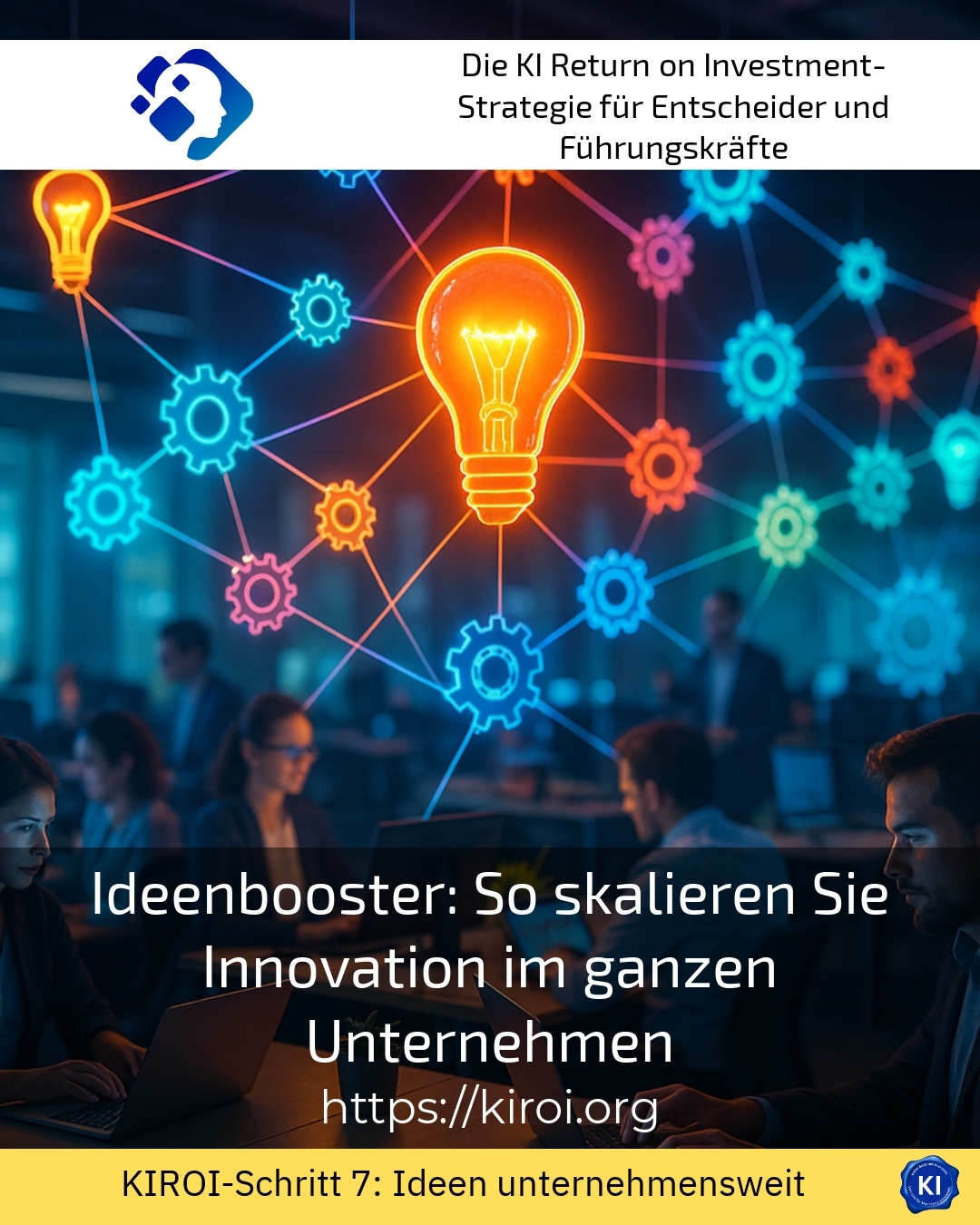
Imagine your company possesses an inexhaustible well of creative ideas, continuously bringing fresh impetus into all departments while systematically generating growth. The Idea Booster: How to Scale Innovation Throughout the Company describes precisely this mechanism that is fundamentally transforming many organisations. Yet how do you succeed in ensuring this seemingly magical process is not left to chance, but is strategically anchored? The answer lies in structured methods and a corporate culture that elevates every single employee into an active co-creator.
Why conventional approaches reach their limits
Many companies rely on isolated creative workshops or sporadic brainstorming sessions. These methods generate short-term enthusiasm. In the long run, however, the results often fizzle out without effect. A medium-sized mechanical engineering group, for example, reported that out of a hundred suggestions gathered, only three were actually implemented. This discrepancy frustrates employees and undermines trust in corporate innovation processes. A technology provider in the automation sector experienced something similar when it discovered that its research department barely communicated with sales. The most valuable insights from customer conversations never reached the developers. A third example shows a logistics company whose decentralised locations operated completely independently of each other, solving identical problems multiple times without knowing about one another.
This fragmentation not only wastes resources, but also prevents real growth. That is why organisations require systematic structures that channel and multiply creative energy.
The Idea Booster: How to scale innovation across the entire company through cultural change
Real change begins in people's minds and subsequently manifests itself in processes and structures. Managers play a crucial role in this. They must demonstrate through their own behaviour that experimentation is welcome and that mistakes are viewed as opportunities for learning. For example, a chemical company introduced so-called „Failure Fridays“, where teams talked openly about failed projects. This transparency significantly reduced the fear of failure. A financial services provider, on the other hand, integrated regular innovation discussions into its annual employee appraisals. As a result, creative engagement became part of performance assessment. An energy supplier, in turn, established cross-departmental tandem partnerships in which, for instance, a controller worked together with an engineer on ideas for improvement.
Cultural change requires patience and consistency. Transruptive coaching can support organisations in shaping this transformation sustainably. The external perspective often helps to uncover blind spots and break up ingrained patterns of thought.
Best practice with a AIROI customer
An internationally active automotive supplier faced the challenge of better connecting its globally distributed development locations while at the same time preserving local expertise. The management recognised that valuable insights from the Asian market rarely found their way to Europe and vice versa. As part of a structured support process, we jointly developed a digital platform that not only functioned as a repository of ideas, but actively established connections between thematically related proposals. The system automatically identified employees with complementary skills and suggested project-related collaborations. Within eighteen months, twelve patentable new developments emerged from this, three of which already went into series production. Particularly noteworthy was the fact that the most successful innovations stemmed from unexpected combinations, such as when a quality engineer from Mexico jointly developed a novel testing method with a software developer from Germany. The cultural shift also manifested itself in measurable metrics: employee satisfaction in the area of creative development opportunities rose by twenty-four percentage points.
Technological infrastructure as an enabler
Digital tools form the backbone of modern innovation systems. They enable asynchronous collaboration across time zones and sustainably document knowledge. For example, a pharmaceutical company uses AI-powered text analysis to automatically establish cross-references between internal research reports and external publications [1]. A construction company implemented virtual ideation spaces where employees could visualise their proposals and have them evaluated by colleagues. A retail company relied on gamified elements where particularly committed innovators collected points and received recognition.
However, technology alone is never enough. It must be embedded into a well-thought-out process. The Idea Booster: How to Scale Innovation Throughout the Company therefore always requires the combination of digital tools and human guidance.
Idea booster: How to scale innovation across the entire business through structured processes
Successful organisations define clear phases for the innovation process. These range from initial idea submission and evaluation to implementation. One telecommunications provider established a three-stage funnel: initially, it collected all proposals in an open pool. Subsequently, interdisciplinary teams assessed feasibility. Finally, selected projects received dedicated resources. An insurance company went a step further, linking the innovation process with its strategy development cycle. As a result, operational insights flowed directly into strategic decisions. A food manufacturer, in turn, used regular innovation fairs where departments presented their projects and competed for internal investment.
This structuring prevents good ideas from petering out. At the same time, it creates transparency regarding the current status of individual projects.
The role of leaders in scaling
Leaders act as door openers and enablers. They create leeway for experimentation and protect innovative projects from premature criticism [2]. For example, a technology company introduced a rule whereby managers were never allowed to reject innovation proposals outright. Instead, they had to work together with the originator to find ways to make improvements. A consultancy established so-called innovation budgets, which team leaders could manage independently without having to go through lengthy approval processes. An industrial corporation even anchored the promotion of innovation in the target agreements of its upper management level.
Transruption Coaching supports leaders in reflecting on and further developing their role in the innovation process. Clients frequently report that it was only through external guidance that they became aware of how their own behaviour was unconsciously blocking their teams' creative impulses.
Measurability and continuous improvement
What isn't measured cannot be improved. That is why companies need meaningful metrics for their innovation activities. For example, a software company tracks „time to implementation“, which is the period between submitting an idea and its initial execution. A consumer goods manufacturer measures the proportion of revenue generated by products launched in the last three years. A mechanical engineering firm, on the other hand, records the number of cross-departmental collaborations that arise from its innovation programme.
These metrics enable data-driven decisions on the further development of the innovation system. They also show where bottlenecks exist and which measures are particularly effective.
Best practice with a AIROI customer
A medium-sized family-owned business in the medical technology sector was looking for ways to carry its long-standing culture of innovation into the digital era without losing its tried-and-tested values. A significant proportion of the workforce consisted of long-standing employees who were sceptical about new digital tools. Together, we developed a hybrid approach combining analogue and digital elements. Physical idea boards in the production halls were fitted with QR codes, allowing employees to submit their suggestions digitally as well. Experienced colleagues acted as innovation mentors, helping younger employees to formulate their technical ideas in a practical way while simultaneously benefiting from their digital skills. The programme was accompanied by intensive training that not only imparted technical skills but also boosted the participants' self-confidence. After two years, the number of submitted suggestions for improvement had tripled, and the implementation rate stood at a remarkable thirty-two percent. Particularly gratifying was the fact that several employees who were initially considered sceptics became some of the company's most active innovators.
Harnessing external stimuli and networks
Innovation thrives on a diversity of perspectives. This is why successful companies consciously open up their processes to the outside. For example, a chemical corporation cooperates with universities to translate basic research into applicable solutions more quickly [3]. A mobility provider runs a start-up accelerator programme, giving it early access to disruptive technologies. A financial institution regularly organises hackathons to which external developers are also invited.
This openness requires courage and clear rules for dealing with intellectual property. However, the benefits usually clearly outweigh the risks.
My AIROI Analysis
The systematic scaling of creative processes represents one of the central leadership tasks of our time. Organisations that neglect this aspect risk their long-term competitiveness. The examples presented clearly show that no one-size-fits-all recipe exists. Every company must find its own path that suits its respective culture, industry and starting point. However, the decisive factor is the combination of cultural change, technological infrastructure and structured processes. None of these elements alone is sufficient. Leaders bear the responsibility to create the necessary framework conditions and to lead by example. Transruption coaching can provide valuable impetus in this regard and serve as a mirror for blind spots. The measurability of innovation activities enables continuous improvement and protects against complacency. External networks enrich the internal pool of ideas and bring in fresh perspectives. Ultimately, it is about viewing every single employee as a potential source of valuable contributions and involving them accordingly. Companies that implement this consistently often report surprising side effects: increased employee satisfaction, reduced staff turnover and a noticeably more positive working atmosphere. The Idea Booster: How to Scale Innovation Throughout the Company is therefore far more than a tool for product development. It transforms the entire organisational culture and makes companies fit for a future whose contours we can only guess at today.
Further links from the text above:
[1] McKinsey: The Eight Essentials of Innovation
[2] Harvard Business Review: Innovation Articles
[3] World Intellectual Property Organisation: Innovation Resources
For more information and if you have any questions, please contact Contact us or read more blog posts on the topic Artificial intelligence here.








 Deutsch
  English (UK)