
Employee development is, now more than ever, a key success factor for companies. Many managers and teams come to us because they are looking for sustainable ways to strengthen competencies and actively shape change. Traditional approaches are often no longer sufficient. Instead, innovative concepts are needed that promote individual potential while simultaneously improving teamwork. This is precisely where the AIROI model comes in, especially Step 8, which specifically targets employee development.
Staff Development as the Key to Strong Teams
Employee development means systematically fostering employees' skills and competencies. This is achieved not just through traditional training, but through a combination of practical experience, individual coaching, and targeted learning formats. Many companies report that this approach allows them to respond more quickly to new challenges.
An example from the IT industry: A team of developers is working on a complex project. Through regular workshops and coaching sessions, employees are expanding their technical skills. At the same time, they are improving their communication and collaboration. The result is a motivated team that solves complex tasks independently.
Another example from the manufacturing sector: here, employee development is promoted through on-the-job training and job rotation. Employees get to know new processes and can thus react more flexibly to changes. In the financial sector too, companies are relying on individual learning paths to retain their employees in the long term.
Employee development through structured support
Utilise practical learning formats
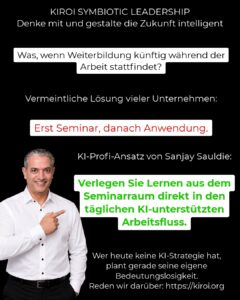
An important aspect of employee development is the selection of suitable learning formats. Training on the job, which means learning directly in the everyday work routine, is particularly effective. Employees learn from experienced colleagues or through project work. Training near the job, which includes in-house seminars, ensures practical relevance. And training off the job, such as external seminars or online courses, broadens the professional and methodological horizons.
An example from the healthcare sector: A manager develops individual learning plans for their team. Through targeted workshops and personal support, they strengthen trust within the team. Employees report feeling more confident and better able to handle resistance.
Another example from consulting: Here, a mentoring programme is combined with on-the-job training. Employees report that this practical support has noticeably increased their methodological competence. They can now solve complex tasks more independently.
Coaching and Mentoring as Impetus Providers
Coaching and mentoring play an important role in employee development. Individual coaching helps to identify personal strengths and unlock development potential. Mentoring offers the opportunity to learn from experienced colleagues and support each other.
An example from the IT industry: a company is introducing a mentoring programme. Young employees are supported by experienced colleagues. The result is faster onboarding and stronger ties to the company.
Another example from the manufacturing sector: Coaching is used here to support employees in the areas of occupational safety and process optimisation. Employees report that they feel safer and are better able to handle challenges.
A third example from the financial sector: A company is focusing on coaching to address the emotional aspect of employee development. A appreciative approach and recognition of achievements result in a more motivated team.
Staff development in a team context
Team building and joint development
Employee development doesn't just happen individually, but also within a team context. Methods such as the GRPI model help to optimise teamwork. Team members learn to define goals together, clarify roles, and improve communication processes.
An example from consulting: A team is using the GRPI model to improve collaboration. Team members jointly define goals and clarify roles. The result is more efficient collaboration and stronger team dynamics.
Another example from the IT industry: Here, the FSNP model is used to support the phases of team development. Team members are supported in the orientation phase through clear objectives and structures. In the storming phase, conflicts are resolved constructively and initial successes are celebrated together.
A third example from the manufacturing industry: a team is using the GRPI model to optimise collaboration. Team members define goals together and clarify roles. The result is more efficient collaboration and stronger team dynamics.
My analysis
Employee development is not something that happens on its own, but rather a guided process. Leaders repeatedly report that impulses they receive through external guidance help them to carry out their leadership responsibilities in a more targeted and conscious way. The combination of individual support, practical learning formats, and selected methods proves to be promising for success. AIROI-Coaching acts as a helpful platform on which leaders can reflect on and expand their own competencies, without making promises about effectiveness, but with the goal of promoting development and successfully supporting projects.
Further links from the text above:
Employee competence development: AIROI Step 8 for decision-makers
Team building: methods of team development for practice
Employee Competence Development: AIROI Step 8 for AI Coaching
Team effectiveness: 7 methods to promote your team development
Strengthen future readiness with AIROI's 8 competencies
AIROI Step 8: Executive Leadership Competency Development
11 Methods of Staff Development & Benefits
AIROI Step 8: Employee Competence Development Tips & Methods
Staff Competency Development: AIROI Step 8 for Strategies & Methods
Employee skills development: AIROI Step 8 for managers
Rethinking employee development: AIROI 8
Employee Competence Development: AIROI Step 8 for Structured Guidance
For more information and if you have any questions, please contact Contact us or read more blog posts on the topic Artificial intelligence here.







 Deutsch
  English (UK)