
Employee development is at the heart of every sustainable corporate strategy today. It is more than traditional further training because it specifically unlocks individual and entrepreneurial potential. Those who focus on continuous employee development secure decisive advantages in the competitive landscape and prepare their teams for upcoming challenges, especially in times of rapid digital transformation.
The KIROI Approach: Eight Competencies for Sustainable Employee Development
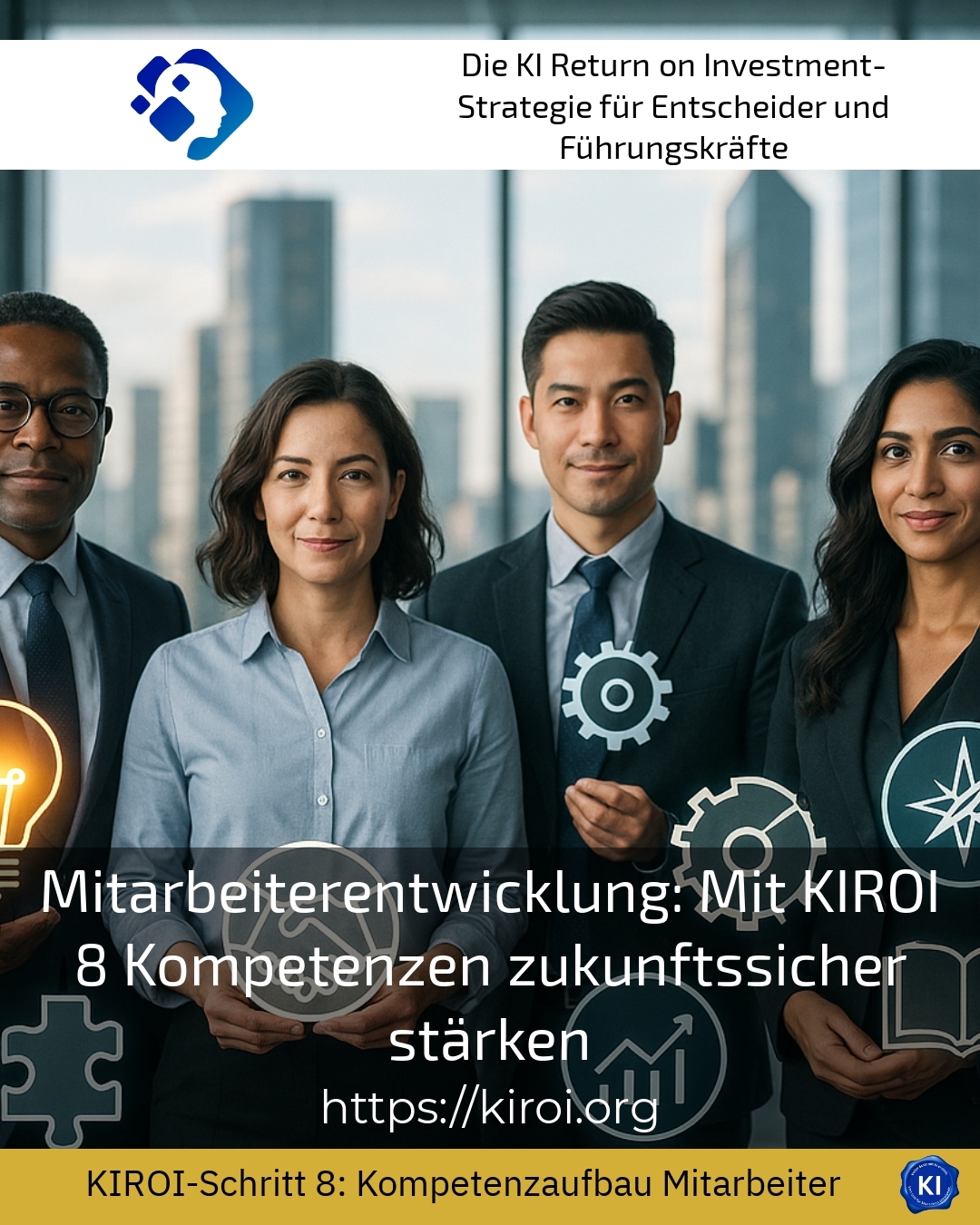
The KIROI framework systematically structures employee development around eight core competencies: technical, methodological, social, and communicative know-how, digital affinity, innovative strength, willingness to learn, and openness to new things. Companies that specifically strengthen these competencies regularly report higher motivation, better teamwork, and smoother change processes. Employee development thus becomes a driving force for entrepreneurial success – and remains not an end in itself, but an integral part of the corporate culture.
Professional competence: Building expertise
Expertise forms the foundation of effective employee development. It encompasses the specific knowledge required for each role. In practice, targeted training, on-the-job training, and job rotation help to build technical skills. For example, employees in customer service can learn how to handle complex inquiries efficiently, or in production, they can apply innovative manufacturing processes. Companies that align their employee development with specific tasks ensure that knowledge is directly integrated into daily work and can be used immediately.
Methodical and digital competence: Agility and digital sovereignty
Methodological competence enables teams to solve tasks in a structured way and to adapt to new requirements. Agile working methods, project management and digital tools play a central role in this. One example: A company gradually introduced agile methods, thereby promoting flexibility and collaboration, even in virtual teams. Employee development was closely linked to the real challenges of the project to enable sustainable change. Digital competence, in turn, is demonstrated by how confidently employees handle new technologies. Digital learning platforms, webinars and internal tool training significantly support this development.
BEST PRACTICE with one customer (name hidden due to NDA contract) As part of employee development, several teams were trained to support the introduction of a digital quality management system. Through practical workshops and individual coaching, employees were able to specifically expand their knowledge and gained more confidence in using new tools. Product quality improved significantly because sustainable skills development and company goals went hand in hand.
Social and communication skills: Cooperation and customer focus
Teamwork, empathy, and strong communication are crucial for modern working. Employee development promotes social competence by enabling interdisciplinary projects, fostering a feedback culture, and offering targeted training. In practice, customers benefit particularly when teams learn to process concerns effectively while simultaneously navigating new communication channels. Companies report that a stronger customer focus and improved internal collaboration directly result from targeted employee development.
BEST PRACTICE with one customer (name hidden due to NDA contract) The digitalisation of customer service was accompanied by coaching impulses. The teams learned to actively listen to customer conversations, resolve conflicts constructively, and use digital channels. Employee development was flexible and perfectly tailored because it was aligned with actual work challenges. Customer satisfaction increased measurably because the employees could purposefully adapt their behaviour.
Innovative strength, willingness to learn and openness: Shaping cultural change
Innovation arises when employees remain curious and actively shape change. Employee development supports this attitude by creating room for experimentation, fostering a culture of accepting mistakes, and regularly reflecting on learning processes. Companies that introduce innovation workshops and internal idea competitions report more creative solutions and a greater sense of identification with the company. In this way, a willingness to learn and openness become the brand core of modern organisations.
Transruptions Coaching as a Support for Employee Development
Transruptions-Coaching supports companies looking to systematically expand their employee development, particularly with projects focusing on digitalisation, AI, and agile transformation. The approach relies on practical insights, individual feedback loops, and sustainable support at one's own pace of learning. Transruptions-Coaching avoids rigid promises of success, instead creating space for genuine development – because employee development is always individual and supported by the company culture. Clients frequently report that this guidance not only increases their confidence in dealing with new technologies but also allows them to actively shape their own role in the change.
BEST PRACTICE with one customer (name hidden due to NDA contract) In a service sector company, workshops focused on digital affinity were specifically conducted. The teams were able to implement software introductions smoothly and felt better supported. Employee development was accompanied by transruption coaching, which provided space for open questions, practical experimentation, and regular reflection. This fostered a culture in which change is perceived as an opportunity, not a threat.
Practical tips for implementing effective employee development
Employee development is successful when it is consistently practised and regularly adapted.
- Begin with an individual skills analysis to highlight strengths and areas for development.
- Opt for a mix of formal and informal learning formats – from classic training sessions and digital learning modules to peer learning.
- Involve employees actively in setting goals and co-create development plans.
- Create spaces for hands-on experimentation and support mistakes as learning opportunities.
- Integrate regular feedback and reflection into the daily workflow.
These measures ensure that employee development is more than just lip service, but becomes a lived practice. Companies that implement these tips report higher employee retention, increased innovation, and greater adaptability to market changes.
My analysis
Employee development is not a short-term project, but a continuous process that makes companies future-proof. Systematically strengthening the eight KIROI competencies creates a culture in which change is understood as an opportunity. Transruption coaching professionally accompanies this path individually. This benefits not only the employees, but the entire company – and sustainably secures competitive advantages in an ever-changing world of work.
Further links from the text above:
Methods of Employee Development & Benefits [1]
Employee Qualification: Strengthening 8 Competencies with KIROI [2]
Instruments and Methods of Personnel Development [3]
For more information and if you have any questions, please contact Contact us or read more blog posts on the topic Artificial intelligence here.











 Deutsch
  English (UK)