
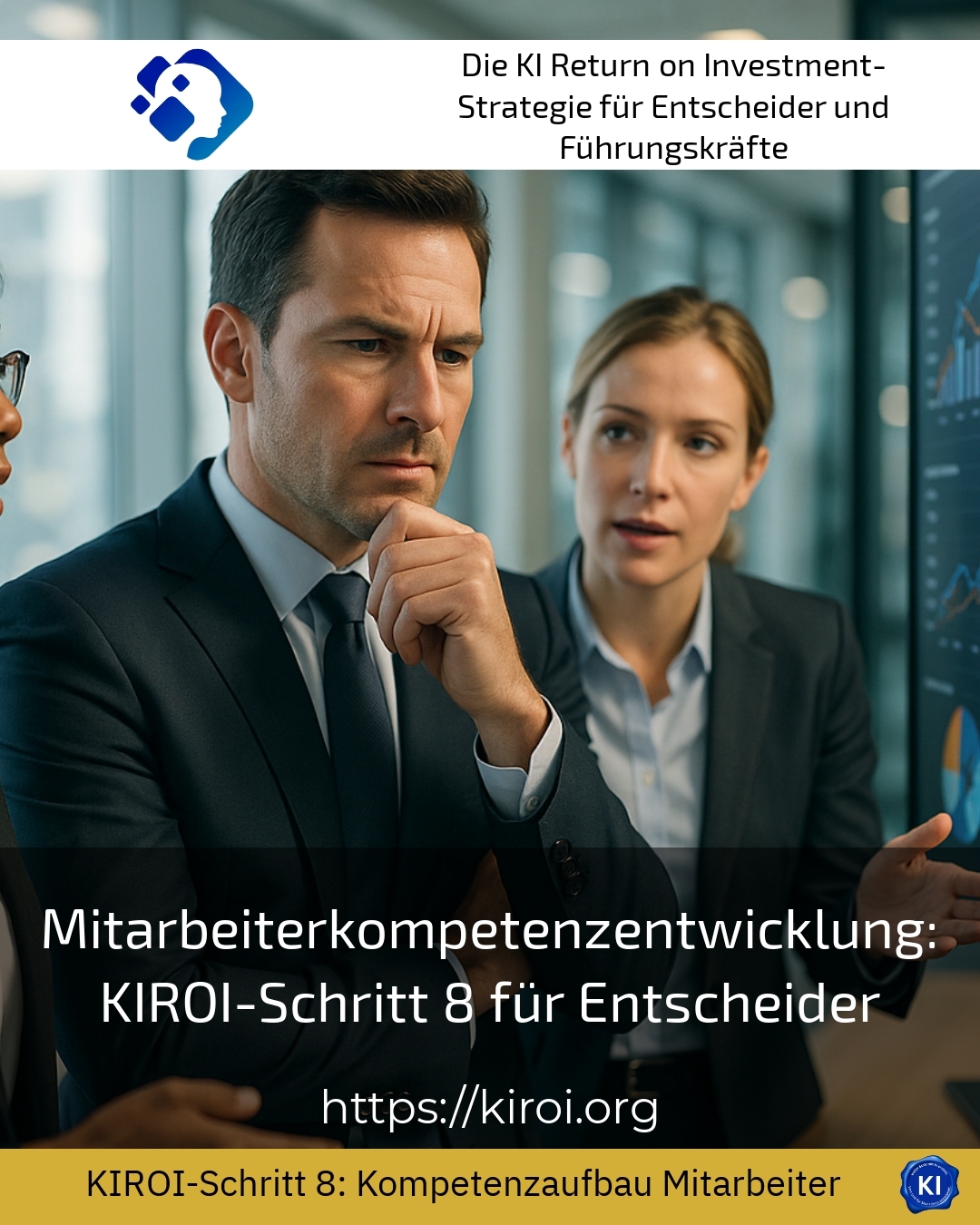
Employee competence development is becoming increasingly important in today's working world. It is especially crucial for decision-makers to design this process in a targeted and sustainable manner. Step 8 of the AIROI model offers numerous valuable impulses for specifically fostering and developing competencies, particularly in connection with innovative technologies such as Artificial Intelligence (AI). This article will guide you through the essential aspects and demonstrate practical examples of how employee competence development can be successfully implemented.
Employee competence development in the context of modern business management
Employee competence development includes not only the imparting of practical knowledge but also requires systematic support for employees. Responsible managers must recognise, promote, and adapt competencies to future requirements. AIROI Step 8 focuses on the targeted development of employees, supported by coaching, individual learning paths, and the use of intelligent technologies.
Examples from different industries illustrate the benefits: In the IT sector, AI helps suggest individual training offers that take into account suitable programming languages or frameworks. In the manufacturing industry, automated analyses identify training needs and address them promptly. In the financial sector, AI-powered career planning enables transparent development and thus retains qualified employees in the long term.
Practice-oriented methods for employee skills development
Typical methods of employee competence development can be divided into three levels:
- On a practical level, employees learn directly in the workplace through job rotation, project work, or on-the-job training.
- The coaching level includes individual support through mentoring or professional coaching, offering feedback, self-reflection, and impetus for further development.
- At the training level, structured workshops, seminars and training courses are used to specifically develop technical and social skills.
In practice, a combination of these methods often proves to be particularly effective. For example, companies in the healthcare sector report that employees have been able to noticeably improve their communication and professional skills through practical team projects and accompanying coaching. At the same time, digital learning platforms, for instance in the media industry, enable flexible learning for all target groups.
Examples from consulting practice
BEST PRACTICE with a client (name withheld due to NDA): The company from the automotive industry has introduced a targeted skills development plan using AIROI-Step 8. Employees were supported through personalised learning paths, covering both technical skills and soft skills such as teamwork and a passion for innovation. This led to a measurable increase in project quality and employee motivation.
Another example from the telecommunications sector illustrates how coaching was used to identify and specifically develop individual strengths. Furthermore, managers received training to better fulfil their role as development facilitators and to support change.
AI-powered tools have been implemented in the logistics industry to automatically identify training needs. This has supported the HR department in providing suitable training more quickly and precisely, leading to more efficient overall employee competency development.
AI and coaching as decisive factors in employee skills development
The use of Artificial Intelligence can significantly simplify the development process. AI analyses individual skills and learning needs, suggests tailor-made training, and thus enables personalised support. This helps to overcome learning obstacles and motivates employees to actively participate in their skills development.
Coaching complements these technological aids with human expertise. Coaches support teams and individuals, creating a space for reflection and personal growth, and imparting strategies for dealing with challenges. This allows leaders to strengthen their role as enablers and to sustainably accompany the development process.
This combination is often relied upon in the energy sector: AI-based learning paths and individual coaching combine to prepare employees in a targeted manner for new tasks and technologies. In the service sector too, managers report positive effects from this integrated approach.
Recommendations for decision-makers on promoting employee competence development
To successfully implement AIROI Step 8, decision-makers should consider the following points:
- Systematically analyse current and future skills requirements.
- Foster an open feedback culture that supports learning and development.
- Utilise digital tools and AI to efficiently identify and nurture individual potential.
- Opt for a blend of practice, training, and coaching for holistic competency development.
- Actively involve managers in the development process so they act as mentors and catalysts.
In particular, the combination of technologies and personal support has proven effective in retaining employees long-term and fostering innovative processes.
My analysis
Employee competency development is an ongoing process that goes far beyond mere advanced training. Step 8 of the AIROI model demonstrates what modern and sustainable support can look like. Through the targeted use of AI and coaching, individual learning paths are created that open up new perspectives and development opportunities for employees. For decision-makers, this concept offers valuable tools to actively shape change in companies and strengthen competitiveness. Transparent communication and an appreciative corporate culture support the long-term success of the measures.
Further links from the text above:
Competence Development: Definition + Successful Examples [1]
Mastering employee development: AIROI step 8 for managers [2]
What is competence development? – teamazing Glossary [3]
AI as a threat or an opportunity in times of skills shortages? [4]
AIROI step 8: Strengthen employee development in a targeted manner with AI [6]
Skills development: importance and methods [7]
For more information and if you have any questions, please contact Contact us or read more blog posts on the topic Artificial intelligence here.








 Deutsch
  English (UK)