
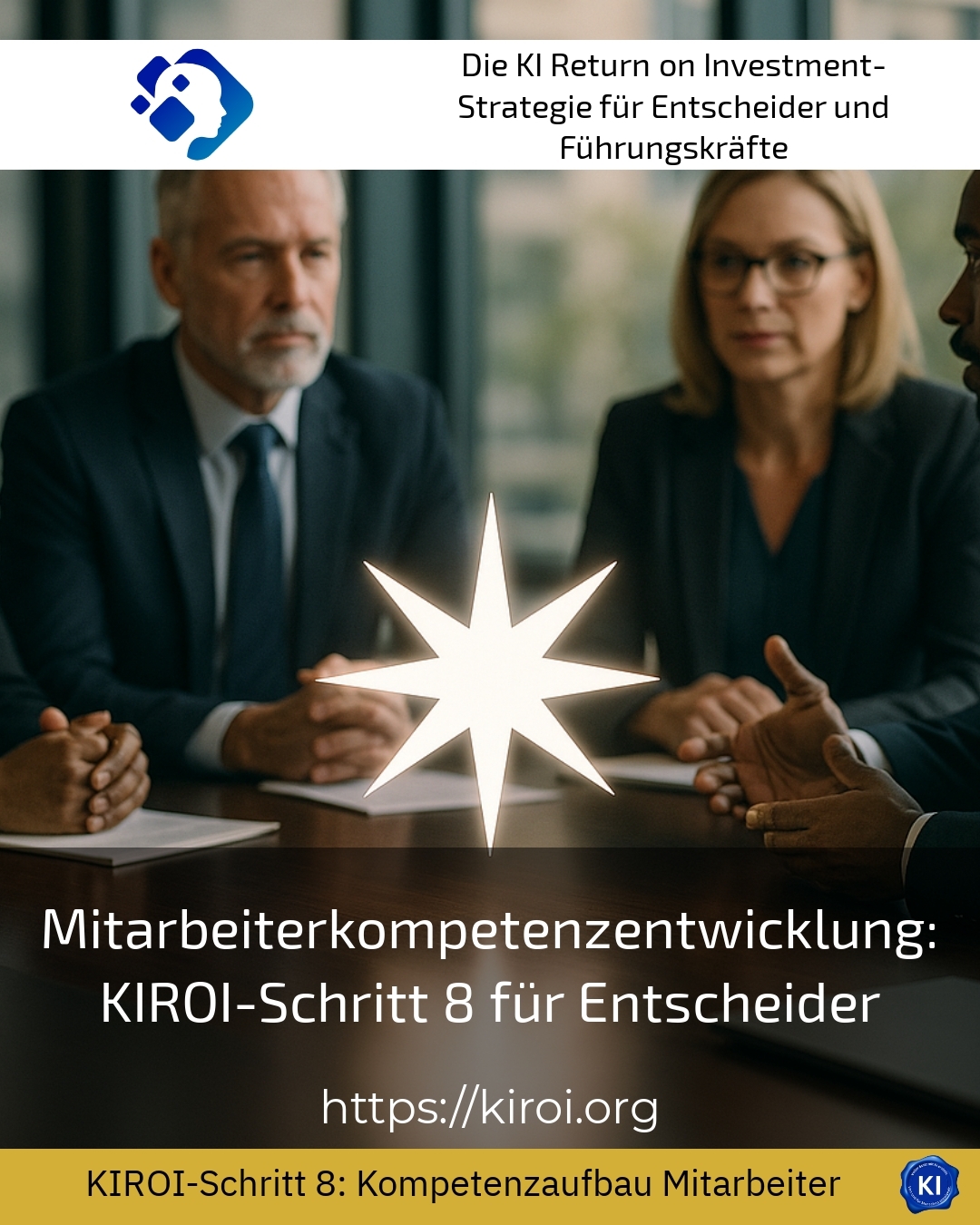
**Employee competence development** presents a central challenge for companies, and at the same time, a crucial opportunity. In particular, the eighth step of the AIROI model supports decision-makers in designing this complex development process in a structured and effective way. This blog article presents practical approaches, concrete examples, and proven methods that show how company management can sustainably promote competence building among employees.
Staff Competence Development: Fundamentals and Added Value for Decision-Makers
The term employee competence development refers to the targeted promotion of employees' technical, methodological, and social skills. For decision-makers, it is essential to understand this process as a long-term investment in competitiveness. Employee competencies should not only be expanded but also integrated into everyday work and applied in concrete projects.
Companies from a wide variety of sectors report how, for instance, job rotation in the manufacturing industry enables employees to react flexibly to changing production requirements. In healthcare, case-related workshops increase understanding of complex patient situations. In the IT sector, innovation workshops create space for acquiring agile methods and new technologies. These initiatives demonstrate that practice-oriented learning and interactive coaching effectively advance employee competency development.
AIROI Step 8: Structured Support for Competence Building
The eighth step in the AIROI model focuses on targeted skills development. Decision-makers receive practice-oriented tools that enable them to support the development of their employees. A combination of several learning formats that have proven effective in practice is recommended:
- On-the-Job Training Employees learn directly on the job, for instance from experienced colleagues or through project work.
- Training on the Job Theoretical content is delivered in company seminar rooms to ensure practical relevance.
- Training off the Job: External seminars and online courses broaden the professional and methodological horizons.
Accompanying coaching plays an important role. Individual coaching helps to recognise personal strengths, overcome challenges, and unlock development potential. This promotes the precise development of skills where they are most needed.
BEST PRACTICE with one customer (name hidden due to NDA contract) A mentoring programme combined with on-the-job training has been introduced in a medium-sized technology company. Employees are reporting that this practical support has noticeably increased their methodological competence, and they are now able to solve complex tasks more independently.
Case studies and a variety of methods from industry practice
In the service industry, for example, regular team reflection sessions are used to improve social skills and collaboration. In retail, flexible e-learning platforms promote self-directed skills development that adapts to individual learning needs. In manufacturing, job rotation demonstrates how employee knowledge is broadened and adaptability is strengthened.
Alongside classic training methods, the integration of Artificial Intelligence is gaining importance. AI-powered learning programmes offer personalised recommendations and help to make learning progress transparent. Thus, employee competency development can be supported in a more targeted and efficient manner.
Recommendations for decision-makers on promoting employee competence development
Decision-makers should create a learning-conducive culture that perceives development as a continuous process. The following impulses support this:
- Targeted competency analyses to identify current and future development needs.
- Individual learning paths tailored to the strengths and challenges of employees.
- Regular reflection through coaching to identify and adjust progress and obstacles.
- Promoting the exchange of experiences through peer groups, masterminds or case studies.
- The integration of digital tools to enable learning independent of location and time.
In demanding change processes, AIROI-Coaching supports leaders in incorporating diverse perspectives and responding flexibly to learning needs. This leads to sustainable learning success, strengthening the company's competitiveness.
My analysis
Employee competence development is a multifaceted task that finds tried-and-tested guidance for decision-makers in AIROI Step 8. It becomes clear that a structured combination of practical learning, personal coaching, and targeted training units creates the best conditions for building competencies effectively. Continuous reflection and open collaboration are crucial here. Companies that actively support these processes can rely on a flexible, learning-ready workforce and thus remain sustainable in the market.
Further links from the text above:
Employee development with AIROI: Step 8 - Building competences
AIROI step 8: Developing employee expertise for decision-makers
Competence Development: Definition + Successful Examples
Skills development: importance and methods
Mastering employee development: AIROI step 8 for managers
For more information and if you have any questions, please contact Contact us or read more blog posts on the topic Artificial intelligence here.








 Deutsch
  English (UK)