
Why do brilliant ideas go unheard in so many departments, even though the potential for ground-breaking change is waiting right on the doorstep?
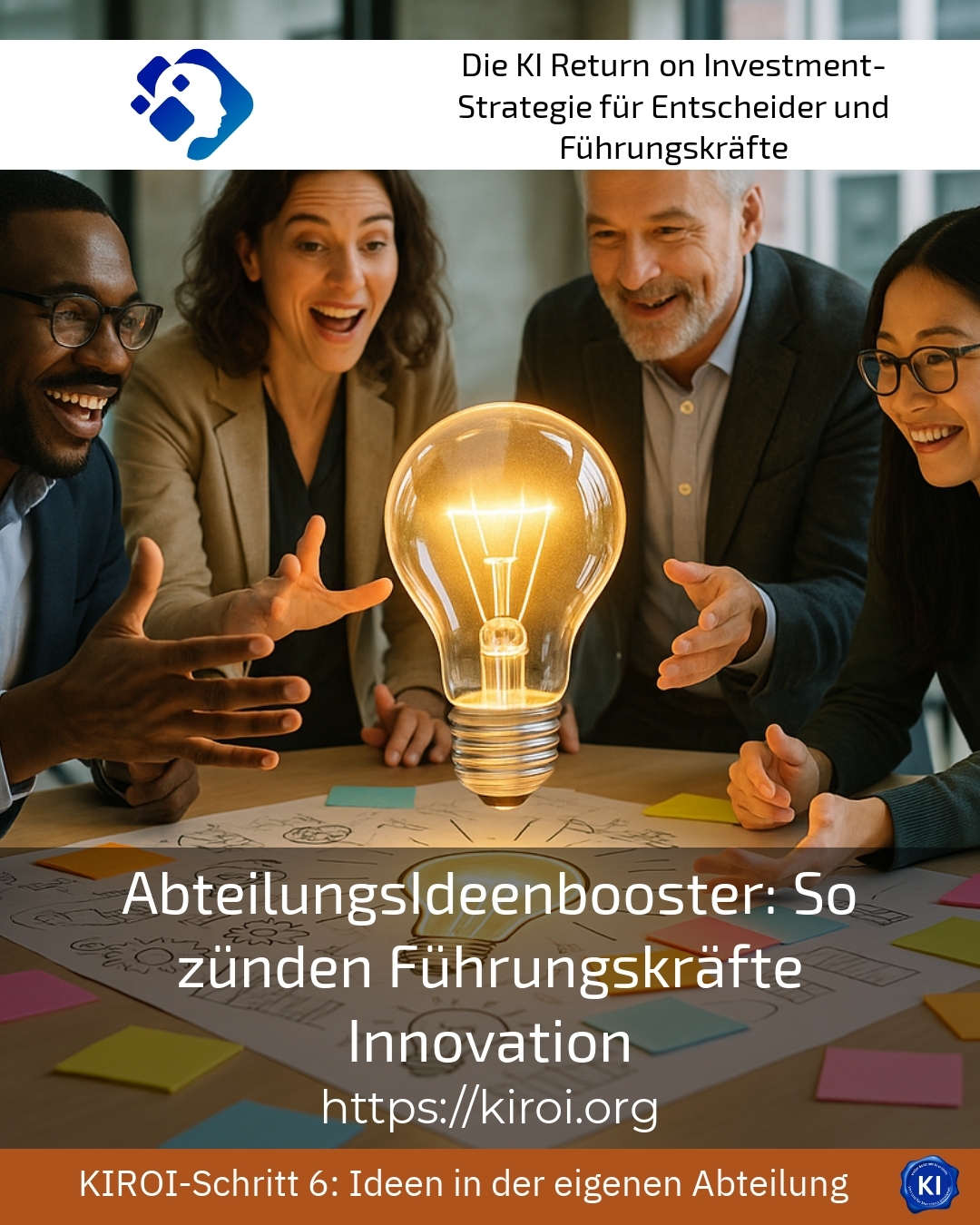
This question occupies managers in numerous organisations because they experience daily how valuable ideas are lost in the daily routine. The Departmental Idea Booster provides a systematic approach here that unleashes creative energy and anchors innovation sustainably. Many clients report that it is only through structured guidance that their teams find the courage to put forward unconventional proposals. This creates a dynamic that goes far beyond traditional brainstorming sessions and enables real change.
Understanding the Power of the Departmental Idea Booster
Innovation rarely happens by chance or through the spontaneous flashes of inspiration of individual geniuses. Rather, it develops in an environment that systematically creates space for new thoughts. Managers who recognise this connection consciously design their departments as innovation laboratories. This is not about elaborate programmes or expensive consultants, but about clever structures in everyday life. A medium-sized manufacturing company introduced weekly twenty-minute brainstorming sessions. The result: within six months, fourteen actionable suggestions for improvement were generated. An insurance company used similar formats for its claims processing and significantly reduced processing times. A retail company thus activated the knowledge of its logistics employees for process optimisations.
The crucial difference lies in the mindset of the leader. Anyone who truly wants innovation must be able to let go of control. Many find this difficult because traditional leadership models still rely on direction and prescription. Transruption coaching guides leaders precisely through this shift in perspective. It helps them develop new behaviours and reflect on old patterns. Participants frequently report that it was only through this support that they recognised their own blockages.
Psychological safety as the foundation for the department idea booster
People only contribute innovative ideas if they do not have to fear negative consequences. Psychological safety therefore forms the indispensable foundation of any innovation culture [1]. Managers shape this atmosphere significantly through their daily behaviour. Every derogatory remark, every eye-roll at an unusual proposal destroys trust lastingly. A pharmaceutical company therefore established the rule that for every objection, three positive aspects must first be mentioned. A bank introduced anonymous idea channels to lower barriers. A technology corporation explicitly rewarded even failed experiments in order to encourage a willingness to take risks.
The challenge lies in conveying this security authentically. Employees immediately sense whether a leader is genuinely open to new ideas. Therefore, working on the climate for innovation always starts with one's own attitude. Transruptive coaching provides important impetus here and supports leaders in their self-reflection.
Best practice with a AIROI customer
An internationally active mechanical engineering company approached us because the innovative capacity within its development department had declined. The managers reported stagnation in new product ideas despite highly qualified employees. As part of our support, we first analysed the existing communication structures and decision-making pathways. This revealed that informal hierarchies systematically suppressed critical voices. Together, we developed a format called „Freedom Friday“, where team members could present ideas without the pressure of evaluation. In individual coaching sessions, the managers learned to recognise and change their own patterns of reaction. After four months, three patentable concepts emerged from this format. Employee satisfaction in the department increased measurably, and staff turnover fell significantly. Particularly remarkable was the transformation of a team leader who had previously been considered hostile to innovation. He developed into one of the most active promoters of new ideas in his area. This example impressively demonstrates how systemic changes can begin at the individual level.
Creating structures that enable innovation
Good intentions alone are not enough to establish innovation on a permanent basis. What is needed are concrete structures that anchor creative thinking in everyday work. The effective formats vary considerably depending on the corporate culture and industry [2]. One energy supplier established monthly innovation breakfasts with changing groups of participants. A retail chain introduced digital idea platforms where suggestions can be evaluated. A consultancy firm sets aside ten percent of working time for self-chosen projects.
The art is to find the right format for your own organisation. It helps to test different approaches and evaluate their effectiveness. Leaders should communicate openly that they are still learning and experimenting themselves. This attitude also encourages employees to accept mistakes as part of the process.
Using the DepartmentIdeaBooster to apply creativity techniques purposefully
Alongside the appropriate structures, methodical tools are also needed for creative processes. Design Thinking, brainwriting or the six thinking hats method provide tried-and-tested frameworks for developing ideas. An automotive supplier uses Design Thinking systematically to develop new product concepts. A hospital group uses brainwriting to gather improvement ideas from all occupational groups. A media company works with the reversal method to break through entrenched thought patterns.
It is important that leaders master these methods themselves and apply them authentically. Nothing is more demotivating than half-heartedly conducted creativity sessions without genuine commitment from management. Transruption coaching supports leaders in learning these methods and using them with confidence.
The role of the leader as an innovation catalyst
Leaders shape the innovation climate of their department more strongly than any corporate policy. Their behaviour sends daily signals about whether new ideas are welcome or not [3]. A leader in finance described it aptly: she sees herself as a gardener preparing the soil. A production manager views himself as a door opener who establishes contacts between departments. A marketing director consciously acts as a shield protecting her team from excessive criticism.
These diverse images show that there is no single right leadership style for innovation. Rather, it is about consciously shaping one's own role and adapting it to the needs of the team. Some teams need more structure and guidance, others more freedom and trust. The ability to recognise these needs develops through reflection and feedback.
Best practice with a AIROI customer
A telecommunications company asked us to support them in the transformation of their customer service department. The previous leadership culture was heavily hierarchical and left little room for independent action. The employees felt like mere executors with no scope for shaping things. We accompanied the managers in a six-month programme that combined individual coaching with team development. First, we worked on personal leadership beliefs and their effects on team behaviour. The managers recognised how their own insecurities led to controlling behaviour. They learned to build trust step by step and to delegate responsibility. At the same time, we established new formats for the exchange of ideas and feedback. Employees were given the freedom to develop improvements in customer contact themselves. After a year, the employee survey showed significantly higher scores in engagement and willingness to innovate. Customer satisfaction increased noticeably in parallel, confirming the path taken. This project illustrates how closely leadership behaviour and the ability to innovate are linked.
Resistances as an opportunity for the department ideas booster
Every change in the culture of innovation encounters resistance, and that is completely normal. This resistance contains valuable information about fears, needs and unspoken conflicts [4]. A chemical company experienced massive rejection when introducing innovation circles among experienced employees. An auditing firm met with scepticism from partners who feared for their status. A construction company struggled with the fear of job loss due to process-improving ideas.
Constructive handling of this resistance is what distinguishes successful innovation initiatives from failed ones. Leaders should take concerns seriously and not dismiss them as a nuisance. Often, behind the rejection lie legitimate worries that deserve attention. Transruption coaching guides leaders in understanding these dynamics and using them productively.
Ensuring the sustainability of innovation culture
Many innovation initiatives start with great enthusiasm and then slowly lose momentum. The challenge lies in sustaining creative energy over a longer period. A software company solves this by regularly celebrating even small innovation successes. An insurance company links innovation activities with the career development of its employees. A logistics group firmly integrates idea development into the performance targets of all managers.
Embedding them in existing systems increases the likelihood that innovation is practised on an ongoing basis. At the same time, care must be taken to ensure that creativity does not degenerate into yet another tick-box exercise. The balance between structure and freedom remains an ongoing leadership task. Regular feedback loops help to critically review one's own innovation culture.
My AIROI Analysis
Working with numerous organisations has shown me that innovation is not a question of budget or industry. It arises wherever leaders consciously create spaces and continuously reflect on their own attitude. The department ideas booster does not function as an isolated measure, but as part of a comprehensive cultural shift.
What seems particularly important to me is the realisation that change must begin with the leader themselves. Anyone who expects creativity and courage from others should first embody these qualities themselves. This requires self-reflection, which can sometimes be uncomfortable and challenges old beliefs.
Transruptions coaching offers valuable guidance here because it operates on an individual level. It supports leaders in recognising their blind spots and developing new behavioural options. At the same time, it links this individual development with the demands of the organisation.
The examples from various industries show that there is no one-size-fits-all solution. Every organisation must find its own path that suits its existing culture and people. We are happy to support this process with impulses, reflective questions and concrete methods. Innovation is not rocket science, but it does require attention, patience and genuine leadership commitment.
Further links from the text above:
[1] Harvard Business Review – Psychological Safety
[2] McKinsey – The Eight Essentials of Innovation
[3] MIT Sloan Management Review – Leadership and Innovation
[4] Forbes – Leadership and Change Management
For more information and if you have any questions, please contact Contact us or read more blog posts on the topic Artificial intelligence here.









 Deutsch
 English (UK)