
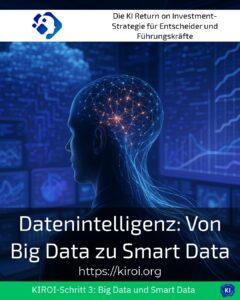
Imagine your company sitting on a mountain of information, but the real treasure remains hidden. This is exactly where the transformation of Unleashing Data Intelligence: From Big Data to Smart Data This has revolutionized organizations worldwide. While many companies are still struggling with the sheer volume of collected data, others have long since realized that quantity alone does not create a competitive advantage. The true art lies in filtering out the digital noise to extract insights that enable real decisions and deliver measurable results. In a time where billions of data points are generated daily, the ability to intelligently analyze data becomes the decisive differentiator.
Understanding the challenge of the modern information deluge
Companies today collect more information than ever before in the history of business. Every click, transaction, and customer interaction leaves digital traces that can be stored and archived. But this is where the real problem begins, which many organizations underestimate and often leads to frustration. The mere accumulation of data does not create value; it simply binds resources and storage capacity. Many executives report that they are drowning in information but at the same time suffer from a lack of actionable insights.
For example, a retail company collects millions of transaction data daily from its stores and online channels. The cash register systems record every single sale, while the website logs visitor click behavior. At the same time, warehouse management systems continuously generate inventory information, and customer cards provide valuable insights into purchasing behavior. However, without a well-thought-out strategy for refining this raw data, these information assets remain untapped and only cause costs for storage and maintenance.
The situation is similar in the manufacturing sector, where modern production facilities are equipped with sensors. These sensors continuously measure temperature, pressure, vibration, and numerous other parameters. The data volumes generated often exceed the capacity of those responsible. A medium-sized machine manufacturer often generates several terabytes of sensor data per production day without knowing how to make sense of this information.
Unleashing data intelligence through strategic transformation
The transition from pure data collection to real value creation requires a fundamental change in thinking and action. Organizations must learn to ask questions before gathering information. This seemingly simple reversal of the usual approach changes everything fundamentally. Instead of storing everything and searching for relevance later, successful companies first define their knowledge goals. Then they specifically identify the information that can contribute to achieving these goals.
In the field of logistics, this approach is particularly impressive in practice. A freight company could theoretically record and store every movement of its vehicles second by second. The resulting data volume would be enormous, but the practical benefits would remain limited. It is more intelligent to define in advance which information is relevant for route optimization, fuel efficiency, and delivery punctuality. This targeted selection drastically reduces the data volume while at the same time significantly increasing the reliability of the collected information.
Best practice with a AIROI customer A medium-sized energy supply company faced the challenge of making meaningful use of the data deluge from its smart meter installations and turning it into actionable insights. Together with the transruptions coaching team, the company developed a clear information enhancement strategy based on specific business goals. First, we jointly defined the most important questions the company wanted to answer. These concerned in particular the prediction of load peaks, the identification of energy theft, and the optimization of network utilization. Subsequently, we analyzed which of the collected data could actually contribute to answering these questions. The result was surprising, as only about fifteen percent of the originally stored data points proved to be relevant for the defined knowledge goals. Through this focus, the company was able to significantly reduce its storage costs while significantly increasing the speed of analysis. Customers often report similar experiences when they adopt this strategic approach and consistently align their data usage with business goals.
Establish quality over quantity as a guiding principle
The refinement of raw information into usable insights follows certain principles that are valid across industries. First, there is relevance, which is the question of whether an information actually contributes to answering an important question. Then there is timeliness, because outdated information can lead to false conclusions and misguided decisions. Finally, accuracy plays a central role because erroneous inputs will inevitably lead to erroneous results.
In healthcare, this principle is particularly illustrated through concrete use cases and experiences. A hospital continuously captures vital parameters of its patients through modern monitoring systems and medical devices. The challenge lies in filtering out from this data stream those signals that indicate critical changes. Not every fluctuation in blood pressure requires immediate medical attention and intervention. Intelligent algorithms help distinguish meaningful patterns from normal noise and inform medical staff specifically.
Insurance companies also benefit from this qualitative approach to information processing and risk assessment. Instead of feeding every available data point into risk models, advanced providers focus on meaningful indicators. These enable more precise predictions while reducing computing effort and accelerating processing times. The trick lies in identifying those variables that provide the greatest explanatory value for the entry risk of specific events.
Practical ways to use data intelligently
Transforming unstructured information into actionable insights requires both technical and organizational measures. On the technical side, modern analytics tools play an important role in pattern recognition. Machine learning enables the discovery of patterns hidden from the human eye in large data sets. At the same time, visualization tools help to make complex situations understandable and accessible to decision-makers.
An example from retail illustrates these technical possibilities and their practical benefits in a very vivid way. By analyzing cash register data, weather data, and local event calendars, retailers can create precise sales forecasts. These forecasts support order planning and help avoid overstocking and delivery bottlenecks. The combination of different information sources generates insights that cannot be obtained from individual data streams alone.
In the financial sector, institutions use similar approaches to detect fraud and prevent risk. By comparing current transaction patterns with historical behavior, algorithms identify suspicious activity in real time. The challenge is to calibrate the sensitivity of these systems so that genuine fraud attempts are detected. At the same time, legitimate transactions should not be mistakenly blocked and customers should not be unnecessarily annoyed.
Unleashing data intelligence in an organizational context
In addition to the technical aspects, organizational culture plays a crucial role in successful transformation. Employees must be empowered to integrate and actively utilize data-based insights into their daily work. This requires training, but also a shift in decision-making and established processes. Leaders should lead by example, ensuring that decisions are based on facts and not solely on gut feelings.
Best practice with a AIROI customer A traditional family business in the food industry approached us with the desire to optimize its production planning based on data and make it future-proof. The previous planning was largely based on the experience of long-standing employees and historically established rules of thumb. During the transruptive coaching, we supported the company in the gradual introduction of analytical planning support that combines human expertise with machine insights. Particularly important was not to replace the experienced employees but to complement their expertise with data-driven insights. We established a system that combines historical sales data, seasonal patterns, and current market trends and analyzes them. The resulting recommendations are provided to the planning managers as a decision-making aid and are not presented as mandatory requirements. This respectful integration of experience and analytical insights led to high acceptance among the employees and a significant improvement in planning accuracy. Clients often report that this participatory approach is the key to success and that resistance to change can be significantly reduced.
Collaboration between IT departments and functional areas gains significant importance in this context and requires new communication channels. Technical experts understand the possibilities of data analysis, but not always the business issues involved. Conversely, functional area employees are familiar with their processes, but rarely are able to independently identify analytical potential. Successful companies create structures that promote this exchange and bring together both perspectives.
From Big Data to Smart Data: The maturity process
The development of an organization from mere data collection to true data intelligence typically takes place in several stages. At the first stage, there is a mere collection and storage of information without systematic analysis. Many companies remain stuck at this stage for a long time and hardly use their data sets. The second stage involves descriptive analyses that describe what has happened in the past and what patterns are discernible.
In the tourism sector, these maturity levels are particularly evident through concrete use cases. A hotel at the first stage only stores booking data, without systematically analyzing them or using them for decision-making. At the second stage, the hotel analyzes which times of day certain room categories were particularly in demand and popular. The third stage enables forecasts regarding future occupancy and corresponding price adjustments in real time. At the fourth stage, the hotel can finally respond automatically and intelligently to booking requests and create personalized offers.
Telecommunications providers undergo similar stages of development in the use of their customer information and network data. Initially, connection data is used solely for billing purposes and then archived. Advanced providers analyze usage patterns to better understand customer needs and offer appropriate rates. The highest stage of maturity enables proactive service offerings before customers even articulate a need or report a problem.
Overcoming obstacles on the path to data intelligence
The path to intelligent data utilization is rarely free of obstacles and setbacks. Technical challenges such as data silos, incompatible systems, and poor data quality must be overcome. Organizational resistance often arises from fear of change or concerns about one’s own workplace. Legal frameworks such as data privacy requirements must also be considered and adhered to.
For example, an automotive supplier had to first connect its various production sites digitally before cross-site analyses were possible. The different machine generations and software systems significantly complicated this process and required significant investment. Only after creating a unified data base could overall optimization potentials be identified and systematically exploited.
Pharmaceutical companies face special challenges when using clinical trial data for further analysis. Strict regulatory requirements limit the possibilities for data utilization and require careful compliance audits. At the same time, this data offers enormous potential for the development of new therapies and the improvement of existing treatment approaches.
My AIROI Analysis
The transformation from mere data collection to real data intelligence represents one of the central challenges of our time for companies across all industries. My experience from numerous consulting projects shows that the technical aspect is often over-emphasized. The real success factors lie in the clear definition of knowledge goals and the consistent alignment of all data activities towards these goals.
I consider the aspect of employee involvement to be particularly important in shaping this transformation. Companies that treat their workforce as partners in this process achieve significantly better results. The combination of human expertise and machine analysis capabilities creates value that neither approach alone could achieve.
The transition from Big Data to Smart Data requires patience, resilience, and a willingness to continuously learn. There are no shortcuts or one-size-fits-all solutions that work in every context and guarantee immediate results. Instead, it is an evolutionary process that takes time and requires regular adjustments. Transruptive coaching can accompany companies on this journey and provide valuable insights for the next steps. Experience shows that organizations that consistently follow this path can achieve significant competitive advantages in the long term and sustainably strengthen their market position.
Further links from the text above:
[1] Bitkom – Big Data and Data Analysis
[2] McKinsey – Data and Analytics Insights
[3] Gartner – Smart Data Definition
[4] Fraunhofer – Artificial Intelligence and Data Analysis
For more information and if you have any questions, please contact Contact us or read more blog posts on the topic Artificial intelligence here.









 Deutsch
 English (UK)