
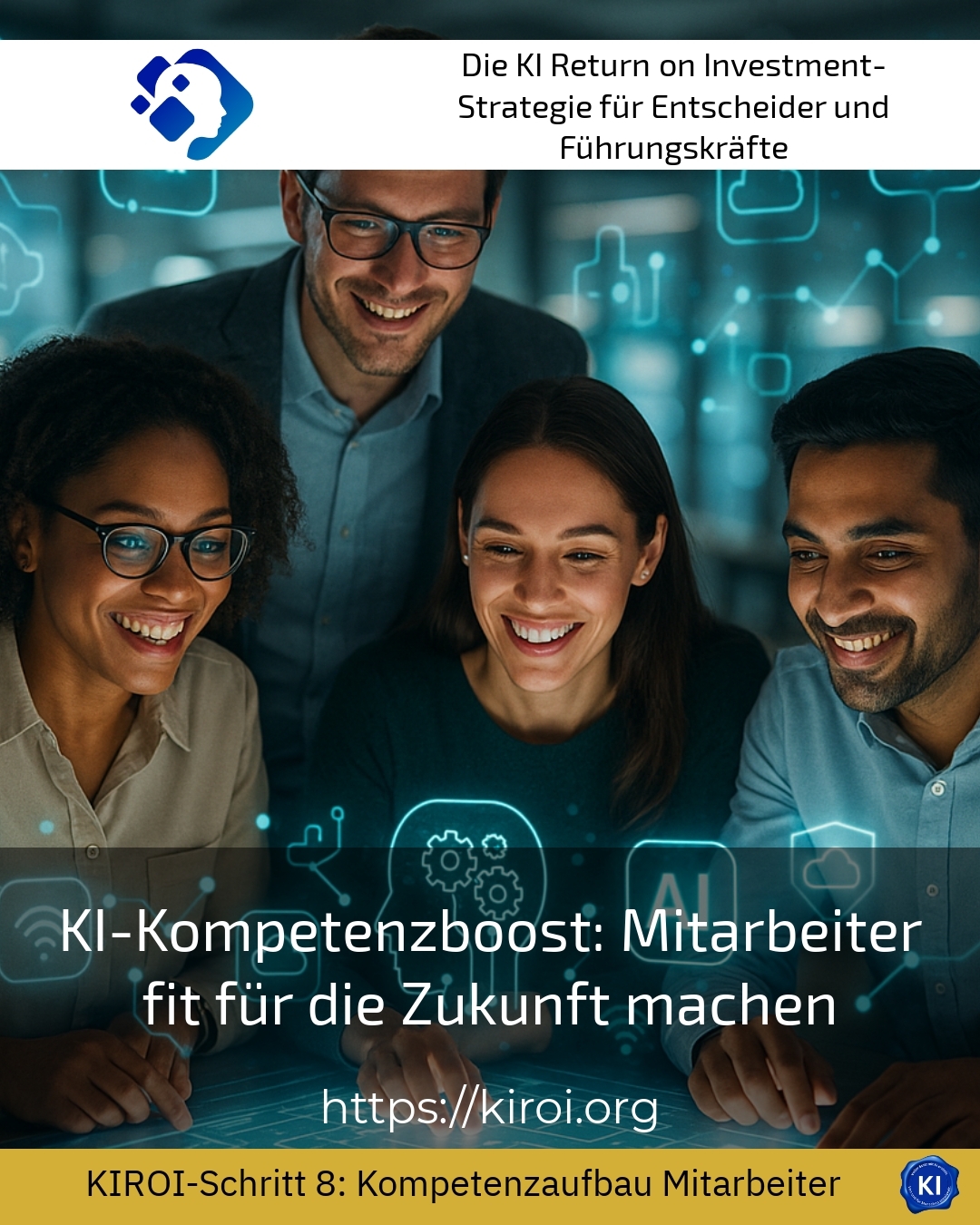
digital transformation is changing our working world at a pace that poses enormous challenges for many companies. While intelligent systems are increasingly taking over complex tasks, uncertainty is simultaneously growing among numerous workforces. The AI Skills Boost: Getting Employees Ready for the Future is therefore right at the top of the agenda for forward-looking organisations. But how do you manage not only to upskill teams technically, but also to bring them along emotionally? This question is on the minds of leaders across all industries. Because one thing is clear: technology alone does not solve problems. It is only the people who understand it and use it sensibly who create real added value.
Why traditional further education is no longer sufficient
Traditional training formats have increasingly lost their effectiveness in recent years. One-off seminars and standardised e-learning modules simply cannot keep pace with the speed of technological developments. Many employees report that they do not feel adequately prepared after such events. This is often because theoretical knowledge quickly fades without practical application. In addition, the transfer into the concrete working day is frequently lacking. Organisations therefore require new approaches that enable continuous learning.
For example, a medium-sized manufacturing company discovered that, despite extensive training investments, the acceptance of new digital tools remained low. Production employees perceived the technology as a threat. It was only through accompanying coaching measures that this resistance was successfully overcome. Another case involves a logistics service provider whose dispatchers felt made redundant by automated route planning. Through targeted guidance, they realised that their expertise remained indispensable for exceptional situations. An insurance company had similar experiences during the introduction of intelligent claims processing.
The AI skills boost as a holistic development approach
Sustainable capability building requires more than technical training. Rather, it is about establishing a learning culture that promotes curiosity and rewards a willingness to experiment. Emotional and social factors play at least as important a role here as technical content. People learn best when they feel secure and are allowed to make mistakes. This is precisely where professional guidance comes in, which AI Skills Boost: Getting Employees Ready for the Future enables.
transruptions-Coaching supports organisations with projects involving these profound transformation processes. The approach combines strategic planning with individual support at all hierarchical levels. Clients frequently report that it is only through this combination that genuine breakthroughs occur. A retail company used this support to prepare its purchasing department for predictive ordering systems. In doing so, the buyers developed a completely new self-image as strategic advisors. An energy supplier also benefited from this approach during the introduction of intelligent grid control.
Best practice with a AIROI customer
An internationally active mechanical engineering company faced the challenge of fundamentally modernising its service organisation. In future, intelligent diagnostic systems were to take over maintenance planning. The experienced service technicians, many of whom had been with the company for decades, initially reacted with clear scepticism to this change. They feared that their many years of expertise would be devalued and their jobs endangered in the long term. Management quickly recognised that technical training alone would not be sufficient to address these deep-seated fears. Together with transruptions-Coaching, a comprehensive support programme was therefore developed that took both technical and emotional aspects into account. In workshops, the technicians worked out how their experience could usefully complement the automated systems. They realised that complex fault situations would still require human judgement. After six months, the initial rejection had turned into genuine enthusiasm. The technicians independently developed proposals for improving the diagnostic algorithms. Service quality increased measurably, while at the same time employee satisfaction rose significantly.
Leaders as key figures of transformation
The success of any change initiative depends crucially on the attitude and behaviour of the managers. They shape the corporate culture and set important signals through their own actions. If managers themselves show uncertainty in dealing with new technologies, this inevitably transfers to their teams. Therefore, an effective AI Skills Boost: Getting Employees Ready for the Future ideally at management level [1].
A pharmaceutical company invested specifically in the development of its research managers before introducing intelligent laboratory assistants. These managers were subsequently able to authentically guide and support their teams. At a telecommunications provider, team leaders first learned how to use automated customer analytics themselves. Only after that did they roll out the system in their departments. A major commercial law firm also relied on this approach when implementing document analysis tools. The partners acquired the necessary understanding to lead credibly.
Taking fears seriously and addressing them constructively
Employees' concerns about job losses due to automation are real and justified. It would be naive and counterproductive to ignore or play down these fears. Instead, there needs to be open discussions about the actual impacts of technological change. This frequently shows that the feared job losses do not materialise in that form. Rather, job profiles shift and new requirements emerge [2].
A bank closely supported its credit analysts during the introduction of automated credit assessments. The analysts subsequently took on more advisory tasks in complex financing. A media company trained its editors to work with content-generating systems. These editors now focus more strongly on investigative research and quality assurance. A call centre operator also found new roles for employees. Today, they handle demanding customer enquiries that automated systems cannot resolve.
Practical strategies for sustainable skills development
The path to becoming a learning organisation requires concrete measures and clear structures. First of all, it is essential to honestly analyse the current level of competence and identify development needs. Both technical skills and soft skills should be taken into account. Appropriate learning formats can then be selected and combined with one another. transruptions-Coaching supports organisations in projects relating to this strategic planning with proven methods [3].
A retail group established so-called learning partnerships between tech-savvy and experienced employees. The mutual exchange of knowledge significantly accelerated skill development. An automotive supplier set up experimentation spaces where teams can try out new tools risk-free. The positive experiences quickly transferred to everyday production. A municipal administration also used innovative formats such as reverse mentoring. Younger staff taught older colleagues how to use digital applications with confidence.
Best practice with a AIROI customer
A hospital group with several thousand employees wanted to introduce intelligent support systems for nursing documentation. The nursing staff were initially very critical of this plan, as they feared spending even more time on bureaucracy. There was also distrust of the technology, particularly regarding data protection and patient safety. The project team therefore decided on a phased introduction with intensive support from external coaches. In small groups, the nursing staff were able to voice their concerns and contribute their own suggestions for improvement. The involvement of so-called champions from the workforce, who acted as multipliers, proved to be particularly effective. These colleagues enjoyed a high level of trust and were able to dispel reservations on an equal footing. After the introduction phase, most of the nursing staff reported a noticeable easing of their workload, as documentation was now faster and more intuitive. They were able to use the time saved more intensively for direct patient care, which increased satisfaction on all sides. This example impressively demonstrates how important careful change management is for project success.
The AI skills boost as a continuous process
One-off qualification measures are no longer sufficient in today's dynamic working world. Organisations must establish continuous learning processes that adapt flexibly to new developments. It has proven effective to integrate learning directly into everyday work. Short, focused learning units often prove more effective than extended training blocks. In addition, informal learning should be encouraged and valued [4].
A management consultancy introduced weekly learning sessions in which teams share current insights. A construction company uses digital platforms for cross-site knowledge transfer. There, experienced site managers share their experiences with intelligent planning tools. A fashion company also relies on continuous learning when using trend forecasting systems. The purchasing teams thus constantly develop their skills in dealing with data-driven decisions.
The importance of a positive error culture
Using new technologies confidently requires practice and gathering first-hand experience. Inevitably, mistakes will happen along the way, from which valuable insights can be gained. Organisations that penalise mistakes thereby inhibit innovation and willingness to learn. A constructive culture of error, on the other hand, encourages experimentation and accelerates the learning process [5]. transruptions Coaching supports organisations in projects related to this cultural development with proven interventions.
A technology company hosts regular Failure Fridays, where teams openly discuss failures. This transparency has significantly boosted trust and innovative strength. An insurance company established a reward system for sharing learning experiences. Even negative outcomes are recognised as a valuable contribution to the knowledge base. A chemical corporation introduced after-action reviews following every pilot project. This systematic review continuously improves the success rate of new initiatives.
My AIROI Analysis
The successful integration of intelligent systems into organisations is primarily a human and cultural challenge. Technology alone does not create a sustainable competitive advantage if the workforce is not brought along. My analysis shows that companies that invest in holistic skills development achieve significantly better project outcomes. The key lies in combining technical qualification with emotional support. Leaders play a central role in this process as role models and enablers. They must themselves embody a positive attitude towards change and actively support their teams. Establishing a learning-friendly culture in which experimentation is encouraged and mistakes are seen as learning opportunities is essential in this regard. Furthermore, organisations should think long-term and establish continuous learning processes rather than relying on one-off training measures. Integrating learning into everyday work proves to be particularly effective. External support can help to identify blind spots and apply proven methods. The examined practical examples from various industries demonstrate that this approach works. It requires investments in time and resources, which nonetheless pay off manifold. Employees who feel competent and secure contribute committedly to the company's success. Technology then becomes a tool that enhances rather than replaces human capabilities.
Further links from the text above:
[1] McKinsey: Building Workforce Skills at Scale
[2] World Economic Forum: Future of Jobs Report
[3] Harvard Business Review: Change Management
[4] Gartner: Future of Work Research
[5] Forbes: Creating Psychological Safety at Work
For more information and if you have any questions, please contact Contact us or read more blog posts on the topic Artificial intelligence here.







 Deutsch
  English (UK)