
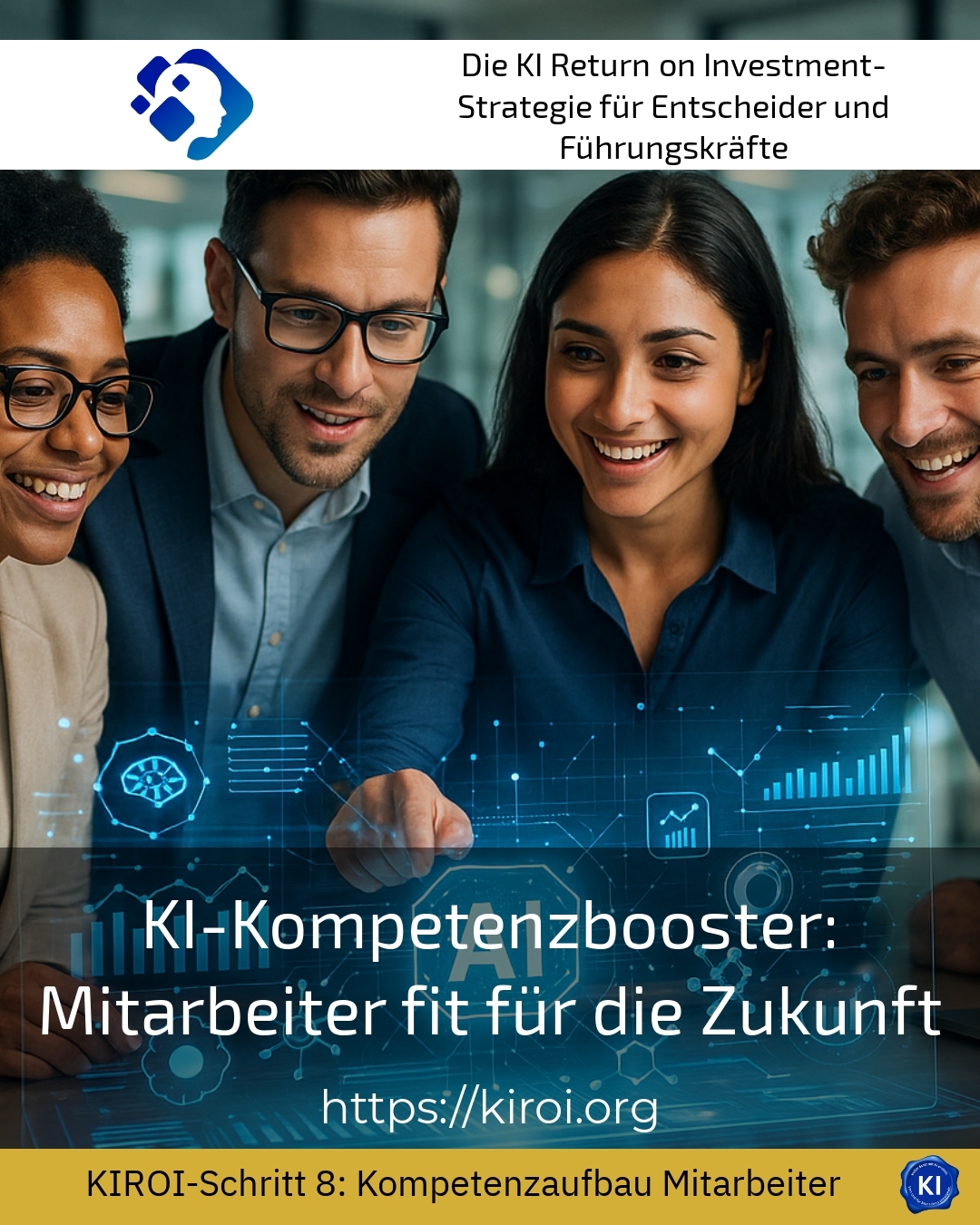
Digital transformation is fundamentally changing our world of work and demanding entirely new skills from employees across all industries. Anyone who hesitates today will lose touch tomorrow with a development that cannot be stopped. The AI Skills Booster: Staff Fit for the Future describes an approach that systematically prepares companies and their teams for upcoming challenges. But how do you manage to bring people along on a journey whose destination is constantly changing? It is precisely this question that we address in the following sections. In doing so, we outline concrete paths that organisations are already successfully treading.
Why the AI Skills Booster is becoming indispensable
The speed of technological change today exceeds the imagination of many people who have worked in stable occupational fields for years. Intelligent systems are increasingly taking over tasks that were previously reserved for human expertise. This development does not only affect individual departments, but permeates all areas of the business [1]. Studies show that companies with well-trained teams are significantly more productive than organisations without systematic further training. Humans remain indispensable in this process, but their role is changing fundamentally.
In the logistics sector, for instance, we are experiencing how intelligent route planning is transforming the work of dispatchers. These professionals are evolving from operational planners into strategic decision-makers. The situation is similar in the financial sector, where analysts are increasingly acting as interpreters of machine-generated evaluations. In healthcare, too, intelligent diagnostic systems are supporting medical staff with complex decisions. As a result, competence requirements are shifting significantly towards analytical and communicative skills.
The AI Skills Booster as a Strategic Instrument
Organisations face the challenge of systematically preparing their workforce for new requirements. It is not enough to simply offer individual training courses or run sporadic workshops. Rather, organisations require a holistic approach that integrates continuous learning into the corporate culture. transruptions coaching supports organisations precisely in such transformative projects. Experience shows that lasting change can only be achieved through consistent guidance.
For example, a mechanical engineering company implemented an internal mentoring system for technological topics. Experienced specialists guided younger colleagues through familiarisation with new systems. An insurance group established so-called learning circles in which teams developed use cases together. A medium-sized retailer also benefited from structured competence-building programmes in its administration [2].
Best practice with a AIROI customer
A long-established family business in the manufacturing sector faced the challenge of preparing its loyal workforce for new technological demands. The employees brought years of experience and deep expertise, but initially showed reluctance towards digital tools. Together with transruptions coaching, the management developed a multi-stage competence development programme. In the first step, we held discussions with all department heads to identify existing touchpoints. This resulted in tailored learning pathways for different functional areas. Production received different impulses than administration or sales. The involvement of multipliers from the workforce itself was particularly important. These internal ambassadors carried the knowledge into their teams and dismantled reservations. After six months, over eighty percent of participants reported increased confidence in handling new systems. Productivity in several departments increased measurably, whilst employee satisfaction simultaneously rose.
Practical implementation in various company departments
The successful implementation of competency programmes requires a nuanced view of individual corporate functions. Each department brings its own prerequisites and requirements that must be taken into account. A one-size-fits-all solution rarely works satisfactorily. Instead, a modular approach that allows for individual adaptations is recommended.
In human resources, intelligent systems are already supporting the preliminary screening of applications. As a result, recruiters are focusing more on personal interviews and cultural fit. In marketing, automated tools analyse campaign data in real time. Marketing professionals interpret these results and derive creative strategies. Job profiles in purchasing are also undergoing fundamental change through automated supplier evaluations [3].
Employees fit for the future through individual learning paths
People learn in different ways, and successful competence programmes take this diversity into account. Some employees prefer structured courses with a clear curriculum. Others learn better through practical application in real projects. Yet others benefit from exchanging ideas with colleagues in informal formats. These different learning styles call for flexible provision.
A pharmaceutical company introduced so-called experimentation spaces where teams could test new tools without risk. An energy supplier established regular technology cafés for low-threshold knowledge exchange. A retail company also reported positive experiences with gamified learning formats for its store employees.
Best practice with a AIROI customer
A local authority was looking for ways to prepare its staff for the digitalisation of public services. The workforce was distributed across various locations and covered a very wide range of age groups. Together, as part of transruptions coaching, we developed a hybrid learning concept. This combined face-to-face sessions with digital self-learning modules and peer coaching. The establishment of an internal platform for questions and reports on experiences proved particularly valuable. There, employees exchanged views on challenges and solution approaches across departmental boundaries. The managers were trained in advance so that they could adequately support their teams. After a year, an internal survey showed significantly increased self-efficacy expectations among the staff. The processing of digital citizen enquiries accelerated measurably. At the same time, the number of queries to internal support dropped considerably. The authority is now planning to expand the programme to further areas.
Challenges and proposed solutions during implementation
The introduction of systematic competence development encounters various obstacles in practice. Time resources frequently represent the biggest problem because day-to-day business ties up all available capacities. Reservations regarding change also sometimes complicate the acceptance of new learning formats. Last but not least, support from company management is occasionally lacking.
An automotive supplier solved the time problem by integrating learning units into existing meeting formats. A bank reduced reservations through transparent communication about goals and expected benefits. A logistics company won over the executive board through pilot projects with measurable successes for the overall approach [4].
The role of managers in skills development
Leaders hold a key position in shaping learning-friendly corporate cultures. Through their own behaviour, they set standards for the entire organisation. When superiors continuously learn themselves, it signals appreciation for further training. At the same time, they create scope for their teams and encourage them to try out new approaches.
In retail, store managers actively accompanied their teams during the introduction of new till systems. In a consultancy, partners openly shared their own learning experiences with junior staff. Similarly, in a hospital, senior consultants assumed a role model function regarding the use of digital documentation systems.
Long-term prospects for sustainable organisations
The development of competencies is not a one-off project, but an ongoing process. Technologies evolve, and with them the requirements placed on employees. Organisations that embed continuous learning into their structures secure a sustainable competitive advantage. They react more quickly to market changes while simultaneously retaining qualified staff.
A media company established quarterly technology updates for all editorial staff. A manufacturing company set up an internal academy for technological further education. A service company also consistently invested in the development of its workforce's digital skills [5].
Best practice with a AIROI customer
An internationally active mid-sized company from the supplier industry wanted to prepare its entire organisation for upcoming technological changes. The management recognised early on that isolated training measures would not suffice. As part of the transruptions coaching support, we jointly developed a comprehensive skills strategy. Alongside traditional training, this included formats such as reverse mentoring and job rotation. Younger employees passed on their technological knowledge to experienced colleagues. At the same time, they benefited from the older generation's industry expertise. The HR department established regular skills reviews as part of line management. During these, managers and staff jointly identified areas for development and agreed on concrete steps. Following the introduction of the programme, the company recorded a significant drop in staff turnover. Particularly qualified specialists cited development opportunities as a key retention factor. The rate of innovation for internal improvement suggestions also rose measurably.
My AIROI Analysis
The systematic development of future skills in organisations requires more than technical training. It demands a cultural shift that treats learning as a natural part of the working day. My experience from numerous accompaniment projects shows that successful companies pay particular attention to three factors. Firstly, they involve their employees in change processes at an early stage, thereby creating acceptance. Secondly, they design learning formats flexibly and individually to address different needs. Thirdly, they embed continuous learning in their management tools and incentive systems.
The AI Skills Booster: Making Employees Fit for the Future does not describe a rigid framework, but rather an adaptive process. Every organisation must find its own path that suits its corporate culture and existing resources. Transruptions coaching provides valuable impetus and guides teams through phases of uncertainty. Clients frequently report that it is precisely this external perspective that has enabled decisive breakthroughs. Investing in human competencies pays off in the long term. It not only strengthens competitiveness, but also employee satisfaction and retention. Organisations that set the right course today will reap the rewards of their forward-looking staff development tomorrow.
Further links from the text above:
[1] McKinsey: The Future of Work
[2] World Economic Forum: Future of Jobs Report
[3] Bitkom: Digital Transformation
[4] Haufe: HR Management and Staff Development
[5] IHK: Digitalisation in SMEs
For more information and if you have any questions, please contact Contact us or read more blog posts on the topic Artificial intelligence here.







 Deutsch
  English (UK)