
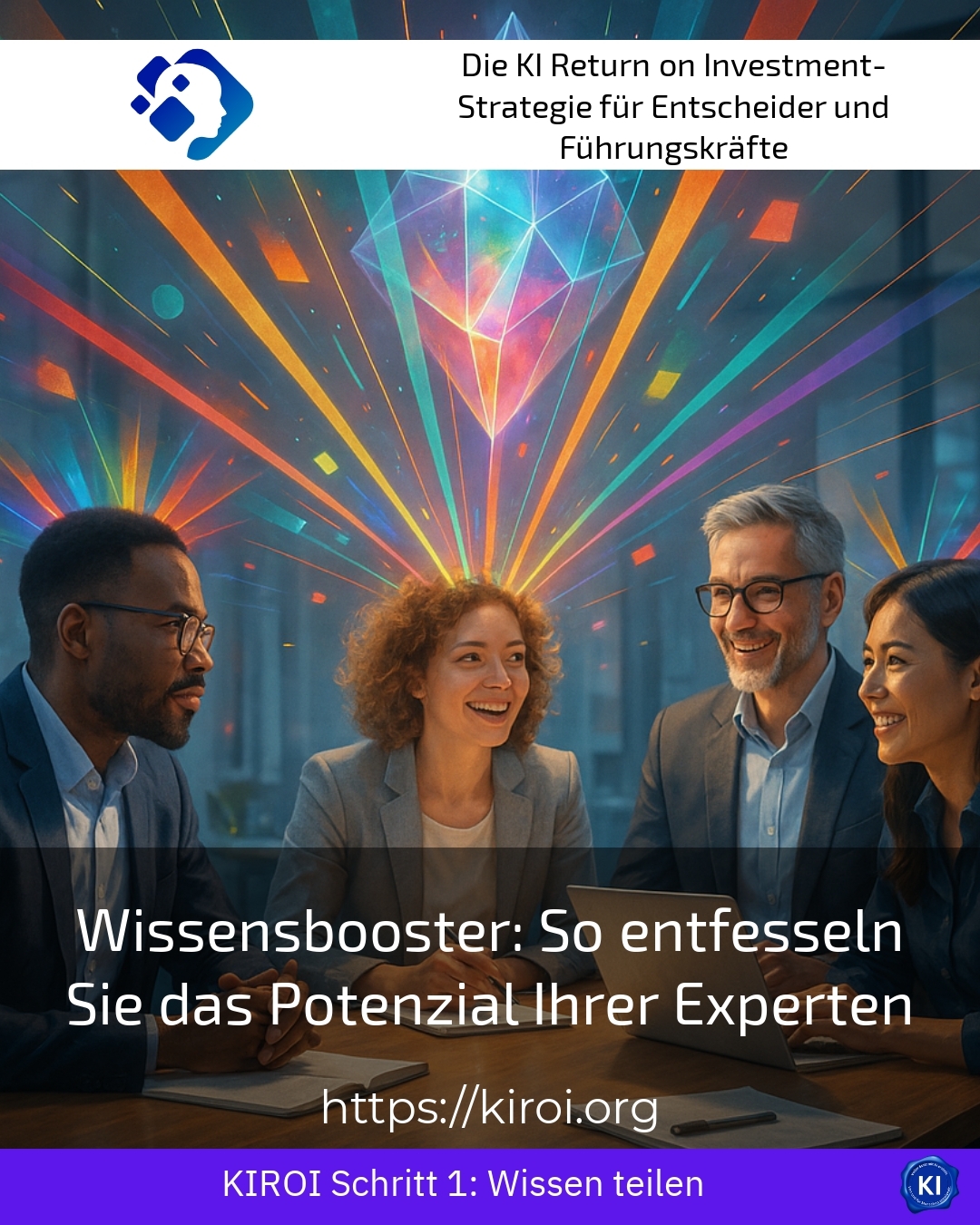
Imagine that your company is sitting on a huge, untapped treasure trove – and this treasure lies within the minds of your most experienced employees. Every day, these individuals make decisions, solve complex problems, and develop innovative approaches, without this valuable knowledge being systematically captured or shared. The Knowledge Booster: How to unleash the potential of your experts by understanding that implicit, experiential knowledge is often more important than any documented process description. In a time of rapid change, it is precisely this hidden know-how that becomes a crucial competitive factor because it cannot be copied and enables genuine differentiation.
The hidden wealth in your teams
Many managers underestimate the wealth of practical experience that their long-serving specialists have accumulated. An experienced sales representative intuitively knows when a customer is ready to buy, without being able to articulate this assessment. The production manager can tell from the sound of a machine whether maintenance is imminent, even though all sensor data appears normal. An IT specialist can find errors in seconds, while colleagues would search for hours [1]. This form of expertise develops over years and decades of intensive practice.
In the automotive industry, engineers often report so-called "gut feelings" during prototype testing. They frequently cannot explain why a particular driving behaviour seems problematic. Nevertheless, they are usually proven right when later tests confirm their concerns. The pharmaceutical industry shows similar behaviour, where experienced laboratory technicians perceive minimal deviations in chemical processes. In the financial sector, traders develop a feel for market movements over years. These skills cannot simply be recorded in manuals.
At the same time, demographic change is on the horizon and many companies will soon lose their most experienced staff. The baby boomers are retiring and taking their knowledge with them. Without systematic approaches to knowledge retention, dangerous gaps in organisational competence will emerge. Therefore, the Knowledge Booster: How to Unleash the Potential of Your Experts is becoming a strategic necessity for future-oriented companies.
Best practice with a KIROI customer
A medium-sized mechanical engineering company faced a unique challenge when three of its most experienced design engineers decided to retire simultaneously. These professionals had developed a deep understanding of bespoke customisations over more than thirty years. They knew precisely which modifications would work under specific operating conditions and which would not. As part of a disruptive coaching project, we developed a structured mentoring programme together. In this programme, the experienced designers supported younger colleagues on real customer projects. We implemented regular reflection sessions in which the experts openly shared their decision-making processes. Additionally, we documented critical situations and their respective solutions in a digital case archive. After nine months, the younger team members reported significantly increased confidence in complex projects. The error rate for initial deliveries measurably decreased because typical pitfalls were now known. The company was able to manage the transition far more smoothly than originally feared.
Knowledge Booster: Unleash Potential with Modern Methods
Digitalisation opens up completely new possibilities for capturing and making tacit knowledge accessible [2]. Intelligent systems can today analyse conversations and automatically extract important insights. Video-based knowledge platforms enable experts to capture their know-how in short sequences. These formats are often more authentic and meaningful than dry text documents. At the same time, the barrier to knowledge sharing is significantly reduced.
In the logistics industry, forward-thinking companies are using digital twins of their warehouse systems. Experienced warehouse managers can play through various scenarios and document their decisions. New employees learn in this way through realistic simulations. In the healthcare industry, hospitals use case discussion systems that systematically record clinical experience. The chemical industry is experimenting with augmented reality solutions for knowledge transfer to plant operators. All these approaches have one thing in common: they make implicit knowledge visible.
However, technology alone is not enough to bring about genuine change. The cultural framework must be right for experts to want to share their knowledge. Many professionals have learned over years that knowledge equals power and ensures uniqueness. This attitude cannot be changed by software; it requires conscious cultural work. Leaders must lead by example, demonstrating that knowledge sharing is valued and rewarded.
Psychological safety as a prerequisite
People only truly open up and share difficult experiences in an environment of psychological safety [3]. Experts must be able to trust that their mistakes will not be used against them. Often, the most valuable lessons can be learned precisely from failures. When companies establish a culture of learning from mistakes, knowledge flows more freely. This understanding has long been established in the aviation industry, and Crew Resource Management relies on open communication. The construction industry is beginning to integrate similar principles into its project completion reports. So-called "Failure Fridays" are also gaining popularity in the banking sector.
Transruptions coaching can support the guidance and sustainable anchoring of such cultural change processes. Clients often report experiencing initial resistance within their teams. Through targeted interventions and moderated dialogue formats, these blockages can usually be resolved. It is important to take the concerns of those involved seriously and not to override them.
Structured approaches to knowledge transfer
A tried and tested approach is the so-called expert debriefing method, where experienced professionals are systematically interviewed about their work. Trained interviewers ask open-ended questions and help to bring unconscious knowledge to the surface. The conversations are recorded, transcribed, and transferred into searchable knowledge bases. This creates a valuable archive that remains available even after the experts have left.
In the energy sector, grid operators use this method to safeguard the knowledge of their master technicians. Many of these professionals know the peculiarities of their power grids from decades of experience. They know which transformers are susceptible in certain weather conditions. In the insurance sector, companies interview their most experienced claims handlers about complex loss events. The retail sector documents the knowledge of long-serving buyers about supplier relationships. Every sector has its own critical knowledge areas that need to be identified.
Best practice with a KIROI customer
A renewable energy technology company wanted to improve its service team because customer complaints were increasing and the first-time fix rate was decreasing. Analysis showed that new service technicians often needed several attempts to solve complex problems. At the same time, some experienced colleagues had an impressive repertoire of solution strategies. In transruption coaching, we developed a tandem model for particularly demanding assignments. Experienced technicians supported younger team members not physically, but in real-time via a video platform. This allowed experts to share their knowledge without having to be on-site themselves. We also established weekly case discussions in which particularly instructive assignments were analysed together. The experienced professionals were given a new role as internal mentors and felt valued as a result. After six months, the first-time fix rate increased by more than a third. Customer satisfaction also improved significantly because problems were resolved more quickly. The company saved considerable travel costs and was able to handle more assignments per day.
Building and nurturing communities of practice
So-called Communities of Practice are particularly effective, in which specialists regularly exchange ideas and learn from each other [4]. These groups often emerge informally but can gain considerably in effectiveness through targeted support. It is important that participation remains voluntary and offers genuine added value. As soon as such communities become mandatory events, they lose their character.
In software development, such developer communities have long been established and function excellently. The pharmaceutical industry organises cross-industry expert circles on regulatory topics. In the food industry, quality managers exchange best practices in similar formats. The knowledge booster: Unleashing the Potential of Your Experts works best when it builds on such collegial structures.
The role of leaders in knowledge transfer
Managers play a central role in whether knowledge transfer in companies succeeds or fails. They must provide the necessary time and resources for corresponding activities. At the same time, they should act as role models themselves and actively share their own knowledge. If managers only demand but do not lead by example, this can be demotivating for the teams.
In the consulting industry, knowledge management is core business and partners invest considerable time in mentoring. The media industry, by contrast, often struggles with silo thinking and competition between editorial departments. In healthcare, hierarchical structures sometimes hinder open exchange between professional groups. The manufacturing sector has recognised that flat hierarchies can facilitate knowledge flow. Each organisation must find its own path that suits its company culture.
Leaders often come to us because they realise that important knowledge is being lost. They report instances where experts have left the company, leaving significant gaps. Sometimes, customer relationship knowledge built up over years has not been passed on. In other cases, specialised technical knowledge held by only one person has disappeared. These situations can be avoided through proactive measures.
Measurability and continuous improvement
Knowledge management initiatives need clear metrics to demonstrate their success. The number of documented best practices is a simple indicator. Usage statistics from knowledge platforms show whether content is actually being accessed. Qualitative surveys capture whether employees perceive added value [5].
In the telecommunications industry, companies measure the average time to problem resolution in customer service. The manufacturing industry monitors ramp-up curves for new production lines. The transport industry analyses error rates during the onboarding of new dispatchers. All these metrics can provide indications of whether knowledge transfer is functioning. It is important to identify the correct key figures for one's own context.
My KIROI Analysis
After intensive consideration of this complex subject, it becomes clear that companies often neglect their most valuable asset. The experiential knowledge stored in the minds of employees is increasingly decisive for competitiveness. Technological solutions can support this but never replace the human factor. The cultural dimension remains the most important lever for successful knowledge transfer.
From KIROI's perspective, I recommend a three-stage approach for organisations that want to make progress here. Firstly, a systematic inventory of critical knowledge areas should be carried out. Secondly, suitable formats need to be developed for the respective context. Thirdly, long-term integration into regular processes is crucial. Without this integration, even the best initiatives will fizzle out after a short time.
The successful companies will be those that don't just see their experts as knowledge carriers. They will understand and involve them as active architects of a learning organisation. Transruption coaching can provide valuable impetus and support change processes. Demographic change necessitates rapid action because time is of the essence. Those who invest now will secure a sustainable advantage over competitors who sleepwalk through this development.
Further links from the text above:
[1] Harvard Business Review – Knowledge Management
[2] McKinsey – People and Organisational Performance
[3] Amy Edmondson – Psychological Safety
[4] Wenger-Trayner – Communities of Practice
[5] Gartner – Knowledge Management Insights
For more information and if you have any questions, please contact Contact us or read more blog posts on the topic Artificial intelligence here.











 Deutsch
  English (UK)