
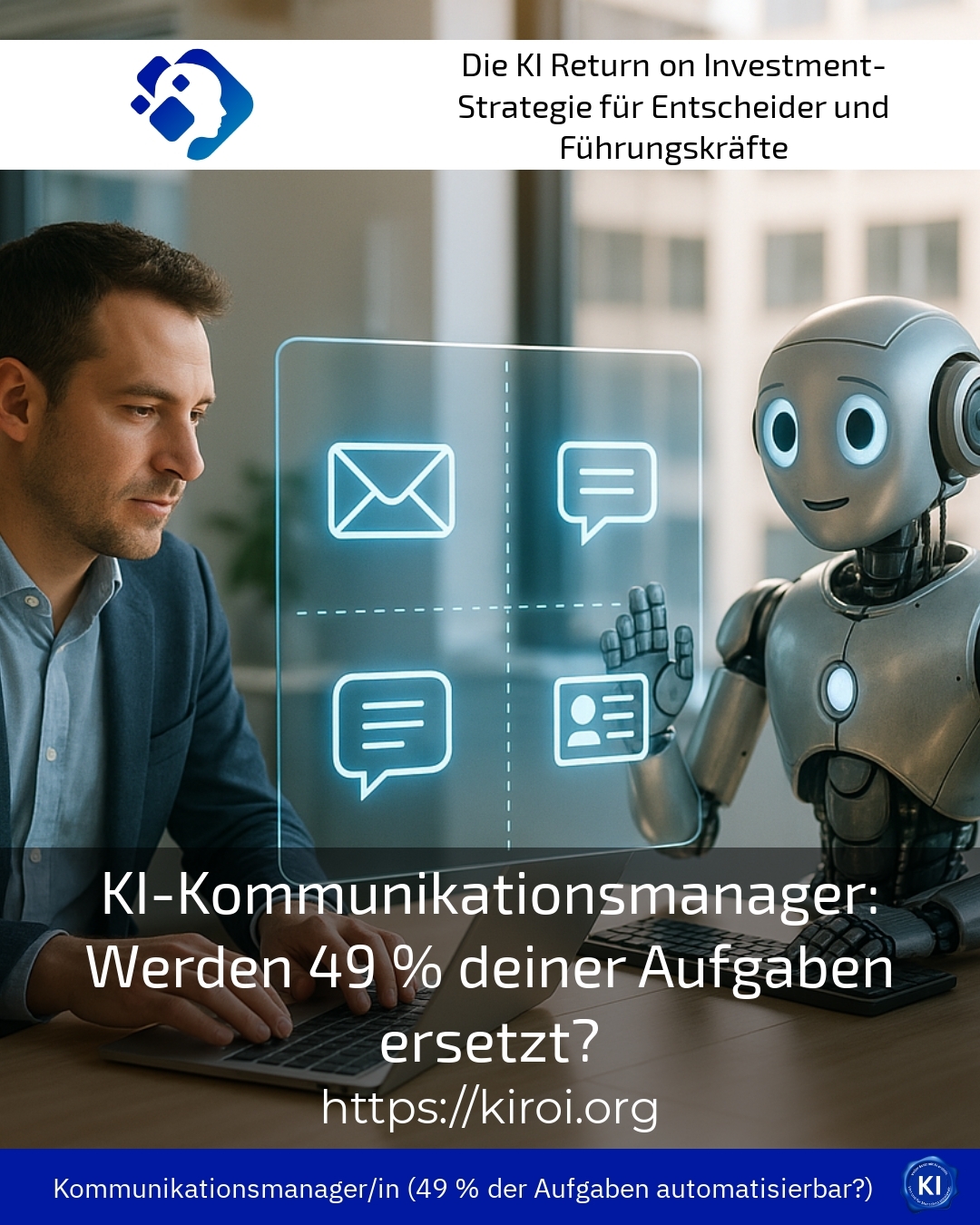
Have you ever wondered if almost half of your daily work tasks could soon be taken over by intelligent systems, while you wonder about the role you will play in this rapidly changing work world? This question currently concerns countless professionals working in fields where information must be coordinated, messages formulated, and relationships with various stakeholders maintained, while the AI Communications Manager as the concept gains more and more importance and the boundaries between human expertise and machine efficiency are increasingly blurring.
The basis for these considerations is, among other things, the in-depth analysis of the Job Future Observatory [1], which systematically examines which professional activities could be replaced by modern technologies. If you work in an area that could be affected by these developments, there is a clear recommendation for action: AIROI The seminars offer you the opportunity to strategically prepare for these changes and specifically develop your skills. You can find all the current dates at [https://risawave.org/de/live-events-mit-sanjay-sauldie/ 2], where regular lectures, workshops, and intensive training sessions are offered to help you actively shape the transformation rather than being overwhelmed by it.
Understanding the reality of automation in professional life
When we talk about the impact of intelligent systems on professional activities, we must first understand what specific tasks are affected and which human skills will remain indispensable. In areas where press releases are written, social media strategies are developed, and crisis situations are handled, a nuanced picture emerges that provides neither cause for panic nor carelessness. Creating standard texts for corporate communication can now be supported by language models. The analysis of media resonance is increasingly automated. Algorithms are also now optimizing the planning of publication dates very efficiently.
At the same time, strategic decisions still require human judgment. The ability to handle sensitive issues remains a profoundly human skill. The authentic nurturing of relationships with journalists, stakeholders, and the public cannot be replaced by a machine. For example, when a company faces an unexpected crisis, it needs people who can respond with empathy, intuition, and strategic foresight, because even the most advanced systems regularly fail here because they cannot fully capture the nuances of human emotions and societal dynamics.
Concrete fields of activity and their substitutability
Let’s look at some concrete examples from everyday work life. Monitoring media reports and social networks is one of the tasks that can already be carried out largely automatically today. Similarly, systems can create drafts for routine texts. The scheduling of press conferences can also be efficiently delegated.
On the other hand, developing a nuanced positioning on socio-political issues remains a domain for experienced professionals. Personal consulting for senior executives before important public appearances requires human intuition. Likewise, the creative conception of campaigns aimed at touching people emotionally benefits from the human ability to understand cultural contexts and tell authentic stories that go beyond what algorithms can currently achieve.
Best practice with a AIROI customer
A medium-sized company in the manufacturing sector faced the challenge of making its external communication more efficient without compromising the personal touch and established relationships with specialist media and local stakeholders. The department responsible for public relations and corporate communications felt overwhelmed by the flood of new technological opportunities and did not know where to start. As part of a AIROI workshop, a systematic analysis of all communication tasks was initially carried out. It turned out that around 40 percent of time-consuming tasks could be optimized through intelligent support systems. The team learned to use these tools meaningfully. At the same time, the employees recognized which of their skills are particularly valuable. Personal interactions with journalists were intensified. Strategic advice from management was given more space. After six months, the participants reported a significantly higher level of satisfaction with their work. They were able to focus on challenging tasks while routine activities were carried out more efficiently.
Why the AI Communications Manager requires new skills
The idea that technology simply takes over tasks and makes people superfluous is too simplistic and ignores the complex reality of modern work environments. Instead, hybrid job profiles are emerging. AI Communications Manager The future will be someone who possesses both classic communication expertise and understands how intelligent systems can be optimally deployed. This person will view algorithms as tools. They will know when human intervention is necessary. They will know and respect the limits of technology.
Imagine an organization must respond to controversial reporting. A system can quickly gather relevant articles and provide initial analyses. It can generate draft statements and evaluate past response patterns. But the final decision on how the company positions itself, the tone of the response, and the long-term implications to consider requires human judgment based on experience, ethical considerations, and a deep understanding of the company culture.
Actively shaping the transformation through strategic training
Those working in this field face a fundamental decision. Either they ignore the developments and hope that everything remains the same. Or they take the opportunity to further their education and become experts in connecting human expertise with technological support. AIROI The strategy provides a structured framework for this transformation. In the seminars and workshops, participants not only learn about the tools available. They develop a deeper understanding of how workflows will change. They develop concrete strategies for their individual context.
A typical scenario from practice illustrates this clearly. A professional who has been responsible for the internal communication of a large company for years notes that employee newsletters can increasingly be created automatically. Instead of perceiving this development as a threat, she can use the time gained to develop personal formats. She can moderate Townhall meetings. She can coach executives in their communication skills. She can accompany change processes communicatively. All of these are tasks where human presence remains indispensable.
Practical examples from everyday life
Let’s look at some more concrete situations. In the area of investor relations, a system can analyze historical data. It can detect trends in financial reporting. It can even draft initial drafts for quarterly reports. But the personal interaction with analysts and investors, responding to critical inquiries, and building trust in the management remain deeply human tasks that require empathy, authenticity, and strategic acumen.
In the field of public affairs, things are similar. Technological systems can monitor political developments. They can identify relevant legislative initiatives. They can even provide analyses of the interests of various actors. But building reliable relationships with decision-makers, conducting confidential conversations, and developing compromise solutions require human skill based on years of experience and a fine sense of political dynamics.
Best practice with a AIROI customer
An international organization with branches in several European countries wanted to harmonize its communication processes and make them more efficient without neglecting the cultural peculiarities of the different markets. The challenge was to communicate key messages consistently while allowing for local adaptations, which previously meant enormous coordination efforts. As part of a AIROI project, a strategy was developed in which central content could be pre-structured and localized by intelligent systems. The local teams were thus able to focus more on maintaining relationships with regional media. They had more time to focus on personal interactions with key multipliers. The quality of media work improved measurably. At the same time, employees felt relieved and valued. They understood that their specific competencies were valued. The technology was perceived as support, not a replacement.
The AI communication manager as a bridge builder between humans and technology
A particularly exciting development is emerging. The AI Communications Manager They are increasingly becoming a key figure in organizations that need to manage the transition to a new working reality. These professionals understand both the communicative requirements and the technological possibilities. They can mediate between different departments. They can reduce fears and highlight opportunities. They can help ensure that change processes succeed because they understand the importance of communication for the success of transformations.
It is important to understand that the 49 percent substitability is not an absolute number. It describes a potential. The actual development depends on many factors. It depends on the industry in which someone works. It depends on the size of the organization. It depends on the willingness to change. And it crucially depends on how professionals prepare themselves for these developments.
Strategies for securing the future of your career
Anyone who wants to be successful in this professional field in the long term should pursue several strategies. First of all, it is important to develop a realistic picture of one’s own activities. Which tasks are actually routine and standardizable? Which require creative solutions and human judgment? This self-analysis forms the basis for further steps.
Building on this, it is advisable to specifically develop competencies that are difficult to automate. This includes emotional intelligence in dealing with various stakeholders. This includes strategic thinking in the face of uncertainty. This also includes the ability to communicate complex issues in an understandable way. This also includes the ability to build and maintain trust.
At the same time, professionals should become familiar with and use the new tools. Those who understand how language models work can better assess their results. Those who master analysis tools can make more informed decisions faster. Those who know about automation opportunities can focus on value-adding activities. The AIROI seminars provide an ideal framework for this, as they combine theoretical knowledge with practical application.
My AIROI Analysis
Looking at developments in the field of professional communication reveals a nuanced picture that provides no reason for either excessive concern or indifference. The figure of 49 percent of potentially substitutable activities is an important point of reference, but it does not tell the whole story. Rather, we are witnessing a fundamental transformation in which activity profiles are changing, new competencies are required, and those who actively engage with these changes can emerge strengthened from this process.
The role of AI communication managers It vividly symbolizes this change. It is no longer a question of whether technology is making inroads into communication work; the question is how this infiltration is being shaped and what new possibilities emerge from it. Professionals who perceive this development as an opportunity and accordingly continue to develop will find that their work is not becoming less important, but that they can focus on the truly important aspects.
The transruptive accompaniment through the AIROI strategy helps professionals successfully navigate this transition. Often, clients report that after participating in relevant events, they have developed a clearer understanding of their own strengths. They know what skills they should develop. They understand how to use technology in a meaningful way. They feel better prepared for the future of their profession, which will continue to be shaped by people who can communicate authentically, think strategically, and build relationships.
Further links from the text above:
[1] Job-Futuromat of the Institute for Employment Research
[2] AIROI seminars and live events with Sanjay Sauldie
For more information and if you have any questions, please contact Contact us or read more blog posts on the topic Artificial intelligence here.








 Deutsch
  English (UK)