
Are you just burning through cash because your fleet of vehicles costs more than necessary – and you don't even notice it?
This question currently concerns numerous managers and fleet managers in Germany, because the times when one could simply chalk vehicle costs up as unavoidable operating expenses are definitely over. Anyone who still works with outdated methods today is not optimizing – but is simply chasing costs. The good news is, however, that modern technologies open up entirely new possibilities for creating transparency, automating processes, and ultimately realizing significant savings. Intelligent systems analyze consumption data in real time, predict maintenance needs before costly breakdowns occur, and help plan routes so that both time and fuel are saved. In this article, you will learn how advanced companies are already benefiting from these developments today and what concrete steps you can take to make your own fleet more efficient.
Why traditional fleet management is reaching its limits
The challenges in the modern fleet business have become manifold and complex. Fuel prices fluctuate greatly. Environmental regulations are continuously becoming stricter. The shortage of skilled workers makes it difficult to find qualified drivers. In addition, increasing insurance premiums, the complexity of leasing contracts, and the pressure to implement more sustainable solutions are all contributing factors. Many companies still work with Excel spreadsheets to manage their vehicle data, while others, although using software, are far from fully utilizing its potential.
A medium-sized logistics company with 50 vehicles generates thousands of data points daily – from fuel levels to driving times to maintenance records. Processing this deluge of information manually and extracting actionable insights from it is overwhelming even experienced fleet managers. At the same time, many companies miss important connections, such as that certain drivers systematically consume more fuel than others or that a vehicle is noticeably frequent in the workshop.
A tradesman with ten service vehicles, for example, struggles to coordinate daily operations optimally. A parcel delivery service has to plan hundreds of deliveries efficiently. A construction company manages specialized vehicles whose failure jeopardizes the entire project workflow. All these scenarios show that complexity is growing exponentially and traditional methods are no longer sufficient.
Are you optimizing your fleet management with AI – or are you still in reactive mode?
The crucial difference between reactive and proactive fleet management lies in the ability to anticipate problems before they arise. Modern analytics systems enable just that. They detect patterns in historical data. They identify anomalies in real time. They provide concrete recommendations for action.
Imagine your system reporting that a specific vehicle is likely to suffer engine damage over the next two weeks – based on vibration data, oil pressure readings, and comparisons with similar vehicles in the past. Instead of a costly breakdown on the highway, you can perform scheduled maintenance that costs a fraction of what it would cost to have it done on the fly. This predictive maintenance, also known as predictive maintenance, is already revolutionizing fleet management in a wide variety of industries today.
A courier service was able to reduce its daily driving distance by 15 percent through intelligent route optimization, which not only saves fuel but also extends the lifespan of the vehicles. A waste management company uses sensor-based level reports to avoid empty runs and only dispatch containers that are actually full. A taxi company relies on dynamic scheduling, which automatically routes vehicles to where demand is highest.
Best practice with a AIROI customer
A medium-sized freight forwarding company from southern Germany faced the challenge of managing its fleet of over 80 vehicles more efficiently. The previous working method was based on experience data and manual coordination by two dispatchers. Fuel costs had continuously increased in recent years. The dispatchers felt increasingly overwhelmed. Together with the AIROI coaching approach, a comprehensive analysis of the existing processes was initially carried out. It revealed that approximately 20 percent of all trips were planned suboptimally. This resulted in unnecessary empty kilometers and increased wear and tear. As part of the coaching, an intelligent dispatch system was implemented that takes into account historical order data, traffic forecasts, and vehicle capacities. The dispatchers were intensively trained to make optimal use of the new system. After six months, the company was able to reduce its fuel costs by 12 percent. The lead time per order decreased by an average of 18 percent. Particularly noteworthy was that employee satisfaction in the dispatch department increased significantly, as repetitive tasks were now automated. The company reports regularly that the investment has already been amortized in less than a year.
Data-driven decisions instead of gut feeling
Many fleet managers still rely on their intuition when it comes to purchasing vehicles, setting maintenance intervals, or hiring drivers. This intuition is valuable. It is based on years of experience. However, practice shows that data-driven decisions in most cases yield better results. The reason is obvious: Modern systems can process millions of data points and recognize patterns that remain hidden from the human eye.
A concrete example from the field of vehicle procurement illustrates this point vividly. A company faced the decision whether to switch to electric vehicles in its next fleet renewal. However, a purely cost-based analysis, which took into account driving profiles, charging infrastructure, maintenance costs, and projected energy prices, led to a different conclusion. For 60 percent of trips in urban traffic, electric vehicles were economically advantageous. This finding led to a differentiated strategy with a mixed fleet.
A care service analyzed its route planning and found that certain employees systematically covered longer distances than others. A furniture store recognized through data analysis that certain delivery times led to frequent traffic jams. A beverage delivery company optimized its loading sequence, thereby saving valuable minutes for each delivery. All these examples show that intelligent data utilization creates concrete competitive advantages.
Practical steps to modernize your fleet of vehicles
The transformation does not begin with the purchase of expensive software, but with an honest inventory assessment. What data do you already have? Which processes are documented? Where do the greatest friction losses occur? These questions form the basis for any meaningful optimization. Often, companies report that even the structured collection of existing data leads to initial insights.
The next step is to define clear goals. Do you primarily want to reduce fuel costs? Is it about better utilization? Is the reduction of downtime at the forefront? Or do you want to improve your CO2 footprint? The more precise the goal setting, the more targeted the measures can be. For example, a moving company has found that reducing waiting times was the most important. An external team focused on minimizing private vehicle trips with company cars. A transport company prioritized avoiding empty runs.
Employee involvement is crucial to the success of any optimization initiative. Drivers who understand why certain data is being collected cooperate better. Dispatchers who recognize how new tools can facilitate their work use them more enthusiastically. Plant managers who can see how predictive maintenance saves costs implement corresponding recommendations more consistently.
Are you optimizing your fleet management with AI or are you missing the connection?
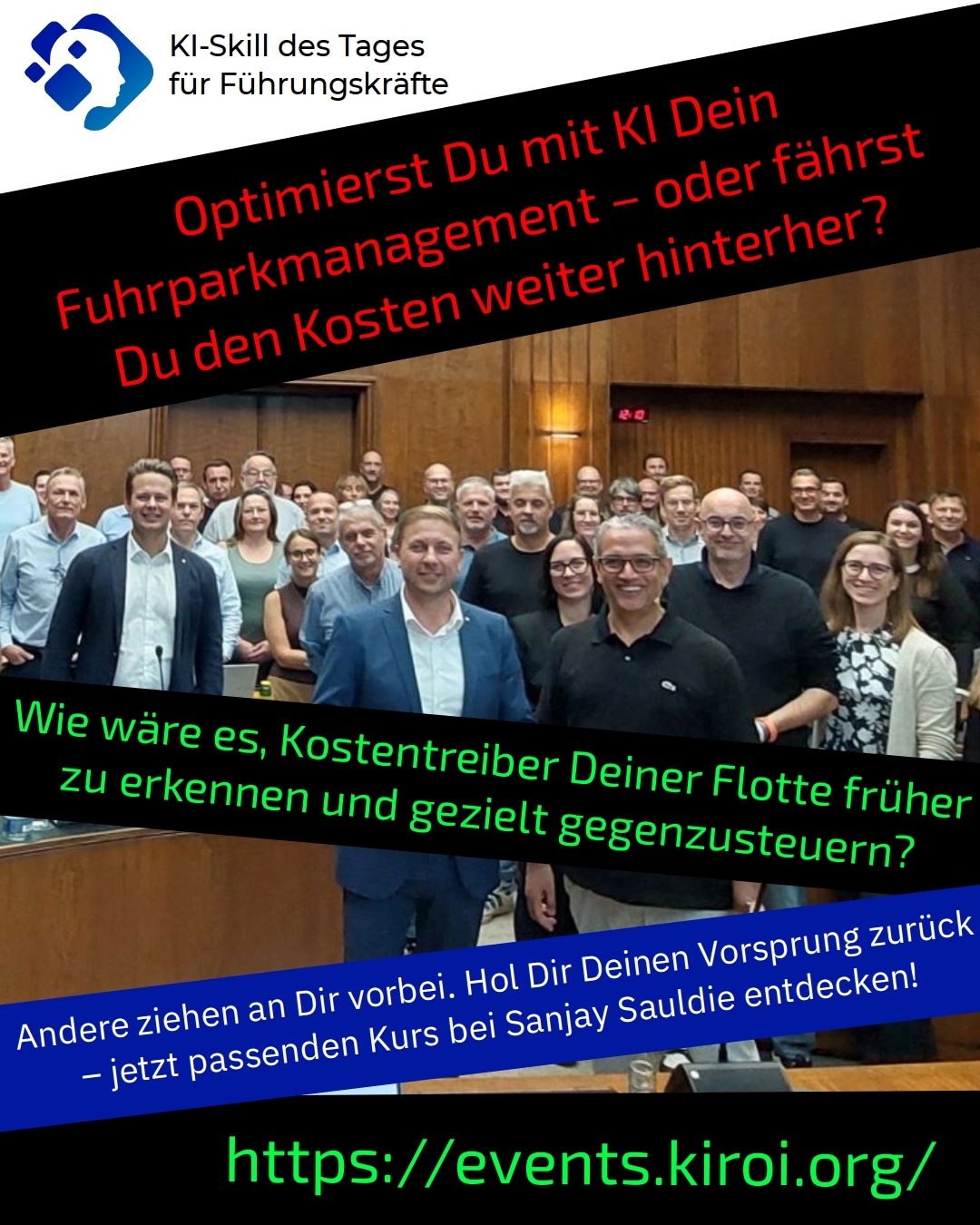
The development is progressing rapidly. Companies that hesitate today risk losing their edge tomorrow. That doesn’t mean that you should blindly invest in every new technology. However, it does mean that you need to actively explore the possibilities. Take your existing skills to the professional level – as already 8,000 people from over 500 companies have done with Sanjay Sauldie! Visit events.airoi.org and learn how to implement modern methods in your company.
A laundry business recently began automatically optimizing its delivery routes. A catering service uses demand forecasts to better plan its vehicle capacities. An installation company relies on digital trip logs that are not only compliant with tax regulations but also provide valuable insights into vehicle usage. These examples show that modernization is possible in any size business and industry.
Best practice with a AIROI customer
A trading company with its own delivery fleet approached the AIROI team because the complaint rate had risen alarmingly due to delayed deliveries. Customers were increasingly complaining about unreliable lead times. Drivers complained about unrealistic deadlines. The management faced increasing costs and declining customer satisfaction. As part of the coaching, a detailed process analysis was initially carried out. It turned out that the delivery lead times were based on outdated assumptions. The actual traffic conditions had changed significantly in recent years. Together, a system was implemented that takes real-time traffic data into account and calculates realistic delivery lead times. Communication with customers has been automated. You now receive proactive information about the estimated delivery time. After implementation, the complaint rate decreased by 40 percent. Customer satisfaction increased measurably. Drivers reported significantly less stress because the time requirements were now achievable. The company was even able to reduce overtime costs because the tours were better planned.
My AIROI Analysis
Looking at numerous companies reveals a clear pattern. Those that actively invest in modernizing their fleet management processes achieve measurable benefits. They reduce their operating costs. They increase their efficiency. They improve their competitive position. The question, therefore, is not whether to optimize, but when and how.
The biggest success factors lie less in the technology itself than in its intelligent application. A software solution alone cannot solve any problems. It must be properly configured, consistently used, and continuously adapted. This is where the value of professional support comes into play, which not only brings technical expertise but also change management skills.
What is particularly remarkable is that the most successful companies follow an iterative approach. They start with manageable pilot projects. They gather experience. They adapt their strategy. Then they scale successful approaches to the entire fleet. This pragmatic approach minimizes risks and maximizes learning effects. Whether you run a small craft business or manage a large logistics fleet – the principles remain the same. Collect data. Identify patterns. Optimize processes. Measure success. Continuously improve. Those who master this cycle will be successful in the long term.
Further links from the text above:
[1] AIROI Events – Training and workshops with Sanjay Sauldie
For more information and if you have any questions, please contact Contact us or read more blog posts on the topic Artificial intelligence here.









 Deutsch
 English (UK)