
Have you ever wondered if your career will still exist in the next few years, as intelligent systems take on more and more tasks that were previously reserved exclusively for humans?
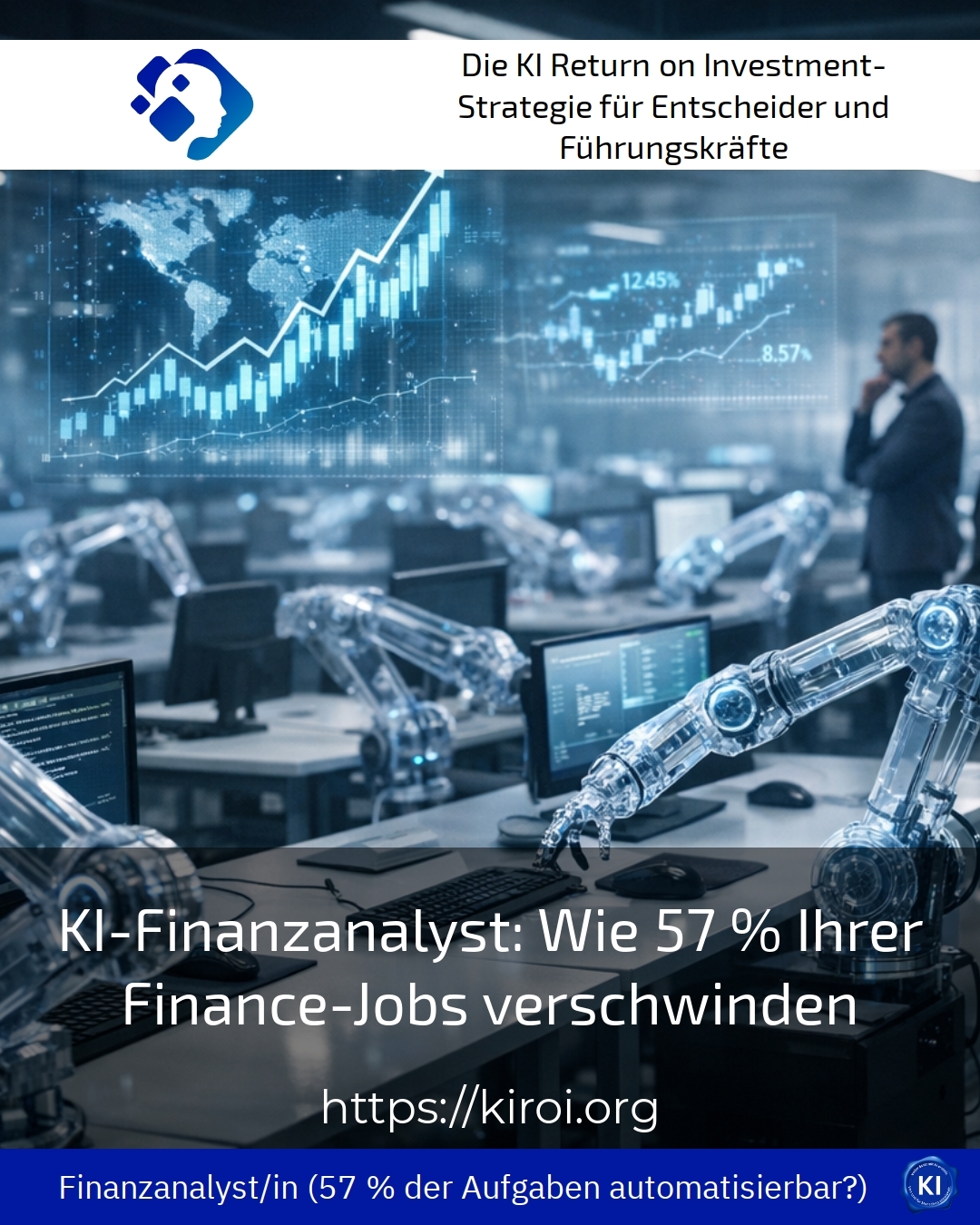
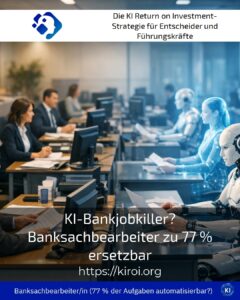
The answer to this question could deeply disturb you. Current surveys by the Institute for Employment Research show a shocking reality. The AI financial analyst It stands as an example of a development that fundamentally changes entire occupational profiles. More than half of all activities in certain sectors could be automated. These figures do not come from speculative future scenarios; they are based on scientific analyses [1]. Therefore, you should continue reading and understand what this transformation means for your professional future.
The automation wave reaches the office floors
For a long time, intellectual work was considered a safe haven against automation. Factories were robotized, but typing tasks seemed impregnable. This assumption increasingly turns out to be a fallacy. Intelligent systems now process balance sheets faster than any human can. They recognize patterns in business reports within seconds. Moreover, they analyze market trends with a precision that exceeds human capabilities.
In accounting, automated processes are already capturing incoming invoices today. They reconcile accounts and generate preliminary monthly statements. Audit firms are using intelligent tools to detect anomalies in financial data. Banks are using algorithmic systems for credit scoring. This is fundamentally changing the requirements for professionals.
A medium-sized company in the logistics sector reduced its department for accounts receivable by two-thirds. Not because positions were eliminated, but because employees were reassigned to new roles. The repetitive tasks were henceforth handled by digital assistants. A insurance company automated the processing of claims to eighty percent. At the same time, the requirements for strategic consulting skills increased significantly.
Best practice with a AIROI customer
An internationally operating trading company faced the challenge of making its controlling department future-proof. The management recognized that repetitive reporting tasks were becoming increasingly automatable. As part of a transruptive coaching process, we supported the leadership team in the strategic realignment. First, we jointly analyzed which tasks actually had potential for automation. It turned out that about sixty percent of the monthly routine tasks could be supported by intelligent systems. The employees subsequently received training in data interpretation and strategic advice. Particularly important was the emotional support during this transformation. Many team members initially reported feelings of uncertainty and future fears. Through regular workshops and individual discussions, we were able to provide impulses that opened up new perspectives. After eighteen months, the team had developed into a strategic consulting unit. Turnover decreased significantly as employees perceived their new role as an asset for the company. This example shows how transruptive coaching can support projects of this type.
The AI financial analyst as a future model
What does it mean concretely when algorithmic systems take on analytical tasks? The AI financial analyst represents a hybrid working form of the future. People and intelligent systems work together in a complementary way. The machine performs data processing and pattern recognition. The human provides context, ethical evaluation, and strategic classification.
In the investment industry, portfolio managers already use algorithmic support for market analyses today. They receive real-time assessments of company metrics and industry developments. But the final decision on investment strategies is still made by humans. Because ethical considerations, customer relationships, and gut feelings cannot be fully algorithmized.
A family office recently implemented a system for automated wealth monitoring. The intelligent tool analyzes portfolio positions daily and identifies areas for improvement. It generates risk reports and performance comparisons fully automatically. Yet, the quality of advice remained the decisive differentiator. Wealthy clients expect personal attention and individual solutions. A tax advisory firm automated the filing of returns and preliminary tax returns. The time saved was invested by the advisors in complex planning issues.
What tasks does the AI financial analyst perform
The range of automated tasks surprises many professionals. Today, intelligent systems can verify the plausibility of annual financial statements and flag deviations. They compare company metrics with industry benchmarks and generate meaningful reports. In addition, they predict cash flows and identify liquidity shortages early on.
In credit analysis, algorithmic systems evaluate creditworthiness based on historical data and behavioral patterns. They detect fraud attempts more reliably than humans by detecting anomalies. At the same time, they create scoring models that continuously learn. One leasing company reports a halving of processing time for new applications. This is because the preliminary review is fully automated and only complex cases require human attention.
In the Treasury area, intelligent tools take on the role of liquidity planning and currency hedging. They optimize payment flows and suggest favorable financing alternatives. A manufacturing company reduced its interest costs by fifteen percent. This was because the system identified optimization potential that had previously remained undiscovered.
The human component remains indispensable
Despite all technological advances, there are areas that cannot be algorithmically captured. Human relationships, creative problem solving, and ethical considerations all require human judgment. AI financial analyst It supports, but it does not completely replace human expertise.
Clients often report feeling overwhelmed. This concern is understandable, but it overlooks an essential aspect. The demand for complex advice and strategic guidance is continuously growing. Companies need people who can interpret data and translate it into actionable recommendations. They need professionals who can reassure customers and build trust.
A business auditor recently recounted a client situation that no algorithm could have solved. The CEO of a family business faced a difficult succession decision. The numbers spoke for a sale, but emotional attachments and employee responsibilities required sensitive advice. These very situations demonstrate the lasting value of human expertise. A bank advisor accompanied an entrepreneur through a restructuring process with personal conversations. The technical analysis would have delivered a system, but human support was crucial.
Best practice with a AIROI customer
A medium-sized private bank recognized early on the need to transform its investment advisory services. The challenge was to combine technological innovation with quality personal service. As part of our transruptive coaching approach, we intensively supported the leadership team over twelve months. First, we jointly identified the core competencies that should remain humanly relevant in the long term. It became clear that relationship building and complex advice represented the key differentiators. The bank subsequently implemented intelligent systems for portfolio analysis and risk assessment. This allowed advisors to spend more time on personal client conversations and strategic advice. Particularly successful was the repositioning of the employee role as a „wealth manager“ rather than a „product salesperson“. Customer satisfaction was demonstrably increased because consultation sessions became more in-depth and solution-oriented. At the same time, administrative tasks were reduced by more than fifty percent. This case illustrates impressively how transruptive coaching can support such projects and how people and technology can work together successfully.
Understanding the role of the AI financial analyst in the transformation
The change does not happen overnight, but in gradual steps. Companies initially implement partial automation in manageable areas. They gather experience and gradually expand successful applications. This gives employees time to adapt to changed requirements.
The insurance industry exemplifies how this change can look. Claims handlers have become claims managers with strategic responsibilities. Underwriters focus on complex risk assessments, while standard cases are automated. Sales representatives use analytical tools for personalized customer interactions.
A fund provider transformed its research department fundamentally. Analysts now produce fewer standard reports and more thematic in-depth analyses. They interpret algorithmically generated insights and complement qualitative assessments. A financial services provider trained its entire back office in data analysis. Because the ability to interpret machine-generated results has become a key competency.
Strategies for career realignment
In light of these developments, the question arises of meaningful responses. Passive waiting is not a recommended strategy. Instead, professionals should actively work on their further development and build new competencies.
A basic understanding of technology is now a basic requirement in many professions. Those who understand how intelligent systems work can better understand their results. At the same time, the value of skills that are difficult to automate is increasing. These include empathy, creative thinking, negotiation skills, and ethical judgment.
One controller reports how he proactively changed his role. He continued to develop his skills in data visualization and storytelling. Today, he presents management teams with strategic insights instead of mere data columns. A tax consultant specialized in international management consulting. Because complex cross-border issues require human expertise. A financial accountant switched to process optimization and now designs automation projects.
The issues that professionals come to us with often resemble each other. Uncertainty about their own future, disorientation when making educational decisions, and fear of losing meaning characterize many conversations. Transruptive coaching can accompany such questions and open up new perspectives.
My AIROI Analysis
The transformation through the AI financial analyst And related developments are not a threat, but an invitation to continue developing. The figures from the Job Future Index illustrate the extent of the change, but they do not tell the whole story. Behind every task that can be automated lies an opportunity to enhance the value of human work.
My experience from numerous coaching processes reveals a nuanced picture. Organizations that proactively shape change benefit significantly. They experience more satisfied employees and better business results. At the same time, transformations often fail due to poor communication and a lack of coaching.
The key lies in consciously designing the transition process. Technology alone does not create added value if people cannot use it meaningfully. That is why accompaniment offerings like transruptions coaching are gaining in importance. They help connect the technical and human aspects of transformation.
For professionals in the financial sector, I recommend a combination of technological training and soft skill development. The future belongs to those who can interpret algorithmic insights and translate them into human actions. Those who assume this bridging role remain indispensable. The seventy-five percent automation of individual tasks does not mean the end of human labor. Rather, it marks the beginning of a new, higher-value form of collaboration between humans and machines.
Further links from the text above:
[1] Job-Futuromat of the Institute for Employment Research
For more information and if you have any questions, please contact Contact us or read more blog posts on the topic Artificial intelligence here.






 Deutsch
 English (UK)