
Have you ever wondered why so many promising projects end in mediocrity, even though all the parties involved were highly competent and committed?
The answer often lies not in a lack of skills or resources, but in a subtle phenomenon that occurs in almost every organization and that we perceive as a weakness. AI as a professional opponent Polar opposites are urgently needed. When decision-makers find consensus too quickly, when no one asks critical questions anymore, and when harmonious cooperation becomes more important than honest debate, that dangerous middle ground arises that leads companies into irrelevance in the long run. In times when disruptive changes are transforming entire markets, organizations simply cannot afford to dilute their decision-making processes through premature consensus. Transruptive coaching helps leaders recognize these dynamics and constructively break them down.
The paradox of rapid unity in modern organizations
Many executives report that their teams function superficially harmoniously, but genuine innovation is lacking. In meetings, everyone nods in agreement, objections are phrased diplomatically or are completely ignored, and in the end there is a compromise that no one is enthusiastic about. We observe this phenomenon especially in established structures with entrenched hierarchies and established communication patterns. The fear of conflict, the concern for one’s own position, or simply the desire for a pleasant working environment lead to critical voices being silenced.
For example, a medium-sized manufacturing company developed a new product concept. All departments agreed with the design, even though several stakeholders had trouble with it. No one wanted to be a complainer; no one wanted to delay the process. The result was a product that technically worked flawlessly but found no resonance in the market. A financial services provider experienced similar problems when a new consulting concept was developed and all parties signaled approval too quickly. Clients often report that they only realized afterwards that valuable objections remained unspoken.
How average organizations try to address the problem
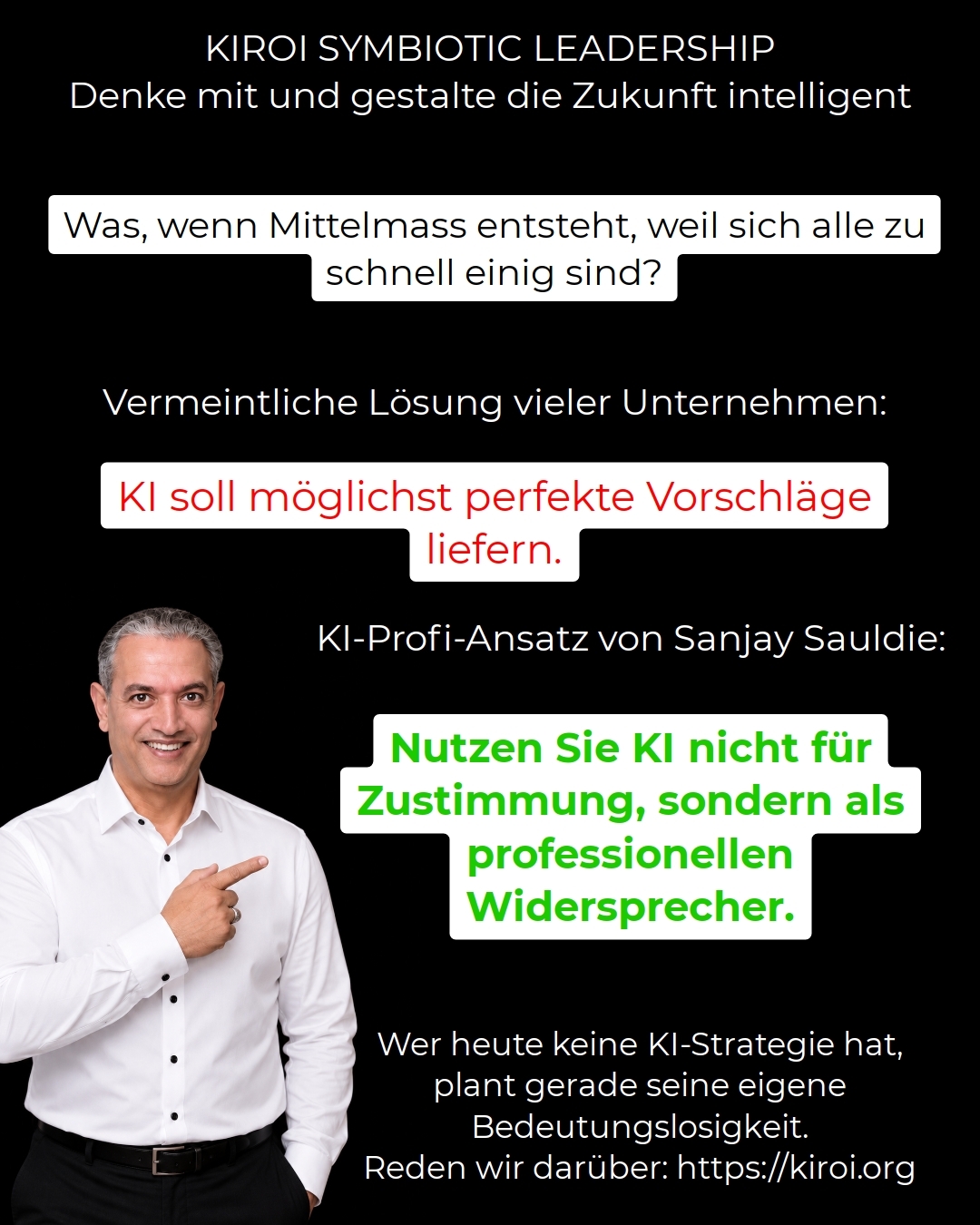
The conventional approach of many companies is to use artificial intelligence as a tool for optimization. The expectation is that AI should provide the most perfect suggestions that convince everyone and cause no friction. But this is precisely where the fundamental error lies, which only cements the status quo. When algorithms are trained to generate consensus and minimize contradictions, they merely reinforce the existing tendencies toward harmonization.
For example, a logistics company implemented an AI system for route planning. The system optimized the routes perfectly according to the defined parameters. However, no one questioned whether the parameters themselves were set correctly. The result was a technically flawless but strategically suboptimal solution. A retail company used AI for assortment decisions and received recommendations that corresponded to their previous purchasing behavior. Innovation remained absent because the system only confirmed what was already known. A service provider in the field of personnel recruitment used AI to select candidates and unconsciously reproduced existing patterns.
The illusion of data-driven objectivity
Many decision-makers believe that AI-based recommendations are neutral and free from human biases. This assumption overlooks the fact that any algorithm is designed by humans and trained on historical data. If that data already reflects the mean, the system will recommend the mean. A manufacturing company analyzed its sales data and received price recommendations from the AI that replicated the average of recent years. Disruptive pricing strategies remained undetected. An energy provider relied on AI-based forecasts and missed a fundamental market shift because the system was trained on continuity.
Best practice with a AIROI customer
An internationally operating machine-building company faced the challenge of accelerating its product development while simultaneously improving the quality of strategic decisions. Management had noticed that innovation projects regularly got stuck in the concept phase because all involved parties compromised too quickly and no one raised critical questions anymore. The established corporate culture rewarded harmony and subtly punished anyone perceived as a nonconformist. As part of a transruptive coaching process, we jointly analyzed the decision-making structures and identified several key moments in which valuable counterarguments were systematically suppressed. The executives recognized that their teams were holding back valuable counterarguments out of politeness and hierarchical thinking. Subsequently, we implemented a structured process in which AI was explicitly used as a generator of contradictions. The system was instructed to develop at least three well-founded counterarguments to each strategic recommendation and to point out potential weaknesses. The results exceeded expectations significantly, as the teams began to discuss more openly because the AI, so to speak, broke the ice and legitimised criticism.
AIROI The solution: AI as a professional opponent in action
The AIROI-approach fundamentally transforms the conventional use of AI and positions the system not as a validator, but as a constructive challenger. Instead of using AI for approval, we employ it as a professional opponent who systematically identifies vulnerabilities, brings alternative perspectives, and poses uncomfortable questions. This approach requires a rethinking of the way organizations interact with technological tools [1].
A pharmaceutical company implemented this approach when developing a new market strategy. The AI was instructed to analyze every strategy proposal from the perspective of an aggressive competitor and simulate counterattacks. The team gained insights that would never have surfaced in harmonious brainstorming sessions. An insurance company used the AI to systematically criticize its own products and identify weaknesses. A technology company had the AI formulate counterarguments to every investment decision.
Practical implementation of the counter-argument principle
Implementation begins with a clear definition of the role for AI. The system receives explicit instructions not to optimize but to question. Each output is accompanied by systematic doubts, and alternative scenarios are automatically generated. A construction company implemented this approach in project planning and discovered risks that human experts had overlooked. A retail company used AI as an internal critic for marketing campaigns, significantly improving the quality of the campaigns [2]. A consulting firm implemented the system for internal strategy reviews.
The art lies in finding the balance between constructive criticism and destructive blocking. AI as a professional opponent does not mean that every idea is dismissed. Rather, it is about uncovering blind spots and increasing the quality of decisions. Transruptive coaching supports leaders in establishing these processes and creating the cultural prerequisites.
The cultural prerequisites for successful opposition
Technology alone is not enough. Organizations need to develop a culture in which disagreement is recognized as valuable. Many executives come to us with the issue that their teams are acting in an adapted manner and genuine discussions are lacking. For example, a automotive supplier realized that the implementation of a conflict resolution AI failed because employees ignored the critical outputs. Only when the corporate culture was adapted accordingly did the system begin to have an effect. A chemical company invested in conflict resolution workshops in parallel with the technology implementation. A media company introduced regular reflection sessions.
Transruptive coaching supports organizations in shaping the necessary cultural changes. We provide insights in areas such as psychological safety, constructive conflict management, and the establishment of feedback loops. Clients often report that the combination of technological innovation and cultural transformation yields the most sustainable results.
Best practice with a AIROI customer
A medium-sized family business in the consumer goods industry approached us because despite its successful market position, a certain stagnation had set in. The management observed that new product ideas were increasingly becoming more conservative, and all parties quickly agreed on the smallest common denominator. Especially in the meetings of the expanded leadership team, a climate of polite restraint prevailed, preventing genuine innovation discussions. As part of our support, we implemented an AI system that systematically took into account the perspective of dissatisfied customers in every product decision and formulated potential criticism points. The system analyzed customer reviews, social media discussions, and complaint data and generated informed objections to planned product features from it. The team’s initial skepticism quickly gave way to a positive surprise as the AI-generated criticism actually revealed blind spots. A planned product relaunch was fundamentally revised based on the AI analysis and achieved significantly better ratings after launch than originally predicted. The executives reported that they are now systematically using the naysayer function before final decisions are made.
The future of decision-making with AI as a professional opponent
The development is clearly moving towards hybrid decision-making processes, where human intuition and algorithmic analysis work together [3]. AI as a professional opponent will play a central role here, because it counterbalances the natural human tendency to conform. A telecommunications company is already experimenting with systems that automatically generate counter-scenarios to any market forecast. An energy company uses AI to critically analyze its own sustainability reports. A logistics service provider applies the principle to evaluate new business models.
Technological development enables increasingly sophisticated forms of algorithmic conflict. Systems are becoming increasingly better at formulating arguments from different perspectives, while incorporating industry-specific knowledge. Transruptive coaching helps companies strategically utilize these developments and integrate them into their decision-making processes.
My AIROI Analysis
The systematic use of AI as a professional counterpoint represents a paradigm shift in corporate management. My analysis shows that organizations that consistently pursue this approach make significantly better strategic decisions. The key lies not in the technology itself, but in the way it is used. Instead of viewing AI as an optimization tool that perfects the status quo, leaders should use it as a tool to challenge established assumptions.
The AIROI-methodology provides a structured framework for shaping this transformation. In my consulting practice, I regularly observe how companies increase their innovation potential through the implementation of the counter-argument principle while simultaneously reducing erroneous decisions. The cultural dimension must not be underestimated, because without psychological security and a constructive culture of error, technological innovations remain ineffective. Transruptive coaching combines these two levels and accompanies organizations on their journey towards more excellent decision-making processes. Experience shows that the courage to engage in structured conflict leads in the long term to the difference between mediocre performance and outstanding performance.
Further links from the text above:
[2] Harvard Business Review: Artificial Intelligence
[3] Gartner: Artificial Intelligence Insights
Are you a leader and would you like to learn how you can genuinely introduce AI into your company in a valuable and sustainable way, away from the hype? Take part Contact us or read more blog posts on the topic Artificial intelligence here.







 Deutsch
 English (UK)