
Have you ever thought about what confidential company information you have already unknowingly transmitted to external servers? This question now concerns numerous executives and IT managers in all industries, because the Data protection in the use of AI It is evolving into a critical challenge of our time. While intelligent assistance systems are revolutionizing productivity in companies and accelerating workflows, a potential data leak lurks behind every inputted prompt, which can irreversibly reveal sensitive business secrets. The temptation is great to have complex documents, contract details, or strategic plans analyzed by automated systems; however, the price for this convenience could be higher than initially assumed.
Why data protection must become a matter of priority when using AI
The integration of intelligent technologies into business processes is advancing relentlessly. Many employees already use assistance systems daily for their work. They use them to formulate emails, create presentations, or analyze complex data. Yet they often underestimate the significance of their inputs. A single careless prompt can reveal customer data, calculations, or personnel information. This information ends up on external servers in different jurisdictions. The control over this data is thus irrevocably lost.
The severity of these issues is particularly evident in sensitive sectors such as healthcare. Doctors compile reports without anonymizing patient data. Nurses use assistive systems for documentation tasks with real names. Clinics are experimenting with automated diagnostic tools without clear data guidelines. The consequences range from data privacy violations to reputational damage. A hospital in southern Germany recently had to pay substantial fines due to the uncontrolled use of external analysis tools by staff.
Law firms are also facing enormous challenges in this area. Lawyers review draft contracts and disclose information to clients in the process. Legal assistants use automated text generators for correspondence containing confidential content. Notaries are experimenting with digital assistants for document drafting. The duty of confidentiality conflicts directly with the convenience gained through modern technologies.
Best practice with a AIROI customer A medium-sized machine engineering company from Baden-Württemberg recognized the risks of uncontrolled technology use early on in its development departments. The engineers had begun to have technical drawings and design data analyzed by external systems in order to identify optimization potential. The management only noticed this practice when a competitor presented suspiciously similar product features at a trade show. Subsequently, the company initiated a comprehensive training program for all employees that focused on the safe use of intelligent tools. Together with external consultants, they developed clear guidelines for handling sensitive design data. They implemented an internal solution that is operated on their own servers and does not transmit data to the outside world. The investment in this infrastructure has already paid off within a few months through the secured knowledge advantage over the competition. Today, the company is regarded as a role model in its industry for responsible technology use.
Critical industries and their specific risks regarding data protection when using AI
The financial sector faces particularly sensitive issues in this context. Asset managers analyze portfolios using automated systems and transmit client assets to them. Bank advisors use chat functions to prepare customer conversations. They enter account balances and investment strategies without realizing their significance. Insurance companies are experimenting with automated claims assessments based on sensitive health data. Financial regulatory authorities have issued warnings on several occasions.
The pharmaceutical industry faces comparable challenges of enormous scale. Research departments use intelligent systems to analyze study results. They transmit patient data from clinical trials to external platforms. The development of new active ingredients is based on strictly confidential formulas. These formulas may, through inadvertent prompts, end up in foreign databases. A large pharmaceutical company presumably lost millions in research results. The suspicion arose from uncontrolled data flows due to employees using external services.
The automotive industry is also experiencing a critical phase of awareness. Designers are sharing blueprints with automated analysis tools. Suppliers are transmitting pricing information and delivery conditions through unsafe channels. Marketing departments are developing campaign strategies based on confidential market research data. The entire value chain is potentially affected. Every single employee can become an inadvertent data leaker.
Practical recommendations for safe handling
Establishing clear company policies forms the foundation of any data protection strategy. These policies must specifically define what information should never be entered. Personal data should not be stored in external systems in the first place. The same applies to business secrets, financial metrics, and strategic planning documents. Employees need training that not only imparts technical knowledge but also develops an awareness of the consequences of careless behavior.
Technical infrastructure plays just as crucial a role as human behavior. Companies should operate their own instances of intelligent systems when this is economically feasible. These on-premises solutions keep all data within their own network boundaries. Alternatively, specialized services offering contractually guaranteed data deletion are available. Choosing the right provider requires careful review of the privacy agreements.
Best practice with a AIROI customer An internationally operating consulting firm headquartered in Frankfurt faced the challenge of providing its consultants with modern work tools without compromising the confidentiality of client projects. The consultants regularly worked with highly sensitive strategy documents, market analyses, and financial data of their clients. In collaboration with specialized partners, the IT department developed a customized solution for this dilemma. They implemented a tiered authorization system that defines different levels of sensitivity for documents. Certain file categories are automatically recognized and excluded from external processing. For less critical tasks, secure connections to trusted services are available. The consultants received intensive training on responsible handling of the new possibilities. The feedback from clients was overwhelmingly positive, as they felt validated by these measures. The business advisory firm is actively using this quality advantage today as a competitive advantage in acquiring new customers.
The human component in data protection when using AI
Technical solutions alone cannot fully address the problem. Man remains the decisive factor in every security chain. Even the most sophisticated protection mechanisms fail when employees circumvent them. The motivation to circumvent them often arises from time pressure or convenience. A sales representative wants to quickly create a quote. He uses external services for this, because the internal solution works more slowly. In doing so, he transfers customer data, price lists, and discount structures.
Human resources development must acknowledge this reality and act proactively. Regular awareness campaigns keep the issue in the employees’ awareness. Practical examples illustrate the concrete risks more effectively than abstract warnings. Positive incentives for data protection-compliant behavior are more effective than sanctions threats. Companies should establish a culture of openness in which errors can be reported.
Senior management bears a special responsibility for establishing this culture. Managing directors and executives must lead by example. Their own use of intelligent systems should be exemplary and transparent. If management itself violates data protection regulations, employee trust erodes. The credibility of any policy depends on its consistent implementation at all levels.
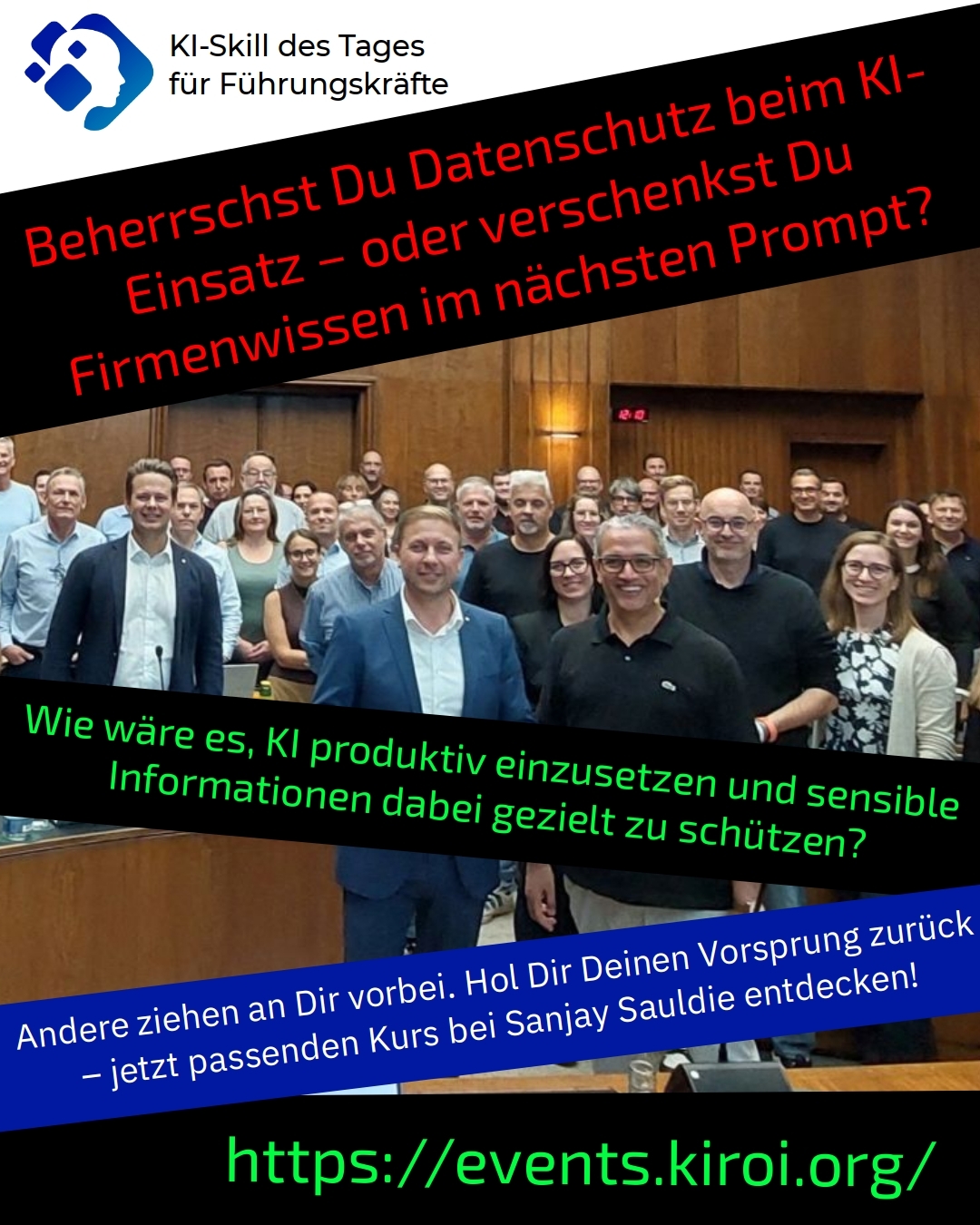
Take your existing skills to the professional level, as already 8,000 people from over 500 companies have done with Sanjay Sauldie! Visit events.airoi.org for further information and practical events on this important topic.
Legal framework and compliance requirements
The European Data Protection Regulation forms the legal framework for the handling of personal data. It sets clear requirements for the processing by automated systems. Companies must be able to demonstrate where the data is being transferred. This obligation to provide proof also extends to the use of external analysis services. Supervisory authorities are increasingly tightening their controls in this area.
Sector-specific regulations significantly complement the general data protection regulations. Financial service providers are subject to additional requirements from banking regulators. Healthcare facilities must take special precautions to protect patient data. Lawyers are bound by their professional code of conduct to maintain confidentiality. The use of external services can potentially violate these obligations.
The international dimension also makes legal classification more difficult. Many providers of intelligent services are based outside Europe. The transfer of data to third countries is subject to special restrictions. Standard contractual clauses and adequacy decisions offer only limited protection. Companies must carefully review their supplier relationships to ensure compliance.
My AIROI Analysis
The responsible handling of sensitive information when using intelligent technologies is developing into a crucial competitive factor for forward-thinking companies. The analysis clearly shows that neither purely technical nor exclusively organizational measures are sufficient to address the complex challenges. Rather, the situation requires a holistic approach that takes people, processes, and technology into account equally. Companies that invest in clear guidelines, training programs, and secure infrastructure today will reap the fruits of this foresight tomorrow. They not only protect their corporate knowledge from unintended disclosure but also position themselves as trustworthy partners for customers and business partners. The AIROI-methodology offers a structured framework that takes into account the individual company situation and enables tailored solution approaches. The guidance provided by experienced experts helps organizations find the balance between the use of innovation and data protection. Clients often report a noticeable improvement in their security level after just a few weeks of collaboration. The investment in professional advice typically pays off quickly through avoided data protection violations and the preservation of valuable business secrets. Transruptions coaching accompanies projects around the secure implementation of intelligent technologies and provides valuable impulses for sustainable changes.
Further links from the text above:
[1] AIROI Events – Continuing education courses on artificial intelligence and data protection
For more information and if you have any questions, please contact Contact us or read more blog posts on the topic Artificial intelligence here.








 Deutsch
 English (UK)